

Home
Class 11
PHYSICS
Three rods AB, BC and BD having thermal ...


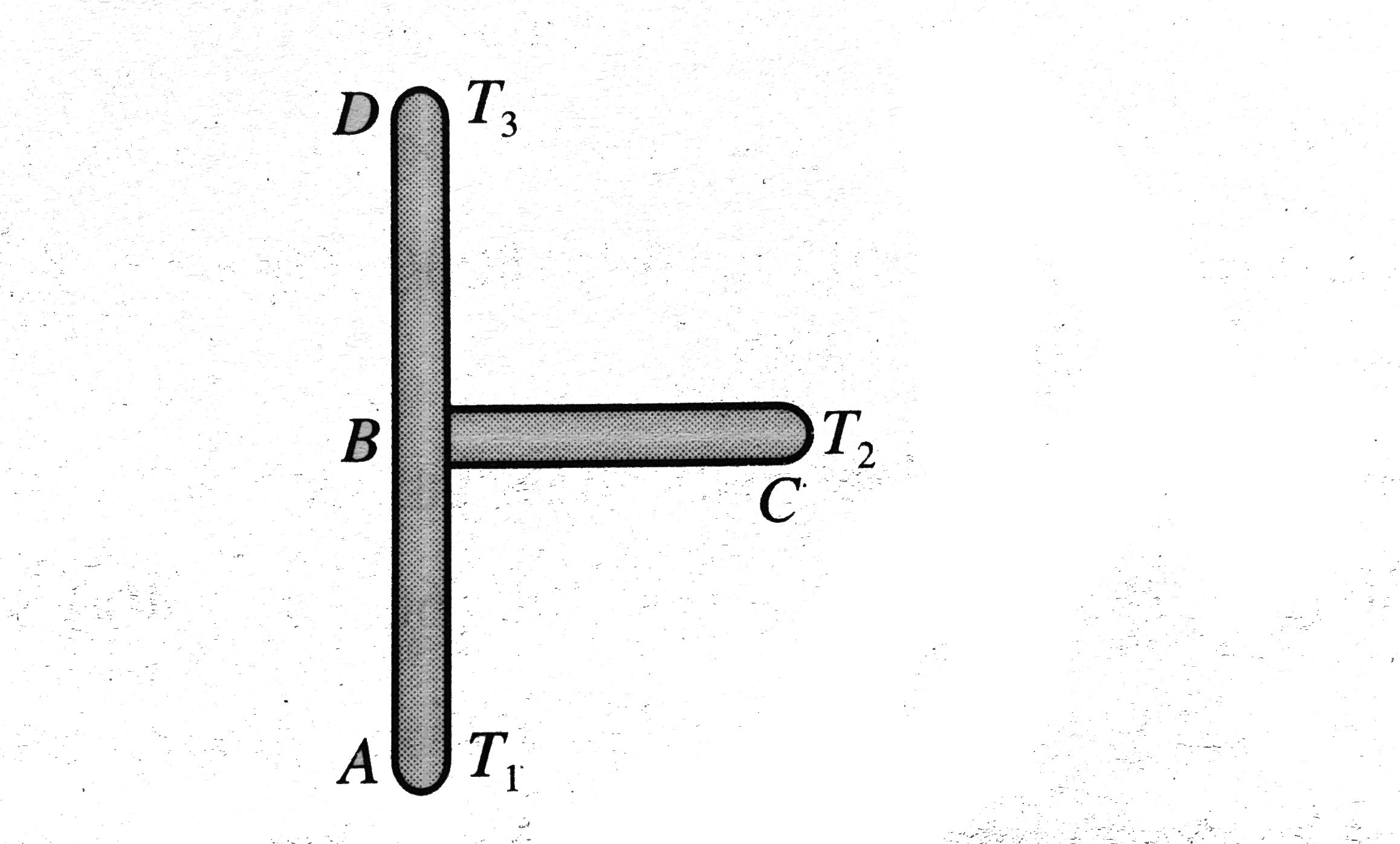
Three rods AB, BC and BD having thermal conductivities in the ratio 1:2:3 and lengths in the ratio 2:1:1 are joined as shown in Fig. The ends A, C and D are at temperature `T_1`,`T_2` and `T_3` respectively Find the temperature of the junction B. Assume steady state.

Promotional Banner

Similar Questions

Explore conceptually related problems

Three rods AB, BC and BD having thermal conductivities in the ratio 1:2:3and length in the ratio 2:1:1 are joined as shown in figure . The ends A , C and D are at temperature T_(1), T_(2) and T_(3) respectively . Find the temperature of the junction B . Assume steady state .

Three rods AB,BC and BD having thremal conductivities in the ratio 1:2:3 and lengths in the ratio 2:1:1 are joined as shown in The ends A,C and D are at temperature theta_(1),theta_(2) and theta_(3) respectively Find the temperature of the junction B (Assume steady state and theta_(1)gt theta gt theta_(2)gttheta_(3)) .

Three rods AB,BC and BD made of the same materical and having the same area of cross section have been joined as shown is the The ends A,C and D are held at temperatures 20^(@)C Cand 80^(@)C respectively If each rod is of same length then find the temperature at the junction B of the three rods .

Three bars of equal lengths and equal area of cross-section are connected in series fig. their thermal conducitives are in the ratio 2:3:4 . If at the steady state the open ends of the first and the last bars are at temperature 200^(@)C and 20^(@)C respectively, find the temperature of both the junctions. .

Three bars of equal lengths and equal area of cross-section are connected in series fig. their thermal conducitives are in the ratio 2:3:4 . If at the steady state the open ends of the first and the last bars are at temperature 200^(@)C and 20^(@)C respectively, find the temperature of both the junctions. .

Four thin identical rods AB, AC, BD and EF made of the same material are joined as shown. The free-ends C,D and F are maintained at temperature T_(1),T_(2) and T_(3) respectively. Assuming that there is no loss of heat of the surroundings, the temperature at joint E when the steady state is attained is (1)/(K) (2T_(1)+2T_(2)+3T_(3)) . Find K (E is mid point of AB)

Four thin identical rods AB, AC, BD and EF made of the same material are joined as shown. The free-ends C,D and F are maintained at temperature T_(1),T_(2) and T_(3) respectively. Assuming that there is no loss of heat of the surroundings, the temperature at joint E when the steady state is attained is (1)/(K) (2T_(1)+2T_(2)+3T_(3)) . Find K (E is mid point of AB)

Three rods A, B and C of the same length and same cross-sectional area are joined as shown. Their thermal conductivities are in the ratio 1:2:3/2. If the open ends of A and C are at 200^@ C and 18^@ C, respectively, then the temperature at the junction of A at steady state is

Consider two rods of equal cross - sectionai area A, one of Aluminium and other of iron joined end to end as shown in figure -4.8. Length of the two rods and their thermal coductivities are l_(1) , k_(1) and l_(2),k_(2) respectively . If the ends of the rods are maintained at temperature T_(1) and T_(2),(T_(1)gt T_(2)) find the temperature of the junction in steady state .