

Home
Class 11
PHYSICS
A flexible chain of length L=20 sqrt(2) ...

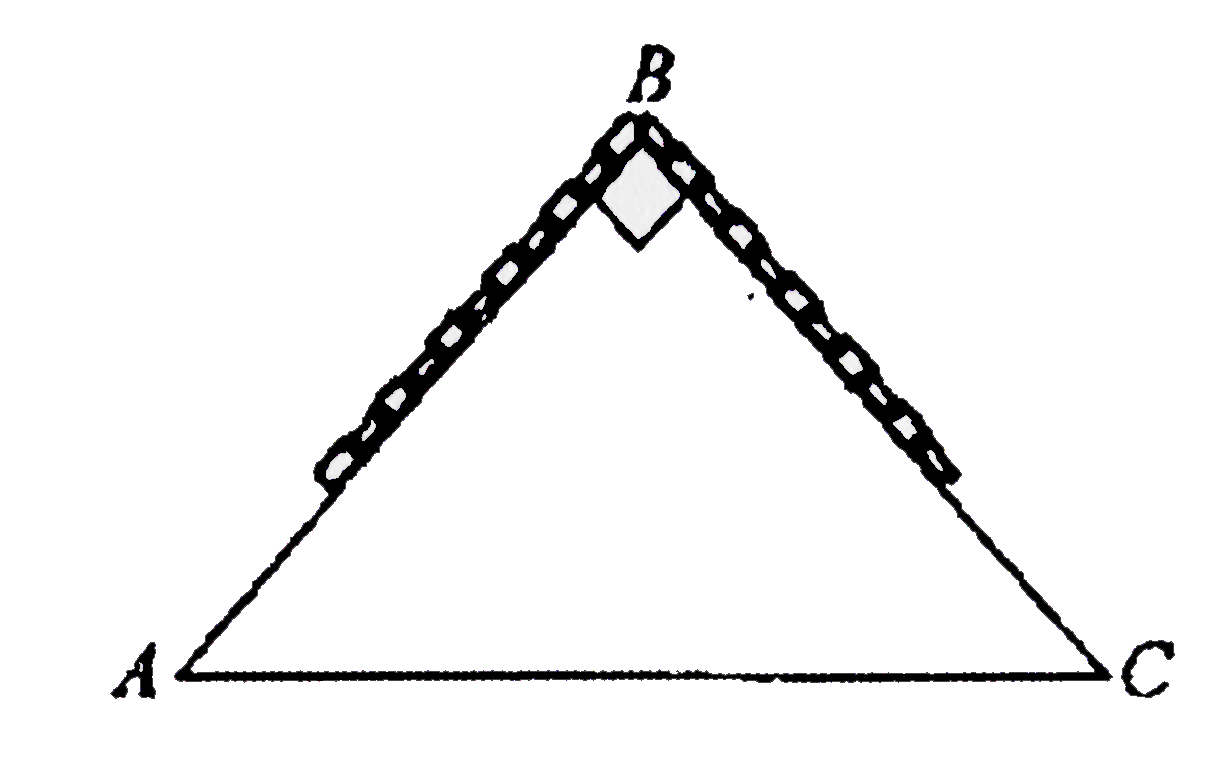
A flexible chain of length `L=20 sqrt(2)` m and weight W=10 kg in initially placed at rest on a smooth frictionless wedge surface ABC. It is given a slight jerk on one side so that it will start sliding on the side. Find the speed of the chain when its one end will leave the vertex of the wedge `(Take g=10m//s^(2))`

Promotional Banner

Similar Questions

Explore conceptually related problems

A uniform chain of mass 4 kg and legth 2 m overhags a smooth table with its one third part lying on the table Find the speed of chain as it c ompletely slips of the table. (Take g=10m//s^(2) )

A uniform chain of mass 4 kg and length 2 m overhangs a smooth table with its one third part lying on the table Find the speed of chain as it completely slips of the table. (Take g=10m/s^(2) )

A uniform flexible chain of mass m and length l hangs in equilibrium over a smooth horizontal pin of neglible diameter. One end of the chain is given a small verticle displacement so that the chain slips over the pin. The speed of chain when it leaves pin is

A uniform flexible chain of mass m and length l hangs in equilibrium over a smooth horizontal pin of neglible diameter. One end of the chain is given a small verticle displacement so that the chain slips over the pin. The speed of chain when it leaves pin is

A uniform flexible chain of mass m and length 2l hangs in equilibrium over a smooth horizontal pin of negligible diameter. One end of the chain is given a small vertical displacement so that the chain slips over the pin. The speed of chain when it leaves the pin is

A uniform flexible chain of mass m and length 2l hangs in equilibrium over a smooth horizontal pin of negligible diameter. One end of the chain is given a small vertical displacement so that the chain slips over the pin. The speed of chain when it leaves the pin is

A chain of length l is placed on a smooth spherical surface of radius R with one of its ends fixed at the top of the sphere. What will be the acceleration of the each element of the chain when its upper end is released? It is assumed that the length of the chain l<((piR)/2) .

A chain of length l is placed on a smooth spherical surface of radius R with one of its ends fixed at the top of the sphere. What will be the acceleration w of each element of the chain when its upper end is released? It is assumed that the length of the chain llt1/2piR .