

Home
Class 11
PHYSICS
A particle of mass m = 1.0 kg is free to...

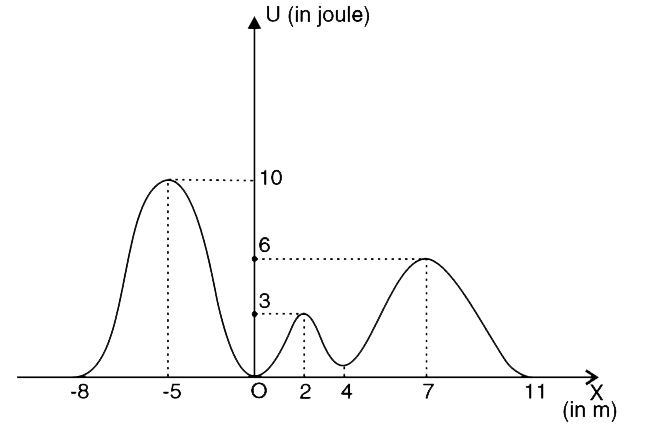
A particle of mass m = 1.0 kg is free to move along the x axis. It is acted upon by a force which is described by the potential energy function represented in the graph below. The particle is projected towards left with a speed v, from the origin. Find minimum value of v for which the particle will escape far away from the origin.

Promotional Banner

Similar Questions

Explore conceptually related problems

A point particle of mass 0.5 kg is moving along the x-axis under a force described by the potential energy V shown below. It is projected towards the right from the origin with a speed v. What is the minimum value of v for which the particle will escape infinitely fasr away from the origin ?

A particle is projected from origin with speed u . Find the minimum value of u if the particle passes through a poiny P (a, sqrt(3)a) .

A particle free to move along x-axis is acted upon by a force F=-ax+bx^(2) whrte a and b are positive constants. , the correct variation of potential energy function U(x) is best represented by.

A particle free to move along x-axis is acted upon by a force F=-ax+bx^(2) whrte a and b are positive constants. For ximplies0 , the correct variation of potential energy function U(x) is best represented by.

As a particle moves along the x- axis, it is acted upon by a conservative force. The potential energy is shown below as a function of the coordinate x of the particle. Rank the labelled regions accoeording to the magnitude of force, least to greatest.

As a particle moves along the x- axis, it is acted upon by a conservative force. The potential energy is shown below as a function of the coordinate x of the particle. Rank the labelled regions accoeording to the magnitude of force, least to greatest.

As a particle moves along the x- axis, it is acted upon by a conservative force. The potential energy is shown below as a function of the coordinate x of the particle. Rank the labelled regions accoeording to the magnitude of force, least to greatest.

A particle of mass m = 1 kg is free to move along x axis under influence of a conservative force. The potential energy function for the particle is U=a[(x/b)^(4)-5(x/b)^(2)] joule Where b = 1.0 m and a = 1.0 J. If the total mechanical energy of the particle is zero, find the co-ordinates where we can expect to find the particle and also calculate the maximum speed of the particle.

The force acting on a particle of mass m moving along the x-axis is given by F (x) = Ax^(2) - Bx. Which one of the following is the potential energy of the particle?

A particle of mass m initially moving with speed v.A force acts on the particle f=kx where x is the distance travelled by the particle and k is constant. Find the speed of the particle when the work done by the force equals W.