Home
Class 11
PHYSICS
Consider a gravity free hall in which a ...

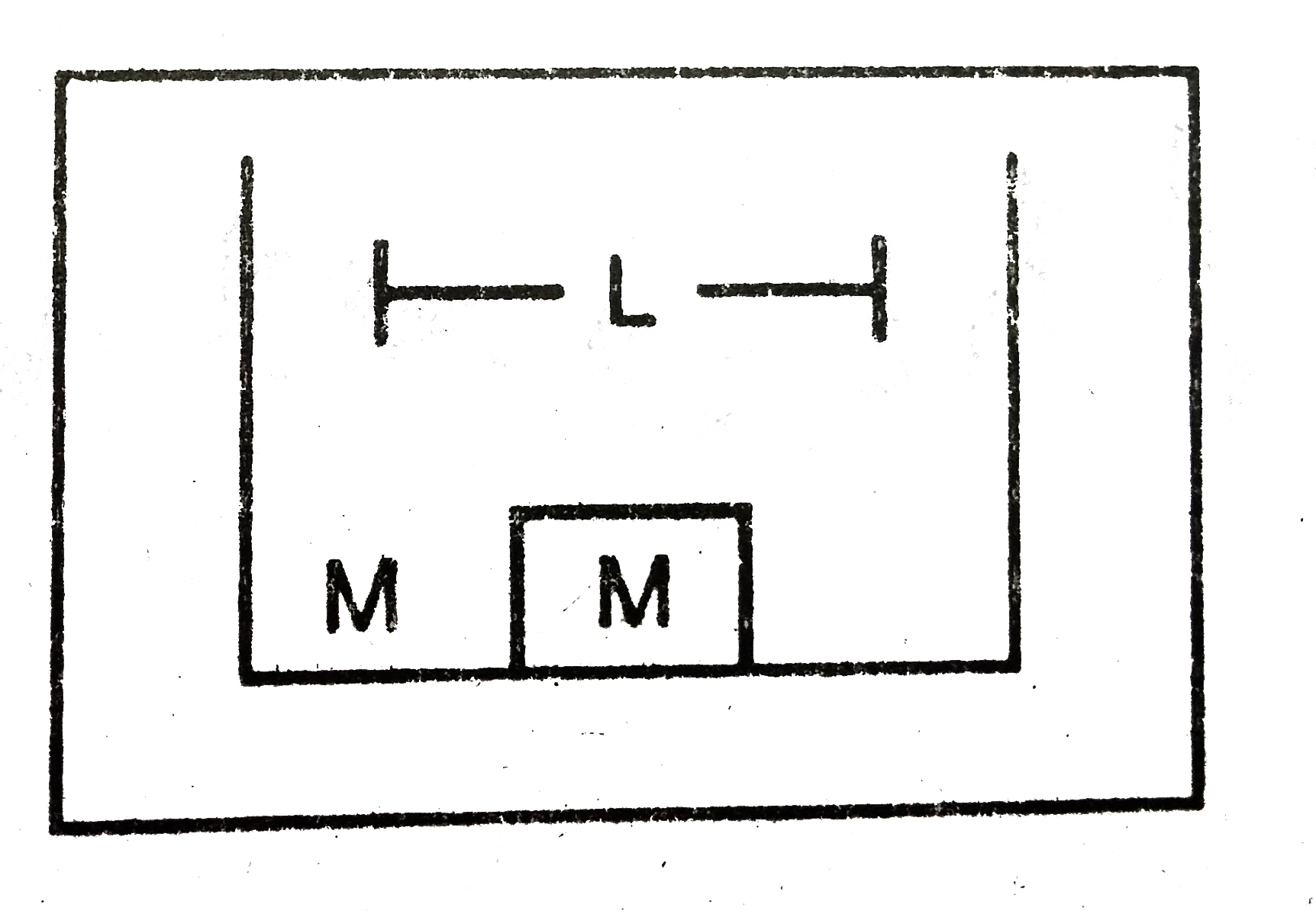
Consider a gravity free hall in which a tray of mas M, carrying a cubical block of icce of mas m and edge L, is at rest in the middle.. If the ice melts, by what distnce does the centre of mass of the tray plus the ice system descend?

Text Solution

Verified by Experts

Initially centre of mass of block of ice is at a height a/2 from the surface of vessel and finally when ice melta then due to large diameter of vessel height of the water formed is negligibly small. So centre of mass of water can be assumed at the surface of vessel, hence we can understand that in the process of melting centre of mass of ice comes down by a distance 4y - a/2. There is no change in the vessel hence its centre of mass remains at the same place. So we can say that displacement of centre of mass of vessel is zero, Ay,=0. Displacement of centre of mass can be written as follows:
`Deltay=(m_(1)Deltay_(1)+m_(2)Deltay_(2))/(m_(1)+m_(2))`
`rArr Delta y=(mxx(a)/(2)+Mxx0)/(m+M)=(ma)/(2(m+M))`
Promotional Banner

Topper's Solved these Questions

  • SYSTEMS OF PARTICLES AND ROTATIONAL MOTION

    MODERN PUBLICATION|Exercise REVISION EXERCISES (Very Short Answer Questions Carrying 1 mark)|29 Videos
  • SYSTEMS OF PARTICLES AND ROTATIONAL MOTION

    MODERN PUBLICATION|Exercise REVISION EXERCISES (Additional Questions Carrying 1 mark )|4 Videos
  • SYSTEMS OF PARTICLES AND ROTATIONAL MOTION

    MODERN PUBLICATION|Exercise NCERT FILE (NCERT EXEMPLAR PROBLEMS (SUBJECTIVES QUESTIONS) (Very Short Answer Type Questions))|9 Videos
  • PHYSICAL WORLD

    MODERN PUBLICATION|Exercise Revision exercises (Long answer questions)|6 Videos
  • THERMAL PROPERTIES OF MATTER

    MODERN PUBLICATION|Exercise CHAPTER PRACTICE TEST|15 Videos

Similar Questions

Explore conceptually related problems

A cubical block of ice of maas m and edge L is placed in a large tray of maas M. If the ie melts, how far does the centre of maas of the system ''ice plus tray'' come down?

The ballon the light rope and the monkey shown in figure are at rest in the air. If the monkey reaches the top of the rope, by what distnce does the ballon descend? Mass of the ballon =M mass of the monkey =m and the length of the rope ascended by the monkey =L

Two beads each of mass m are fixed on a light rigid rod of length 2l which is free to rotate in a horizontal plane. The bead on the far end is given some velocity upsilon as shown in the figure. If K_(cm) represents the kinetic energy of the centre of mass of the system and K_(R) represents the rotational kinetic energy of the system, then what is the value of (K_(cm))/(K_(R)) ?

A man of mass m stands at the left end of a uniform plank of length L and mass M, which lies on a frictionaless surface of ice. If the man walks to the other end of the plank, then by what distance does the plank slide on the ice?

A smooth ring A of mass m can slide on a fixed horizontal rod. A string tied to the ring passes over a fixed pulley B and carries a block C of ma M(=2m) as shown in figure. At an instant the string between the ring and the pulley makes an angle theta with the rod. a. Show that, if the ring slides with a pspeed v, the blockdescends with speed v cos theta , b. With whast acceleration will the ring starts moving if the system is released from rest with theta= 30^0

A wheel of moment of inertia I and rdius r is free to rotate about its centre as shown in figure. A string is wrapped over its rim and a block of mass m is attached to the free end of the string. The system is released from rest. Find the speed of the block as it descends through a height h.

According to the principle of conservation of linear momentum if the external force acting on the system is zero, the linear momentum of the system will remain conserved. It means if the centre of mass of a system is initially at rest, it will remain at rest in the absence of external force, that is, the displacement of centre of mass will be zero. A plank of mass M is placed on a smooth horizontal surface. light identical springs, each of stiffness K , are rigidly connected to struts at the end of the plank as shown in Fig. When the springs are in their unextended position, the distance between their free ends is 3l . A block of mass m is placed on the plank and pressed against one of the springs so that it is compressed to l . To keep the block at rest it is connected to the strut means of a light string. Initially, the system is at rest, Now the string is burnt. The maximum kinetic energy of the block m is

According to the principle of conservation of linear momentum if the external force acting on the system is zero, the linear momentum of the system will remain conserved. It means if the centre of mass of a system is initially at rest, it will remain at rest in the absence of external force, that is, the displacement of centre of mass will be zero. A plank of mass M is placed on a smooth horizontal surface. light identical springs, each of stiffness K , are rigidly connected to struts at the end of the plank as shown in Fig. When the springs are in their unextended position, the distance between their free ends is 3l . A block of mass m is placed on the plank and pressed against one of the springs so that it is compressed to l . To keep the block at rest it is connected to the strut means of a light string. Initially, the system is at rest, Now the string is burnt. The maximum displacement of the plank is

According to the principle of conservation of linear momentum if the external force acting on the system is zero, the linear momentum of the system will remain conserved. It means if the centre of mass of a system is initially at rest, it will remain at rest in the absence of external force, that is, the displacement of centre of mass will be zero. A plank of mass M is placed on a smooth horizontal surface. light identical springs, each of stiffness K , are rigidly connected to struts at the end of the plank as shown in Fig. When the springs are in their unextended position, the distance between their free ends is 3l . A block of mass m is placed on the plank and pressed against one of the springs so that it is compressed to l . To keep the block at rest it is connected to the strut means of a light string. Initially, the system is at rest, Now the string is burnt. The maximum velocity of the plank is
