Home
Class 11
PHYSICS
The system described in previous questio...

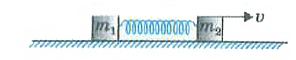
The system described in previous question is kept on a frictionless horizontal floor with spring at its natural length. Now a sharp impulse is applied on the block m2 to impart it a speed of v. Calculate velocity acquired by the centre of mass just after the impulse is applied on the block m2. Also calculate maximum possible elongation suffered by the spring.

Text Solution

Verified by Experts

Velocity of the centre of mass can be written as follows:
`v_(cm)=(m_(1)v_(1)+m_(2)v_(2))/(m_(1)+m_(2))=(m_(1)xx0+m_(2)xxv)/(m_(1)xxm_(2))=(m_(2)v)/(m_(1)xxm_(2))`
When block my starts moving then it elongates the spring which in turn applies force on blockm, to move it along. Spring force opposes the motion of m, and so its velocity decreases and spring force accelerates the block m, and its velocity increases. Elongation of the spring increases till the time both the blocks acquire common velocity. And this common velocity will be equal to velocity of centre of mass. At this instant elongation of the spring will be maximum.
Let x be the maximum elongation, then using conservation of mechanical energy we can write the following:
Loss in kinetic energy = gain in spring potential energy
`(1)/(2)m_(2)v^(2)-(1)/(2)(m_(1)+m_(2))[(m_(2)v)/(m_(1)+m_(2))]^(2)=(1)/(2) kx^(2)`
`rArr kx^(2)= m_(2)v^(2)-(m_(2)^(2)v^(2))/(m_(1)+m_(2))`
`rArr kx^(2)=(m_(1)m_(2)^(2)v^(2))/(m_(1)+m_(2))`
`rArr x=v sqrt((m_(1)m_(2))/(k(m_(1)+m_(2))))`
Promotional Banner

Topper's Solved these Questions

  • SYSTEMS OF PARTICLES AND ROTATIONAL MOTION

    MODERN PUBLICATION|Exercise REVISION EXERCISES (Very Short Answer Questions Carrying 1 mark)|29 Videos
  • SYSTEMS OF PARTICLES AND ROTATIONAL MOTION

    MODERN PUBLICATION|Exercise REVISION EXERCISES (Additional Questions Carrying 1 mark )|4 Videos
  • SYSTEMS OF PARTICLES AND ROTATIONAL MOTION

    MODERN PUBLICATION|Exercise NCERT FILE (NCERT EXEMPLAR PROBLEMS (SUBJECTIVES QUESTIONS) (Very Short Answer Type Questions))|9 Videos
  • PHYSICAL WORLD

    MODERN PUBLICATION|Exercise Revision exercises (Long answer questions)|6 Videos
  • THERMAL PROPERTIES OF MATTER

    MODERN PUBLICATION|Exercise CHAPTER PRACTICE TEST|15 Videos

Similar Questions

Explore conceptually related problems

Consider a case of fixed smooth sphere of radius R . A block of mass m is placed at the most poit of the sphere . A sharp impulse is applied on the block to impart it a speed v . What is the normal reaction between block and the sphere just after the impulse is applied ?

A rod of mass M and length L is kept on a frictionless horizontal floor. A particle of mass m moving perpendicular to the rod with a speed v strikes at the end of the rod and sticks there. Calculate angular velocity acquired by the combined system.

Two blocks A and B each of mass m are connected by a massless spring of natural length L and spring constant k. The blocks are initially resting on a smooth horizontal floor with the spring at its natural length. A third identical block C also of mass m moves on the floor with a speed v along the line joining A and B and collides with A. Then The kinetic energy of the A-B system at maximum compression of the spring is mv^(2)//4 The maximum compression of the spring vsqrt(m//3k) The kinetic energy of the A-B system at maximum compression The maximum coppression of the spring is vsqrt(m//k)

Consider a case of fixed smooth sphere of radius R . A block of mass m is placed at the most poit of the sphere . A sharp impulse is applied on the block to impart it a speed v . What si the maximum possible value of v so that block does not lose contact with the sphere at the top point ?

A block of mass m is attached with a spring of force constant k. The block is kept on a frictionless plank. Mass of the plank is M and it is also kept on a horozontal frictionless surface. Initially the sysetm is stationaryl. An impulse p is applied on the block as shown. The maximum copression in the spring will be

Two blocks A and B of masses m and 2m are connected by a massless spring of natural length L and spring constant k . The blocks are intially resting on a smooth horizontal floor with the spring at its natural length , as shown . A third identical block C of mass m moves on the floor with a speed v_(0) along the line joining A and B and collides elastically with A . FInd (a) the velocity of c.m. of system (block A + B + spri ng) and (b) the minimum compression of spring.

Block of mass m is pushed towards a horizontal spring as shown in figure , with initial speed u . Spring constant of the spring is K and floor is smooth . Calculate maximum possible compression of the spring .

The block of mass M moving on the frictionless horizontal surface collides with the spring constant k and compresses it by length L . The maximum momention of the block after collision is

Two blocks of masses 5kg and 2kg are connected by a spring of negligible mass and placed on a frictionless horizontal surface. An impulse provides a velocity of 7m/s to the heavier block in the direction of the lighter block. The velocity of the centre of mass is :-
