Home
Class 11
PHYSICS
Two blocks of masses m, and m, are conne...

Two blocks of masses m, and m, are connected to the ends of a spring of spring constant k. System is kept at rest on a frictionless horizontal floor with spring in its natural length. Both the blocks are pulled along opposite directions with forces of same magnitude F. Calculate maximum elongation of spring and distances travelled by the blocks during this motion.

Text Solution

Verified by Experts
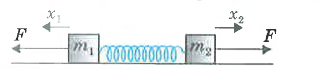

Net force in the horizontal direction is zero hence acceleration of centre of mass is zero. Initially, both the blocks are at rest hence initial velocity of centre of mass is zero. So we can conclude that centre of mass remains at rest and both the blocks come to momentary rest simultaneously at the time of maximum elongation.
Let `x_(1) and x_(2)` be the distances travelled by the blocks during this period in opposite directions as shown in figure. We can understand that `(x_(1) + x_(2))` will be maximum elongation of spring
Using conservation of energy we can write the following:
Work done by both the forces = Energy stored in spring
`Fx_(1)+Fx_(2)=(1)/(2)k(x_(1)+x_(2))^(2)`
`x_(1)+x_(2)=(2F)/(K) " "....(1)`
Hence 2Fis maximum elongation of the spring, Here we know that displacement of centre of mass is zero so we can write the following equation:
`m_(1)x_(1)=m_(2)x_(2) " "....(2)`
Solving the above two equations we can find `x_(1) and x_(2)`
`x_(1)=(m_(2))/(m_(1)+m_(2))[(2F)/(K) And x_(2)=(m_(1))/(m_(1)+m_(2))[(2F)/(k)]`
Promotional Banner

Topper's Solved these Questions

  • SYSTEMS OF PARTICLES AND ROTATIONAL MOTION

    MODERN PUBLICATION|Exercise REVISION EXERCISES (Very Short Answer Questions Carrying 1 mark)|29 Videos
  • SYSTEMS OF PARTICLES AND ROTATIONAL MOTION

    MODERN PUBLICATION|Exercise REVISION EXERCISES (Additional Questions Carrying 1 mark )|4 Videos
  • SYSTEMS OF PARTICLES AND ROTATIONAL MOTION

    MODERN PUBLICATION|Exercise NCERT FILE (NCERT EXEMPLAR PROBLEMS (SUBJECTIVES QUESTIONS) (Very Short Answer Type Questions))|9 Videos
  • PHYSICAL WORLD

    MODERN PUBLICATION|Exercise Revision exercises (Long answer questions)|6 Videos
  • THERMAL PROPERTIES OF MATTER

    MODERN PUBLICATION|Exercise CHAPTER PRACTICE TEST|15 Videos

Similar Questions

Explore conceptually related problems

Two blocks are connected to the two free ends of a spring of spring constant K . Both the blocks are moved apart to extend the psring beyond its natural length and then released . In subsequent motion

A block of mass m is connected to another .block of mass M by a massless spring of spring constant k. A constant force f starts action as shown in figure, then:

A block of mass m is connected to another block of mass M by a massless spring of spring constant k . the blocks are kept of a smooth horizontal plane and are at rest. The spring is unstretched when a constant force F starts acting on the block of mass M of pull it. Find the maximum extension of the spring

Two blocks A and B of masses m and 2m are connected by a massless spring of natural length L and spring constant k . The blocks are intially resting on a smooth horizontal floor with the spring at its natural length , as shown . A third identical block C of mass m moves on the floor with a speed v_(0) along the line joining A and B and collides elastically with A . FInd (a) the velocity of c.m. of system (block A + B + spri ng) and (b) the minimum compression of spring.

Two blocks of masses m and m' are connected by a light spring on a horizontal frictionless table . The spring is compressed and then released . Find the ratio of acceleration of masses .

Two blocks of masses m_(1) and m_(2) are connected by an ideal sprit, of force constant k . The blocks are placed on smooth horizontal surface. A horizontal force F acts on the block m_(1) . Initially spring is relaxed, both the blocks are at rest. What is acceleration of centre of mass of system at the instant of maximum elongation of spring

Blocks A&B of mass m each are connected with spring of constant k both blocks lie on frictionless ground and are imparted horizontal velocity v as shown when spring is unstretched find the maximum stretch of spring.

Two blocks A and B each of mass m are connected by a massless spring of natural length L and spring constant k. The blocks are initially resting on a smooth horizontal floor with the spring at its natural length. A third identical block C also of mass m moves on the floor with a speed v along the line joining A and B and collides with A. Then The kinetic energy of the A-B system at maximum compression of the spring is mv^(2)//4 The maximum compression of the spring vsqrt(m//3k) The kinetic energy of the A-B system at maximum compression The maximum coppression of the spring is vsqrt(m//k)

A block of mass m connected to a spring of stiffness k is placed on horizontal smooth surface. When block is at x=0 , spring is in natural length. The block is also subjected to a force F=(k|x|)/(@) then

