Home
Class 12
PHYSICS
Two infinitely long line charges having ...

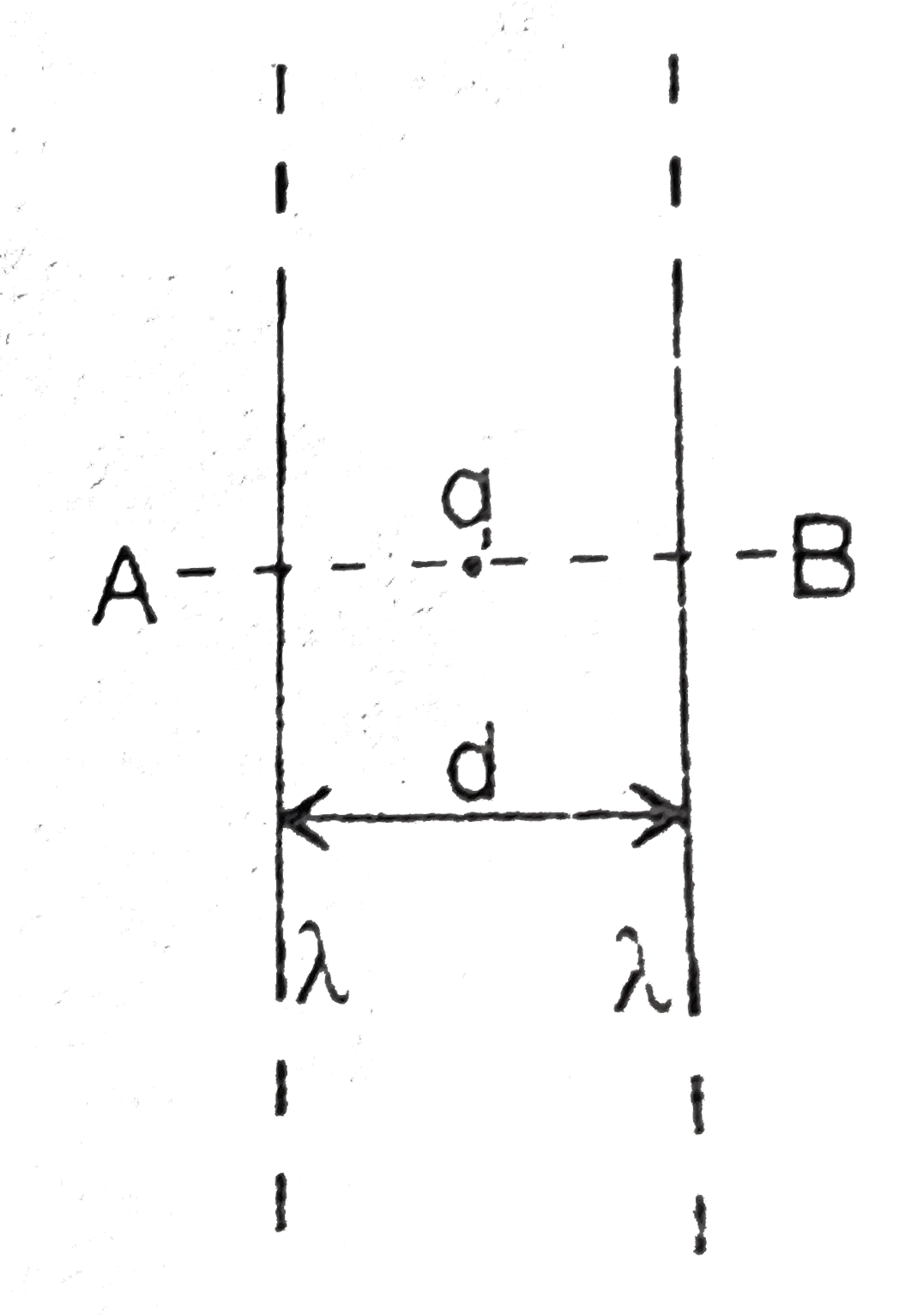
Two infinitely long line charges having charge density `lamda` each are parallel to each other and separated by distance d. A charge particle of mass m and charge q is placed at mid point between them. This charge displaced slightly along a line AB which is perpendicular to the line charges and in the plane of the charges. prove that the motion of the particle will be SHM for small displacement and `lamda q gt 0` Neglect gravity. Find the time period.

Text Solution

Verified by Experts

In the given figure the centre of AB is equilibrium position for a charged particle, because both charges apply the same repulsion on the particle of placed at this point. But when the particle is displaced towards one of the charges then its distance decreases from that charge but increases from other . The greater repulsion of near charge moves back the particle to its equilibrium, and subsequently the particle starts oscillating . Let a be the acceleration of particle when it is at displaced position as shown in the figure.

`ma=F_1-F_2`
Using Coulomb.s law , we can rewrite the above equation as follows :
`ma=1/(4piepsilon_0)(Qq)/(d-x)^2 -1/(4piepsilon_0)(Qq)/(d+x)^2`
`rArr a=(Qq)/(4piepsilon_0m) [1/(d-x)^2-1/(d+x)^2]`
`rArr a=(Qq)/(4piepsilon_0m)[(4xd)/(d^2 x^2)^2]`
For x < < d , we can neglect `x^2` in comparison to `d^2`. We get the following :
`rArr a=(Qq)/(piepsilon_0 md^3)x`
`rArr a=omega^2x`
`omega=sqrt((Qq)/(piepsilon_0md^3))`
Acceleration is proportional to displacement and always towards the centre O, hence it is S.H.M. Its time period is given by :
`T=(2pi)/omega rArr T=2pi sqrt((piepsilon_0md^3)/(Qq))`
`rArr T=sqrt((4pi^3epsilon_0md^3)/(Qq))`
Promotional Banner

Topper's Solved these Questions

  • ELECTRIC CHARGES AND FIELDS

    MODERN PUBLICATION|Exercise Ncert File (Textbook Exercise)|34 Videos
  • ELECTRIC CHARGES AND FIELDS

    MODERN PUBLICATION|Exercise Ncert File (Ncert (Exemplar Problems) )|25 Videos
  • ELECTRIC CHARGES AND FIELDS

    MODERN PUBLICATION|Exercise Conceptual Questions|51 Videos
  • DUAL NATURE OF RADIATION AND MATTER

    MODERN PUBLICATION|Exercise CHAPTER PRACTICE TEST|15 Videos
  • ELECTROMAGNETIC INDUCTION

    MODERN PUBLICATION|Exercise CHAPTER PRACTICE TEST FOR BOARD EXAMINATION|14 Videos

Similar Questions

Explore conceptually related problems

A particle of mass m and charge q is located midway between two fixed charged particles each having a charge q and a distance 2l apart. Prove that the motion of the particle will be SHM if it is displaced slightly along the line connecting them and released. Also find its time period.

An infinitely long time charge has linear charge density lamdaC//m the line charge is along the line x=0,z=2m find the electric field at point (1,1,1) m.

For an infinite line of charge having linear charge density lambda lying along x-axis the work done in moving a charge q form C to A along CA is

Two infinite plane parallel sheets, separated by a distance d have equal and opposite uniform charge densities sigma . Electric field at a point between the sheets is

A particle of mass m and charge +q is located midway between two fixed charged particles each having a charge +q and at a distance 2L apart. Assuming that the middle charge moves along the line joining the fixed charges, calculate the frequency of oscillation when it is displaced slightly.

Two electrons each are fixed at a distance '2d'. A third charge proton placed at the midpoint is displaced slightly by a distance x (x lt lt d) perpendicular to the line joining the two fixed charges. Proton will execute simple harmonic motion having angular frequency : (m = mass of charged particle)

two identical rings of radius R have uniformly distributed charge Q(Qgt0) each. Both the rings are fixed and are placed coaxially separated by a distance of R. if a small positive point charge is placed at the mid point and is displaced slightly along the axis then,

Two identical charges, 5 muC each are fixed at a distance 8 cm and a charged particle of mass 9 xx 10^(-6) kg and charge -10 muC is placed at a distance 5 cm from each of them and is released. Find the speed of the particle when it is nearest to the two charges.

MODERN PUBLICATION-ELECTRIC CHARGES AND FIELDS -Tough & Tricky Problems
  1. Two identically charged spherical objects are suspended from a common ...

    Text Solution

    |

  2. A charge is divided into two charges q and (Q-q) .The value of q so th...

    Text Solution

    |

  3. A point charge Q is situated at point B on the ground. A point charge ...

    Text Solution

    |

  4. A charged particle of mass m having charge q remains in equilibrium at...

    Text Solution

    |

  5. Consider three charged spheres made of some insulating material . Two ...

    Text Solution

    |

  6. Each circle shwon in the figure given below is of radius R. Six identi...

    Text Solution

    |

  7. Two equal positive charges , Q , are fixed at points (0 , d) and (0 , ...

    Text Solution

    |

  8. Two infinitely long line charges having charge density lamda each are ...

    Text Solution

    |

  9. A mass m carrying a charge q is suspended from a string and placed in...

    Text Solution

    |

  10. A ring of radius R carries a uniformly distributed charge +Q. A point ...

    Text Solution

    |

  11. A very small electric dipole with dipole moment p is placed in such in...

    Text Solution

    |

  12. There is a pentagon ABCDE, whose centre is O. Five identical charges Q...

    Text Solution

    |

  13. Two point charges , -2muC and +6muC are fixed on a table at a distanc...

    Text Solution

    |

  14. A particle of mass m and charge q is released from rest in uniform el...

    Text Solution

    |

  15. A uniform electric field of magnitude E exists in between two parallel...

    Text Solution

    |

  16. Four charges are kept at the corners of a square of size a. Three char...

    Text Solution

    |

  17. Two large metal plates with surface charge densities +sigma and -sigma...

    Text Solution

    |

  18. The kinetic energy of the electron in an orbit of radius r in hydrogen...

    Text Solution

    |

  19. A Uniformly charged solid non-conducting sphere of uniform volume char...

    Text Solution

    |

  20. A charge q0 is distributed uniformly on a ring of radius R. A sphere o...

    Text Solution

    |

