Home
Class 12
PHYSICS
Consider the network of capacitors as sh...

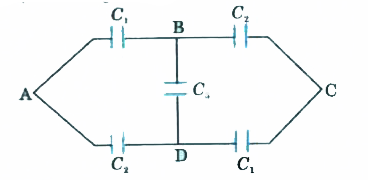
Consider the network of capacitors as shown in the figure. Find equivalent capacitance between points A and C. Assume `C_(1)=1muF, C_(2)=0.5muF and C_(3)=1muF`.

Text Solution

Verified by Experts
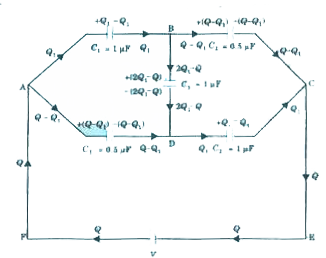
In the given network of capacitors we can see thatequivalent capacitance cannot be obtained by using the formulae for series and parallel combinations. Apart from that it is nto the case of a balanced Wheatstone bridge. We can still make use of reverse symmetric values of capacitances of the given network to cut short the calculation to a certain extent.
When we connect a battery between the points A and C of circuit, then charge flowing from A to B can be taken as same as flowing from D to C. Similarly charge flowing from A to D will be same as charge flowing form B to C. Flow of charge through the bridge capacitor form B to D can be written accordingly. See the following diagram how total charge Q is distributed in the circuit when a potential difference of V is applied between the points A and C. Here, we must note the fact that, the ratio Q/V will be the equivalent capacitance between A and C, which is required as the final answer to this quesiton.

Kirchhoff.s loop Law: Algebraic sum of all the potential differences in a loop must add to zero. This a due to conservative nature of electric field.
On applying Kirchhoff.s law for the loop EFABCE we get the following equation:
`V-(Q_(1))/(1)-(Q-Q_(1))/(0.5)=0`
`rArr V-Q_(1)-2Q+2Q_(1)=0 rArr V=2Q-Q_(1)" " ...(i) `
On applying Kirchhoff.s law for the loop ABDA we get the following equation:
`-(Q_(1))/(1)-(2Q_(1)-Q)/(1)+(Q-Q_(1))/(0.5)=0`
`rArr -Q_(1)-2Q_(1)+Q+2Q-2Q_(1)=0`
`rArr 5Q_(1)=3Q rArr Q_(1)=(3Q)/(5) " " ...(ii)`
Substituting `Q_(1)` from equation (ii) in equation (i) we get the following:
`V=2Q-(3Q)/(5)=(7Q)/(5) rArr C_(eq)=(Q)/(V)=(5)/(7)muF`
Promotional Banner

Topper's Solved these Questions

  • ELECTROSTATIC POTENTIAL AND CAPACITANCE

    MODERN PUBLICATION|Exercise NCERT FILE Solved (Textbook Exercise)|11 Videos
  • ELECTROSTATIC POTENTIAL AND CAPACITANCE

    MODERN PUBLICATION|Exercise NCERT FILE Solved (Additional Exercises)|23 Videos
  • ELECTROSTATIC POTENTIAL AND CAPACITANCE

    MODERN PUBLICATION|Exercise Conceptual Questions|37 Videos
  • ELECTROMAGNETIC WAVES

    MODERN PUBLICATION|Exercise CHAPTER PRACTICE TEST|14 Videos
  • MAGNETISM AND MATTER

    MODERN PUBLICATION|Exercise CHAPTER PRACTICE TEST FOR BOARD EXAMINATION|16 Videos

Similar Questions

Explore conceptually related problems

In the network of capacitors shown in figure 6.14 find the equivalent capacitance between a and b. Take C=2 muF

Each capacitor shown in the figure is 2muF . Then the equivalent capacitance between points A and B is

All the capacitances shown in figure are in muF . Find the equivalent capacitance between A and B.

Seven capacitor are connected as shown in the figure. . The equivalent capacitance in muF between A and B is.

Find the capacitance C in the circuit shown in figure if the equivalent capacitance between points A and B is 1muF .

In a given network the equivalent capacitance between A and B is [C_(1)=C_(4)=1muF,C0_(2)=C_(3)=2muF]

Five capacitors each of capacitance 20muF are joined as shown in the figure. The equivalent capacitance between A and C is

Find the equivalent capacitane between the points P and Q as shown in Fig. Given C = 18 muF and C_(1) = 12 muF

In the arrangement of capacitors shown in the figure, each capacitor is of 9muF , then the equivalent capacitance between the point A and B is

