Home
Class 12
PHYSICS
Consider a thick walled metallic spheric...

Consider a thick walled metallic spherical shell with inner radius a and outer radius b. No charge is given to the spherical shell. A point charge +Q is kept at the centre. Find the electric potential at a point distance x from the centre where `0lt x lt oo`.

Text Solution

Verified by Experts
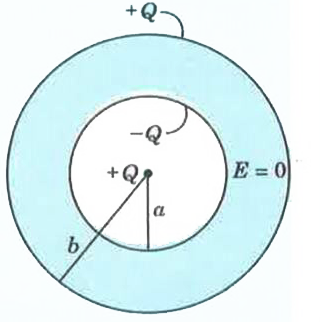

See the figure for charges induced on the inner and outer surfaces of a thick walled spherical shell. Charge induced on the inner surface is -Q and charge appearing on outer surface is +Q . These two spherical surfaces will act like two thin spherical shells of radius a and b respectively. In between these two faces, electric field intensity will remain zero. Hence, electric potential will remain constant for `a lt x lt b`. Moreover to proceed further we should be aware of the fact that elecrtric potential, due to a thin spherical shell for points outside it or on the surface, is same as that of a point charge as it it were kept at its centre and electric potential inside the thin spherical shell is same as that on its surface. We know that electric potential due to a point charge at a point that is at a distance x from it is given by the formula `V=(q)/(4pi epsilon_(0)x)` and now we can use the above stated information to write electric potential for different points due to the given system.
(i) `0 lt x lt a`
`V=(Q)/(4pi epsilon_(0)x)+(-Q)/(4pi epsilon_(0)a)+(Q)/(4pi epsilon_(0)b)`
`rArr V=(Q)/(4pi epsilon_(0)x)-(Q)/(4pi epsilon_(0)a)+(Q)/(4pi epsilon_(0)b)" " ...(i)`
(ii) `a lt x lt b`
`V=(Q)/(4pi epsilon_(0)x)+(-Q)/(4pi epsilon_(0)x)+(Q)/(4pi epsilon_(0)b)`
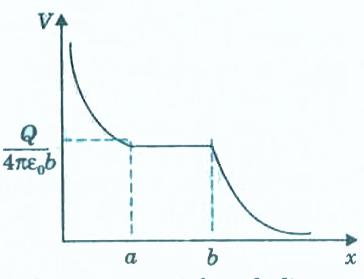
`rArr V=(Q)/(4pi epsilon_(0)b)" " ...(ii)`
Note that value of potential for x = a, is same from both the equations (i) and (ii). Hence, there is no discontinuity.
(iii) `b lt x lt oo`
`V=(Q)/(4pi epsilon_(0)x)+(-Q)/(4pi epsilon_(0)x)+(Q)/(4pi epsilon_(0)x)`
`rArr V=(Q)/(4pi epsilon_(0)x)" " ...(iii)`
Note that value of potential at x = b is same from both the equaiton (ii) and (iii). Hence, there is no discontinuity at this point also.

Electric potential due to the sbove system is defined for all the points except x = 0. At x = 0, potential approaches infinity.
Graph between electric potential and distance from the centre is shown in the figure.
Promotional Banner

Topper's Solved these Questions

  • ELECTROSTATIC POTENTIAL AND CAPACITANCE

    MODERN PUBLICATION|Exercise NCERT FILE Solved (Textbook Exercise)|11 Videos
  • ELECTROSTATIC POTENTIAL AND CAPACITANCE

    MODERN PUBLICATION|Exercise NCERT FILE Solved (Additional Exercises)|23 Videos
  • ELECTROSTATIC POTENTIAL AND CAPACITANCE

    MODERN PUBLICATION|Exercise Conceptual Questions|37 Videos
  • ELECTROMAGNETIC WAVES

    MODERN PUBLICATION|Exercise CHAPTER PRACTICE TEST|14 Videos
  • MAGNETISM AND MATTER

    MODERN PUBLICATION|Exercise CHAPTER PRACTICE TEST FOR BOARD EXAMINATION|16 Videos

Similar Questions

Explore conceptually related problems

A thin spherical conducting shell of radius R has a charge q. Another charge Q is placed at the centre of the shell. The electrostatic potential at a point P a distance R/2 from the centre of the shell is

A conducting shell of radius R carries charge -Q . A point charge +Q is placed at the centre. The electric field E varies with distance r (from the centre of the shell) as

A point charge is kept at the centre of a metallic insulated spherical shell. Then

A metallic spherical shell has an inner radius R_(1) and outer radius R_(2) . A charge is placed at the centre of the spherical cavity. The surface charge density on the inner surface is

A conducting spherical shell having inner radius a and outer radius b carries a net charge Q. If a point charge q is placed at the centre of this shell, then the surface charge density on the outer surface of the shell is given as:

Both question (33) and (34) refer to the system of charges as shown in the figure. A spherical shell with an inner radius 'a' and an outer radius 'b' is made of conducting material. A point charge +Q is placed at the centre of the spherical shell and a total charge -q is placed on the shell. Assume that the electrostatic potential is zero at an infinite distance from the spherical shell. The electrostatic potential at a distance R(a lt R lt b) from the centre of the shell is