Home
Class 12
PHYSICS
Twelve identical capacitors of capacitan...

Twelve identical capacitors of capacitance C are connected across each edge of a cube. Find equivalent capacitance across one of the edges.

Text Solution

Verified by Experts
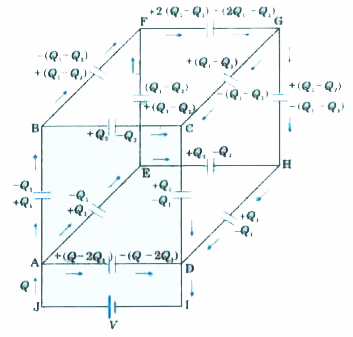
Refer to the figure for charge distribution. We have to calculate effective capacitance between points A and D. Let us suppose that a battery of potential difference V is connected between these two points.
We know that if Q is the total charge supplied by the battery to the network of capacitors then equivalent capacitance will be `Q//V`.
Capacitor connected between points A and D is in parallel with the rest of the circuit. In case we do not include it in calculation then we can add it to the answer of remaining network in parallel later. Nevertheless we have included it in charge distribution.

Branches AE and AB are similarly connected to the point A. Hence we have taken equal charges `Q_(1)` for capacitors connected to both of them. Branches BC and EH are also identical so we have taken the same charge `Q_(2)` for capacitors in these two branches. Moreover the whole network is in symmetric halves between the two terminals of a battery. That is why we can see symmetry in charge distribution for left and right parts of the network except reverse polarity is used on both sides. Rest of the charge distribution is self-explanatory.
Let us apply Kirchhoff.s law for loop IJAEHDI:
`V-(Q_(1))/(C)-(Q_(2))/(C )-(Q_(1))/(C )=0 rArr 2Q_(1)+Q_(2)=CV " " ...(i)`
Let us apply Kirchhoff.s law for loop HEFGH:
`(Q_(2))/(C )-(Q_(1)-Q_(2))/(C )-2 (Q_(1)-Q_(2))/(C )-(Q_(1)-Q_(2))/(C )-0`
`rArr (Q_(2))/(C )=(4(Q_(1)-Q_(2)))/(C ) rArr Q_(2) =4Q_(1)-4Q_(2)`
`rArr 4Q_(1)=5Q_(2) rArr Q_(2)=(4Q_(1))/(5)" " ...(ii)`
Now substituting `Q_(2)` from equation (ii) in equation (i) we get the following:
`2Q_(1)+(4Q_(1))/(5)=CV rArr Q_(1)=(5CV)/(14) " " ...(iii)`
Let us apply Kirchhoff.s law for loop IJADI:
`V-(Q-2Q_(1))/(C )=0`
`Q-2Q_(1)=CV " " ...(iv)`
Substituting `Q_(1)` from equation (iii) in equation (iv) we get the following:
`Q-2((5CV)/(14))=CV rArr Q=(5)/(7)CV+CV`
`rArr (Q)/(V)=(12)/(7)C rArr C_(eq)=(12)/(7)C`
Alternate solution:
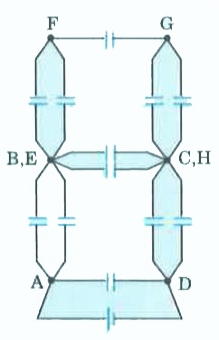
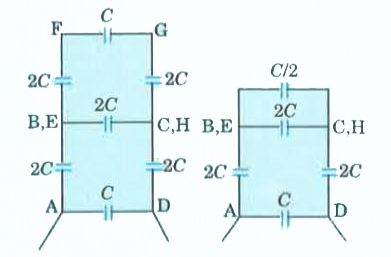
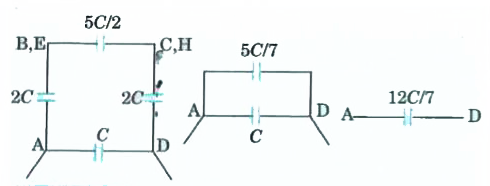
The moment we get to know that capacitors of branches AE and AB carry the same charge then due to same capacitance we can say that potential of points B and E must be same due to the similar potential difference across both the capacitors. Using the same logic we can say that points C and H must also be at the same potential. Points of same potential can be assumed as points at same location and circuit can be redrawn as follows:

We know that capacitances of all the capacitors are C in the above redrawn network of capacitors. The network can be solved for equivalent capacitance between points A and D using method of series and parallel combinations. Following are the steps to arrive at the same answer using this alternate method.

Promotional Banner

Topper's Solved these Questions

  • ELECTROSTATIC POTENTIAL AND CAPACITANCE

    MODERN PUBLICATION|Exercise NCERT FILE Solved (Textbook Exercise)|11 Videos
  • ELECTROSTATIC POTENTIAL AND CAPACITANCE

    MODERN PUBLICATION|Exercise NCERT FILE Solved (Additional Exercises)|23 Videos
  • ELECTROSTATIC POTENTIAL AND CAPACITANCE

    MODERN PUBLICATION|Exercise Conceptual Questions|37 Videos
  • ELECTROMAGNETIC WAVES

    MODERN PUBLICATION|Exercise CHAPTER PRACTICE TEST|14 Videos
  • MAGNETISM AND MATTER

    MODERN PUBLICATION|Exercise CHAPTER PRACTICE TEST FOR BOARD EXAMINATION|16 Videos

Similar Questions

Explore conceptually related problems

Twelve identical capacitors of capacitance C are connected across each edge of a cube. Find equivalent capacitance across one of the face diagonals.

Find the equivalent capacitance across A & B

Find the equivalent capacitance across A & B

Find the equivalent capacitance across A and B. .

Find the equivalent capacitance across points A and B.

There are 10 identical capacitors each of capacitance C .

An infinite number of identical capacitors each of capacitance 1 mF are connected as shown in the figure. Then the equivalent capacitance between A and B is. .

Twelve capacitors, each having a capacitance C, are connected to form a cube . Find the equivalent capacitance between the diagonally opposite corners such as A and B.

Three identical 10 muF capacitors and a capacitor of capacitance C are connected as shown in the figure. Find the capacitance C if the equivalent capacitance between X and Y is 20muF .