Home
Class 12
PHYSICS
There are four concentric spherical shel...

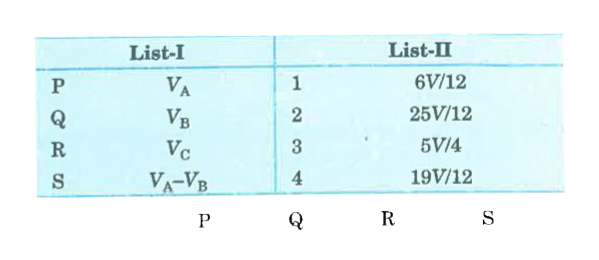
There are four concentric spherical shells A, B, C and D of radii R, 2R, 3R and 4R respectively. Net charge on all the spherical shells are same and equal to Q. If `V_(A), V_(B), V_C ) and V_(D)` represent electric potentials of A, B, C and D respectively, the magnitude of `V_(D)=V`.

A

`{:(P,Q,R,S),(1,3,2,4):}`

B

`{:(P,Q,R,S),(1,2,4,3):}`

C

`{:(P,Q,R,S),(2,4,3,1):}`

D

`{:(P,Q,R,S),(4,2,3,1):}`

Text Solution

Verified by Experts

The correct Answer is:

C

To write electric potential due to a uniformly charged spherical shell, we should know that its behaviour for points outside it or on its surface is same as a point charge kept at its centre. We know that electric field intensity inside the hollow sphere is zero. Hence, we know that potential due to a hollow sphere at any point inside it is same as the potential at its surface.
In this given situation, the net charge on each spherical shell is Q, but due to induction phenomenon different charges will appear on both the inner and outer surfaces of sphere but net charge is not going to change. We need not pay attention to induction of charge because potential depends only on the net charge.
Total electric potential of sphere D can be written as follows:
`V_(D)=(1)/(4pi epsilon_(0))[(Q)/(4R)+(Q)/(4R)+(Q)/(4R)+(Q)/(4R)]=(1)/(4pi epsilon_(0)) (Q)/(R )=V " " ...(i)`
We can see that in the above case of sphere D, it is outside all the other spheres, so distance 4R is used due to all these spheres. But we should note that in case of other spheres it is not so.
`V_(A)=(1)/(4pi epsilon_(0))[(Q)/(R )+(Q)/(2R)+(Q)/(3R)+(Q)/(4R)]`
`=(25)/(12)(1)/(4pi epsilon_(0)) (Q)/(R )=(25)/(12)V " " ...(ii)`
`V_(B)=(1)/(4pi epsilon_(0))[(Q)/(2R)+(Q)/(2R)+(Q)/(3R)+(Q)/(4R)]`
`=(19)/(12)(1)/(4pi epsilon_(0)) (Q)/(R )=(19)/(12)V " " ...(iii)`
`V_(C )=(1)/(4pi epsilon_(0))[(Q)/(3R)+(Q)/(3R)+(Q)/(3R)+(Q)/(4R)]`
`=(5)/(4) (1)/(4pi epsilon_(0)) (Q)/(R )=(5)/(4)V " " ...(iv)`
`V_(A)-V_(B)=(25)/(12)V-(19)/(12)V=(V)/(2)=(6V)/(12)`
We can see that option (c ) is correct.
Promotional Banner

Topper's Solved these Questions

  • ELECTROSTATIC POTENTIAL AND CAPACITANCE

    MODERN PUBLICATION|Exercise Competition file (MATRIX TYPE QUESTIONS)|1 Videos
  • ELECTROSTATIC POTENTIAL AND CAPACITANCE

    MODERN PUBLICATION|Exercise Competition file (INTEGER TYPE QUESTIONS)|10 Videos
  • ELECTROSTATIC POTENTIAL AND CAPACITANCE

    MODERN PUBLICATION|Exercise Competition file (ASSERTION REASON TYPE QUESTIONS)|8 Videos
  • ELECTROMAGNETIC WAVES

    MODERN PUBLICATION|Exercise CHAPTER PRACTICE TEST|14 Videos
  • MAGNETISM AND MATTER

    MODERN PUBLICATION|Exercise CHAPTER PRACTICE TEST FOR BOARD EXAMINATION|16 Videos

Similar Questions

Explore conceptually related problems

Three concentric spherical conductors A, B and C of radii R, 2R and 4R respectively. A and C is shorted and B is uniformly charged . Potential at B is

Three concentric spherical conductors A, B and C of radii R, 2R and 4R respectively. A and C is shorted and B is uniformly charged Potential at A is

Three concentric spherical conductors A, B and C of radii R, 2R and 4R respectively. A and C is shorted and B is uniformly charged Charge on conductor A is

There are four concentric shells A,B, C and D of radii a,2a,3a and 4a respectively. Shells B and D are given charges +q and -q respectively. Shell C is now earthed. The potential difference V_A-V_C is k=(1/(4piepsilon_0))

Three concentric spherical metallic shells A, B, and C of radii a,b, and c(a lt b lt c) have surface charge densities sigma, -sigma and sigma , respectively. If V_(A), V_(B) and V_(C) are potential of shells A, B and C, respectively, match the columns {:("Column A",,,"Column B"),(a. V_(A),,i.,sigma/epsilon_(0)[(a^(2)-b^(2)+c^(2))/c]),(b. V_(B),,ii.,sigma^(2)/epsilon_(0)[a^(2)/b-b+c]),(c. V_(C),,iii.,sigma/epsilon_(0)[a-b+c]):}

Four concentric conducting spherical shells P, Q, R and S of radii a, 2a, 3a and 4a respectively. Shell P and S are given charges q and -q respectively. If shell R is grounded then potential difference (VP — VR) is (where V, and VR are potential at surfaces of P and R respectively)
