Home
Class 12
PHYSICS
In the circuit shown in figure , initial...

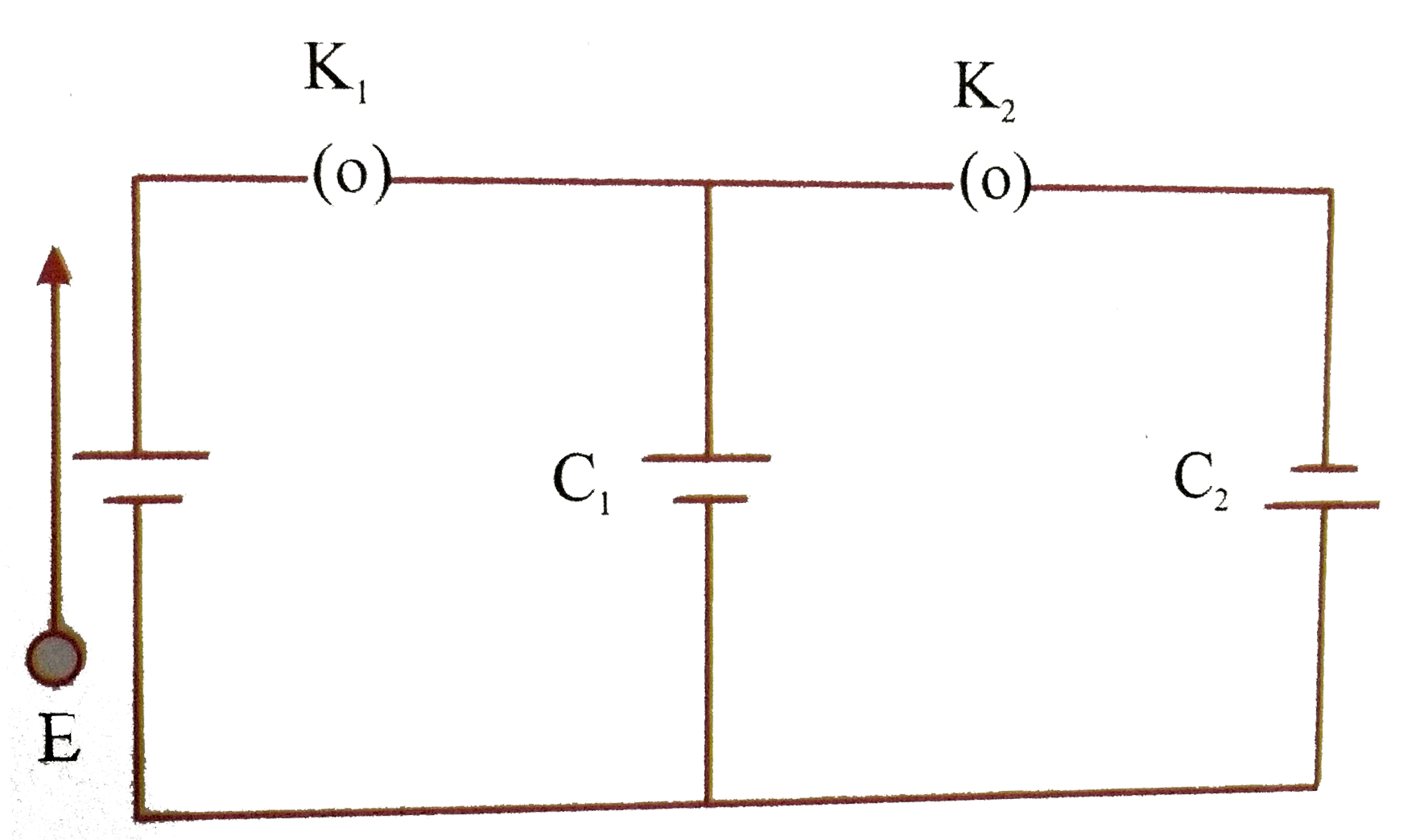
In the circuit shown in figure , initially key `K_(1)` is closed and key `K_(2)` is open. Then `K_(1)` is opened and `K_(2)` is closed (order is important). [Take `Q_(1)^(')` and `Q_(2)^(')` as charges on `C_(1)` and `C_(2)` and `V_(1)` and `V_(2)` as voltage respectively].

Then

A

charge on `C_(1)` gets redistributed such that `V_(1)=V_(2)`

B

charge on `C_(1)` gets redistributed such that `Q_(1)^(')=Q_(2)^(')`

C

charge on `C_(1)` gets redistributed such that
`C_(1)V_(1)+C_(2)V_(2)=C_(1)E`

D

Charge on `C_(1)` gets redistributed such that
`Q_(1)^(')+Q_(2)^(')=Q`

Text Solution

Verified by Experts

The correct Answer is:

A, C

Initially, `K_(1)` is closed and `K_(2)` is open, thus the capacitor `C_(1)` gets fully charged. When `K_(1)` is opened and `K_(2)` is closed, the charged capacitor `C_(1)` is connected across an uncharged capacitor `C_(2)`. When a charged capacitor is connected across an uncharged capacitor, the charged capacitor supplies charge to uncharged capacitor till both the capacitors have common potential difference between their plates. Thus, charge on `C_(1)` gets redistributed such that `V_(1)=V_(2)`.
Charge acquired by `C_(1)` is `C_(1)E` when key `K_(1)` is closed. Now `K_(1)` is opened and `K_(2)` is closed hence this total charge will be redistributed between the two as per specified condition of `V_(1)=V_(2)`. As per charge conservation, total charge after redistribution must be same as before.
`C_(1)V_(1)+C_(2)V_(2)=C_(1)E`.
Hence, options (b) and (c ) are correct.
Q in option (d) is not defined, hence we cannot accept this option.
Promotional Banner

Topper's Solved these Questions

  • ELECTROSTATIC POTENTIAL AND CAPACITANCE

    MODERN PUBLICATION|Exercise Chapter Practice Test|9 Videos
  • ELECTROSTATIC POTENTIAL AND CAPACITANCE

    MODERN PUBLICATION|Exercise Competition file (NCERT Exemplar Problems: Multiple Choice Questions Type-I)|6 Videos
  • ELECTROMAGNETIC WAVES

    MODERN PUBLICATION|Exercise CHAPTER PRACTICE TEST|14 Videos
  • MAGNETISM AND MATTER

    MODERN PUBLICATION|Exercise CHAPTER PRACTICE TEST FOR BOARD EXAMINATION|16 Videos

Similar Questions

Explore conceptually related problems

In the circuit shown in Figure, initially key K_(1) is closed and key K_(2) is open. Then K_(1) is opened and K_(2) is closed. Then

In the circuit shown in Fig, instially K_(1) is closed and K_(2) is open . What are the charges on each capacitor. Then K_(1) was opened and K_(2) was closed (order is important). What will be the charge on each capacitor now ? [C = 1muF]

A circuit containing two capacitor C_(1) and C_(2) shown in figure is in steady state with switch K_(1) closed and K_(2) open. At the instant t=0,K_(1) is opened and K_(2) is closed. The correct statements are.

Initially K_(1) is closed, now if K_(2) is also closed, find heat dissipated in the resistances of connecting wires

Shown in the figure is a parallel R , L,C circuit with key K_(1) closed and K_(2) opened . When K_(1) is opened and K_(2) is closed simultaneously find the maximum potential difference across the capacitor and maximum charge stored in it .

In the circuit shown in, C_(1)=6 muF, C_(2)=3 muF , and battery B=20 V . The switch S_(1) is first closed. It is then opened, and S _(2) is closed. What is the final charge on C_(2) .

A circuit containing capacitors C_(1) and C_(2) shown in Fig. is in the steady state with key K_(1) closed. At the instant t = 0, K_(1) is opened and K_(2) is closed. The angular frequency of oscillation of the circuit and charge across C_(1) at t = 125 (mu)s are respectively

Shown in the figure is an R-L circuit. Just after the key (K) is closed
