Home
Class 12
PHYSICS
A (current vs time) graph of the current...

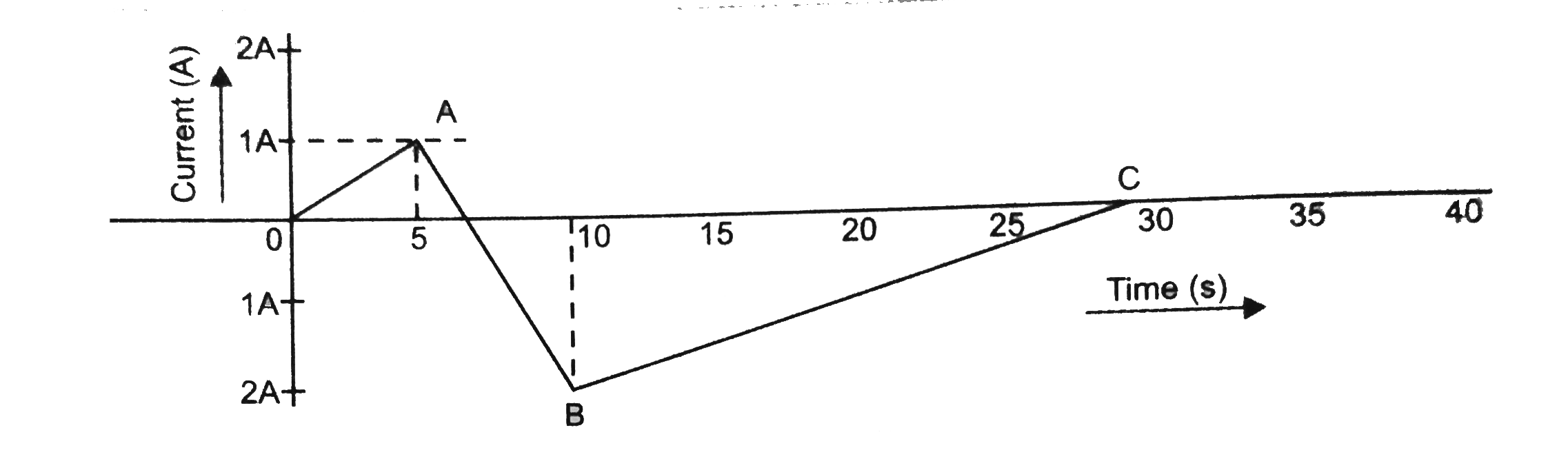
A (current vs time) graph of the current passing through a solenoid is shown in Fig. For which time is the back electromotive force (u) a maximum? If the back emf t = 3 s is e, find the back emf at t = 7 s, 15 s and 40 s OA, AB and BC are straight line segments.

Text Solution

Verified by Experts

Induced emf or back emf in a solenoid is given by
`|epsilon|=(LdI)/(dt)`
`epsilon` will be maximum when `(dI)/(dt)` is maximum.
In the graph shown, `(dI)/(dt)` (rate of change of current) is maximum for AB, i.e. for `5 s lt t lt 10 s`
(i) For `0 s lt t lt 5 s`, `(dI)/(dt)=((1-0)A)/((5-0)s)=(1)/(5) A // s`
Time t = 3 s will lie on the above slope. Back emf at t = 3 s is
`epsilon=-(LdI)/(dt)=-(L)/(5)` or L = - 5 e
(ii) For `5 s lt t lt 10 s`, `(dI)/(dt)=((-2-1)A)/((10-5)s)=-(3)/(5) A // s`
Time t = 7 s will lie on the above slope. Back emf at t = 7 s
`epsilon =-(LdI)/(dt)=-(-5e) xx ((-3)/(5))` (`:.` L = -5 e)
`implies epsilon= -3 e`
(iii) For `10 s lt t lt 30 s`
`(dI)/(dt)=([0-(-2)]A)/((30-10)s)=(1)/(10) A // s`
Time t = 15 s will lie on the above slope. Back emf at t = 15 s is
`epsilon=-(LdI)/(dt)= -(-5e) xx (1)/(10)`
`implies epsilon=(e)/(2)`
(iv) For `t gt 30 s`, `(dI)/(dt)=0`
Time t = 40 s will lie on the above slope. Back emf at t = 40 s is
`epsilon=-(LdI)/(dt)=0`
Promotional Banner

Topper's Solved these Questions

  • ELECTROMAGNETIC INDUCTION

    MODERN PUBLICATION|Exercise HIGHER ORDER THINKING SKILLS AND ADVANCED LEVEL|8 Videos
  • ELECTROMAGNETIC INDUCTION

    MODERN PUBLICATION|Exercise REVISION EXERCISE (Very Short Answer Questions Carrying I mark)|44 Videos
  • ELECTROMAGNETIC INDUCTION

    MODERN PUBLICATION|Exercise NCERT FILE (NCERT EXEMPLAR PROBLEMS SUBJECTIVE QUESTIONS) (Very short answer type questions)|6 Videos
  • ELECTRIC CHARGES AND FIELDS

    MODERN PUBLICATION|Exercise Chapter Practice Test|15 Videos
  • ELECTROMAGNETIC WAVES

    MODERN PUBLICATION|Exercise CHAPTER PRACTICE TEST|14 Videos

Similar Questions

Explore conceptually related problems

Current l versus time t graph through a conductor is shown in the figure. Average current through the conductor in the interval 0 to 15 s is

The current I through a conductor varies with time t as shown in figure. The average electric current during t=0 to t=10 s will be

The velocity-time graph of an object moving along a straight line is as shown in Fig. 3.37. Find the net distance covered by the object in time interval between t=0 to t=10s. Also find the displacement in time 0 to 10 s.

The velocity-time graph of a particle moving in a straight line is shown in figure. The mass of the particle is 2kg . Work done by all the forces acting on the particle in time interval between t=0 to t=10s is

The acceleration time graph of a particle is shown in the Fig. 2 (CF). 11. At time t= 10 s is the particle is 8 ms^(-1) . Its velocity t= 10 s is. .

Displacement-time graph of a particle moving in a straight line is as shown in figure. s t a o b c Q. Find the sign of velocity in regions oa, ab, bc and cd

Velocity-time graph of a particle moving in a straight line is shown in figure. At time t= 0. s = 20 m. Plot a-t and s-t graphs of the particle.

In the circuit shown in figure switch S is closed at time t=0 Current I from the battery at time t is given by
