Home
Class 12
PHYSICS
Two parallel vertical metallic rails AB ...

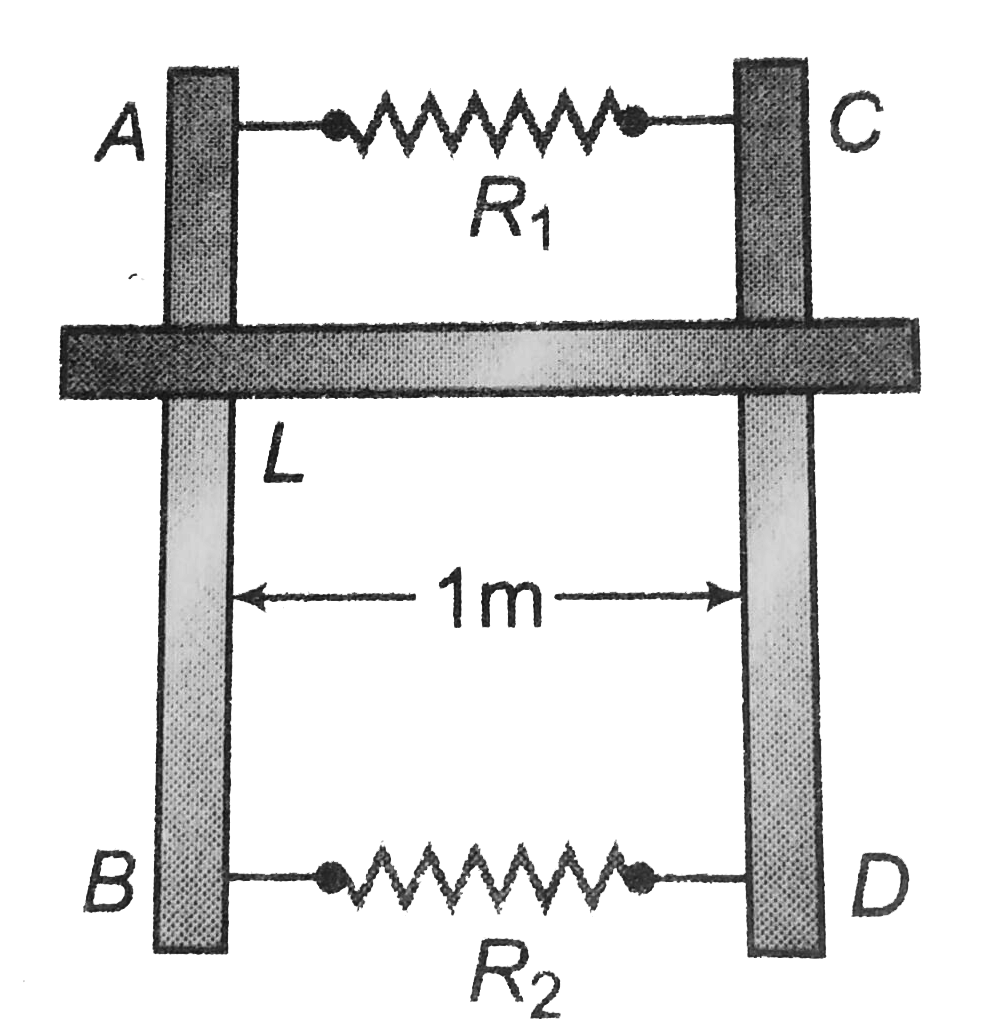
Two parallel vertical metallic rails `AB` and `CD` are separated by `1m`. They are connected at the two ends by resistances `R_1` and `R_2` as shown in the figure. A horizontal metallic bar `l` of mass `0.2 kg` slides without friction, vertically down the rails under the action of gravity. There is a uniform horizontal magnetic field of `0.6 T` perpendicular to the plane of the rails. It is observed that when the terminal velocity is attained, the powers dissipated in `R_1` and `R_2` are `0.76W` and `1.2W` respectively `(g=9.8m//s^2)`

The value of `R_1` is

Text Solution

Verified by Experts

When rod moves downward under gravity then motional emf is generated across its ends and current starts flowing through the rod. Magnetic force thus acting on the rod tries to oppose its motion. As speed of rod increases, emf induced also increases which in turn increases the current flowing through the rod which further increases magnetic force acting on the rod. At a particular speed magnetic force becomes equal to the weight of the rod and then rod attains terminal velocity.
Hence for terminal velocity we can write the following equation:
IlB = mg
`implies I=(mg)/(lB)=(0.2 xx 9.8)/(1 xx 0.6)=(1.96)/(0.6) amp`
If e is the emf induced in the rod then el will be the power delivered by the rod as a source of emf and this will be equal to the sum of the power dissipated across both the resistors. Hence we can write the following:
`eI=P_(1)+P_(2)`
`implies e xx (1.96)/(0.6)=1.2+0.76`
`implies e xx (1.96)/(0.6)=1.96`
`implies` e = 0.6 V
Motional emf induced across the length of rod can also be written as Bvl, where v is the velocity of rod perpendicular to its length. Hence terminal velocity can be calculated as follows:
Bvl = 0.6
`implies v=(0.6)/(0.6 xx 1) = 1 m // s`
Hence rod attains a terminal velocity of `1 m // s`.
Rate of heat dissipation across a resistor when e potential difference is applied across its ends can be written as follows:
`P=(e^(2))/(R) implies R=(e^(2))/(P)`
Hence both the resistances can be calculated as follows:
`R_(1)=(e^(2))/(P_(1))=((0.6)^(2))/(1.2)=0.3 Omega`
and `R_(2)=(e^(2))/(P_(2))=((0.6)^(2))/(0.76)=0.47`
Promotional Banner

Topper's Solved these Questions

  • ELECTROMAGNETIC INDUCTION

    MODERN PUBLICATION|Exercise REVISION EXERCISE (Very Short Answer Questions Carrying I mark)|44 Videos
  • ELECTROMAGNETIC INDUCTION

    MODERN PUBLICATION|Exercise REVISION EXERCISE (Additional Questions (Carrying I mark))|11 Videos
  • ELECTROMAGNETIC INDUCTION

    MODERN PUBLICATION|Exercise NCERT FILE (NCERT EXEMPLAR PROBLEMS SUBJECTIVE QUESTIONS) (Short answer type questions)|5 Videos
  • ELECTRIC CHARGES AND FIELDS

    MODERN PUBLICATION|Exercise Chapter Practice Test|15 Videos
  • ELECTROMAGNETIC WAVES

    MODERN PUBLICATION|Exercise CHAPTER PRACTICE TEST|14 Videos

Similar Questions

Explore conceptually related problems

Two parallel vertical metallic rails AB and CD are separated by 1m . They are connected at the two ends by resistances R_1 and R_2 as shown in the figure. A horizontal metallic bar l of mass 0.2 kg slides without friction, vertically down the rails under the action of gravity. There is a uniform horizontal magnetic field of 0.6 T perpendicular to the plane of the rails. It is observed that when the terminal velocity is attained, the powers dissipated in R_1 and R_2 are 0.76W and 1.2W respectively (g=9.8m//s^2) The terminal velocity fo the bar L will be

Two parallel vertical metallic rails AB and CD are separated by 1m. They are connected at two ends by resistanace (R_1) and (R_2) as shown in fig. A horizontal metallic bar L of mass 0.2 kg slides without froction vertically down the rails under the action of gravity. THere is a uniform horizontal magnetic field of 0.6 Tesla perpendicular to the plane of the rails. It is observed taht when the teminal velocity is attained, the power dissipated in (R_1) and (R_2) are 0.6 watt and 1.2 watt respectively. Find the terminal velocity of the bar L and the values of (R_1)and (R_2) .

Two parallel vertical metellic rails AB and CD are separated by 1m . They are connecting at two ends by resistances R_(1) and R_(2) as shown in Fig. 3.96. A horizontal metallic bar L mas 0.2 kg slides without friction vertically down the rails under the action of gravity. There is a uniform horozontal magnetic field of 0.6 T perpendicular to the plane of the rails. It is observed that when the terminal velocity is attained, thwe power dissipated in R_(1) and R_(2) are 0.76 and 1.2W , respectively. Find the terminal velocity of the bar L and the values of R_(1) and R_(2) .

A conducting wire xy of lentgh l and mass m is sliding without friction on vertical conduction rails ab and cd as shown in figure. A uniform magnetic field B exists perpendicular to the plane of the rails, x moves with a constant velocity of

A copper rod of mass m slides under gravity on two smooth parallel rails l distance apart set at an angle theta to the horizontal. At the bottom, the rails are joined by a resistance R . There is a uniform magnetic field perpendicular to the plane of the rails. the terminal valocity of the rod is

A vertical ring of radius r and resistance on R falls vertically. It is in contact with two vertical rails which are joined at the top. The rails are without friction and resistance. There is a horizontal uniform, magnetic field of magnitude B perpendicular to the plane of the ring and the rails. When the speed of the ring is v , the current in the section PQ is

Two vertical conducting rails separted by distance 1.0m are placed parallel to z -axis as shown in figure. At z=0 , a capacitor of 0.15 F is connected between the rails and a metal rod of mass 100g placed across the rails slides down along the rails. if a constant magnetic fields of 2.0 T exists perpendicular to the plane of the rails, what is the acceleration of the rod?
