Home
Class 12
PHYSICS
Unpolarised light of intensity I0 passes...

Unpolarised light of intensity `I_0` passes through two polaroids `P_1 and P_2` such that pass axis of `P_1`. A third polaroid `P_3` is placed between `P_1 and P_2` with pass axis of `P_3` making an angle `60^@` with that of `P_1`. Determine the intensities of light transmitted by `P_1, P_2 and P_3`.

Text Solution

Verified by Experts
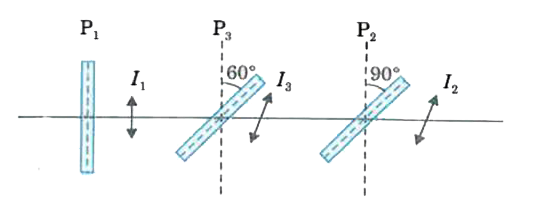
Let `I_1, I_2 and I_3` are the intensities of light after passing through `P_1, P_2 and P_3` respectively.
`I_1 = I_0//2`
`I_3 = I_1 cos^2 60^@ = ((I_0)/2)(1/4)`
`implies I_3 = I_0//8`
`I_2 = I_3 cos^2 30^@ = ((I_0)/8)(3/4)`
`implies I_2 = 3I_0//32`
Promotional Banner

Topper's Solved these Questions

  • WAVE OPTICAL

    MODERN PUBLICATION|Exercise PRACTICE PROBLEMS (1)|23 Videos
  • WAVE OPTICAL

    MODERN PUBLICATION|Exercise PRACTICE PROBLEMS (2)|10 Videos
  • SEMICONDUCTOR ELECTRONICS METERIALS DEVICES AND SIMPLE CIRCUITS

    MODERN PUBLICATION|Exercise CHAPTER PRACTICE TEST FOR BOARD EXAMINATION|12 Videos

Similar Questions

Explore conceptually related problems

Unpolarized light is intensity I_(0) passes through two polaroids P_(1) and P_(2) such that pass axis of P_(2) makes an angle theta with the pass axis of P_(1) . A third polaroid P_(3) is placed between P_(1) and P_(2) with pass axis of P_(3) making an angle beta with that of P_(1) . If I_(1), I_(2), I_(3) represent intensities of light trnasmitted by P_(1), P_(2), P_(3) , determine the values of angle theta and beta for which I_(1) = I_(2) = I_(3) .

(a) Using the phenomenon of polarization, show, how, transverse nature of light can be demonstrated. (b) Two polaroids P_(1) and P_(2) are placed with their pass axes perpendicular to each other. Unpolarised light of intensity 10 is incident on P1. A third polaroid P3 is kept in between P_(1) and P_(2) such that its pass axis makes an angle of 30^(@) with that of P_(1) . Determine the intensity transmitted through P_(1),P_(2) and P_(3) .

A narrow beam of unpolarised light of intensity I_(0) is incident on a polaroid P_(1) . The light transmitted by it is then incident on a second polaroid P_(2) with its pass axis making an angle of 60^(@) to the pass axis of P_(1) . Find intensity of light transmitted by P_(2) .

(a) Distinguish between unpolarized light and linearly polarized light. How does one get linearly polarised light with the help of a plaroid ? (b) A narrow beam of unpolarised light of intensity I_(0) is incident on a polaroid P_(1) . The light transmitted by it is then incident on a second polaroid P_(2) with its pass axis making angle of 60^(@) relative to the pass axis of P_(1) . Find the intensity of the light transmitted by P_(2) .

Two polaroids P_1 and P_2 are placed with their axis perpendicular to each other. Un-polarized light I_0 is incident on P_1 . A third polaroid P_3 is kept in between P_1 and P_2 such that its axis makes an angle 45^@ with that of P_1 . The intensity of transmitted light through P_2 is

