Home
Class 12
PHYSICS
Two slits are made on an opaque surface ...

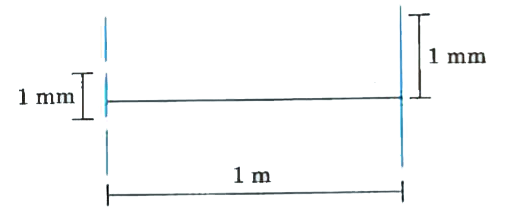
Two slits are made on an opaque surface at a separation of 1 mm from each other. A screen is placed at a distance 1 m from the plane of the slits. A small hole is made on the screen at a distance 1 mm from the centre of the screen as shown in the figure. If we observe the light coming out from hole on the other side, then which wavelengths in the visible region will be absent and which will show strong presence ? Wavelength of visible light ranges from 400 nm to 700 nm.

Text Solution

Verified by Experts

Path difference between two waves from slits reaching the hole can be written as follows :
`Delta x = (yd)/D = (1 xx 10^(-3) xx 1 xx 10^(-3))/(1) = 10^(-6)`
(A) Wavelengths interfering destructively at the location of hole will be absent from light coming out from hole.
Destructive interference `implies Delta x = (2n + 1) lambda//2`.
`(2n +1) lambda/2 = 10^(-6)`
By substituting minimum and maximum wavelengths of visible region in the above relation, we get corresponding maximum and minimum values of n and then we can find integers in this range of values.
`implies (2n_("min") + 1) xx 700 xx 10^(-9) = 2 xx 10^(-6)`
`implies 2n_("min") + 1 = 2.86`
`implies 2n_("min") = 1.86`
`implies n_("min") = 0.93`
Similarly we can proceed to get `n_("max")`
`implies (2n_("max") + 1) xx 400 xx 10^(-9) = 2 xx 10^(-6)`
`implies (2n_("max") + 1) = 5`
`implies n_("max") = 2 " " ......(1)`
Integers in the above-calculated range are `n = 1` and 2, corresponding wavelenghts can be calculated by substituting back in the same relation.
`(2n+1) lambda = 2 xx 10^(-6) implies (2 xx 1 + 1) lambda_1 = 2 xx 10^(-6) implies lambda_1 = 667 nm`
`(2n + 1) lambda = 2 xx 10^(-6) implies (2 xx 2 + 1) lambda_2 = 2 xx 10^(-6) implies lambda_2 = 400 nm`
The above-calculated two wavelengths will be absent from light coming out from the hole.
(B) Wavelengths interfering constructively at the location of the hole will be present strongly in the light coming out from the hole.
Constructive interference, `Deltax = n lambda`
`n lambda = 10^(-6)" "....(1)`
By substituting minimum and maximum wavelengths of visible region in the above relation, we get corresponding maximum and minimum values of n and then we can find intergers in this range of values.
`implies n_("min") xx 700 xx 10^(-9) = 1 xx 10^(-6)`
`implies n_("min") = 1.43`
Similarly we can proceed to get `n_("max")`
`implies n_("max") xx 400 xx 10^(-9) = 1 xx 10^(-6)`
`implies n_("max") = 2.5`
Only integer in the above calculated range is 2 and corresponding wavelength can be calculated by substituting back in the same relation.
`n lambda = 10^(-6) implies 2 lambda = 10^(-6) implies lambda = -500 nm`
Hence 500 nm wavelength will be strongly present in the light coming out from hole.
Promotional Banner

Topper's Solved these Questions

  • WAVE OPTICAL

    MODERN PUBLICATION|Exercise NCERT FILE SOLVED (TEXT BOOK EXERCISES)|10 Videos
  • WAVE OPTICAL

    MODERN PUBLICATION|Exercise NCERT FILE SOLVED (Additional Exercises)|11 Videos
  • WAVE OPTICAL

    MODERN PUBLICATION|Exercise Conceptual Questions|23 Videos
  • SEMICONDUCTOR ELECTRONICS METERIALS DEVICES AND SIMPLE CIRCUITS

    MODERN PUBLICATION|Exercise CHAPTER PRACTICE TEST FOR BOARD EXAMINATION|12 Videos
