Home
Class 12
PHYSICS
In Young's experiment the upper slit is ...

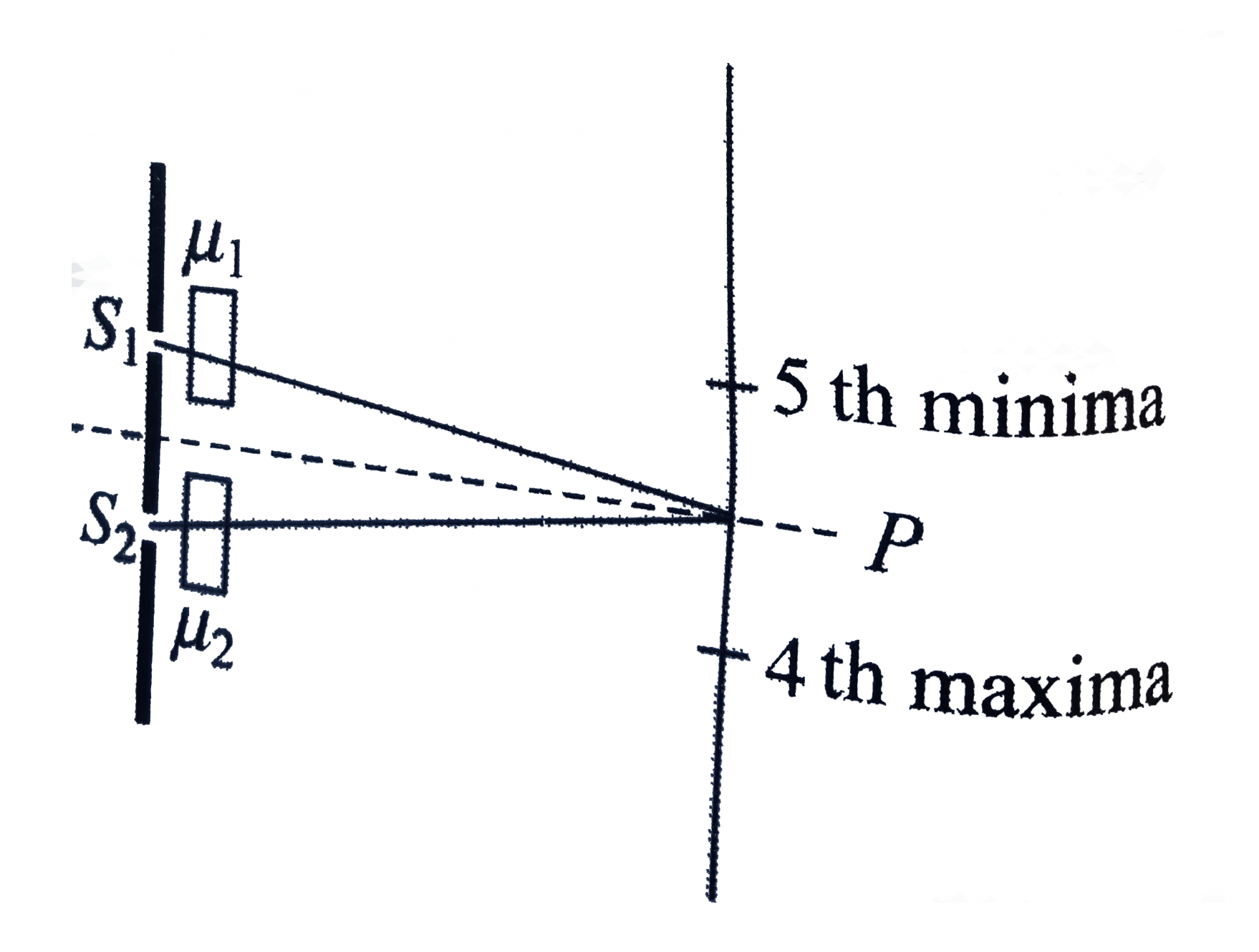
In Young's experiment the upper slit is covered by a thin glass plate of refractive index `1.4` while the lower slit is covered by another glass plate, having the same thickness as the first one but having refractive index `1.7` interference pattern is observed using light of wavelength `5400 Å`
It is found that point P on the screen where the central maximum `(n = 0)` fell before the glass plates were inserted now has `3//4` the original intensity. It is further observed that what used to be the fourth maximum earlier, lies below point P while the fifth minimum lies above P.
Calculate the thickness of glass plate. (Absorption of light by glass plate may be neglected.
.

Text Solution

Verified by Experts

For sources of equal intensities, we can write resultant intensity as follows :
`I = 4I_0 cos^2 (delta)/2`
without films, intensity at the centre is `4I_0`, but after the introduction of films, resultant intensity reduces to `3//4` of the value , hence we can write the following equation:
`3/4 (4I_0) = 4I_0 cos^2 (delta)/2`
`implies cos (delta)/(2) = (sqrt3)/(2)`
`implies delta/2 = pi/6`
`implies delta = pi/3`
We know that refractive index of lower slit is more and hence fringe pattern will be downwards. It is given that fifth maximum earlier has crossed centre and is there below the centre. And hence total phase difference introdcued at the centre due to introduction of film can be written as follow :
`phi = 10pi + pi//3`
`implies phi = 31pi//3 " " .....(i)`
Path difference introduced at the centre due to films can be written as follows:
`Deltax = (mu_2 - mu_1) t`
Corresponding phase difference can be written as follows :
`phi = (2pi)/lambda xx (mu_2 - mu_1) t`
We can substitute from equation (i) to write the following:
`phi = (2pi)/lambda xx (mu_2 - mu_1)t = (31pi)/3`
`implies t = 31/6 xx (lambda)/(mu_2 - mu_1)`
`implies t = 31/6 xx (5400 xx 10^(-10))/(1.7 - 1.4)`
`implies t = 31/6 xx (5400 xx 10^(-10))/(0.3)`
`implies t = 9.3 xx 10^(-0)m`.
Promotional Banner

Topper's Solved these Questions

  • WAVE OPTICAL

    MODERN PUBLICATION|Exercise NCERT FILE SOLVED (TEXT BOOK EXERCISES)|10 Videos
  • WAVE OPTICAL

    MODERN PUBLICATION|Exercise NCERT FILE SOLVED (Additional Exercises)|11 Videos
  • WAVE OPTICAL

    MODERN PUBLICATION|Exercise Conceptual Questions|23 Videos
  • SEMICONDUCTOR ELECTRONICS METERIALS DEVICES AND SIMPLE CIRCUITS

    MODERN PUBLICATION|Exercise CHAPTER PRACTICE TEST FOR BOARD EXAMINATION|12 Videos

Similar Questions

Explore conceptually related problems

In Young’s double slit experiment, the upper slit is covered by a thin glass plate of refractive index 1.4 while the lower slit is covered by another glass plate having same thickness as the first one but having refractive index 1.7. Interference pattern is observed using light of wavelength 5400overset(@)A . It is found that the point P on the screen where the central maximum fell before the glass plates were inserted, now has 3/ 4 the original intensity. It is also observed that what used to be 5^(th) maximum earlier, lies below the point P while the 6_(th) minimum lies above P. Calculate the thick- ness of glass plates. Absorption of light by glass plate may be neglected.

In a Young's experimenttje upper slit is covered by a thin glass plate of refractive index. 1.4 while the lower slit is covered with another glass plate, having the same thickness as the first one but having refravtive index 1.7. Interference pattern is observed using light of wavelength 5400Å. It is found that the point P on the sreen where the central where the central maximum (n=0) fell before the glass plates were inserted now has 3/4 the original intensity. It is further observed that what used to be the fifth maximum earlie, lies shown the point P while the sixth minimum lies above P. Calculate the thickness of glass plate. (Absorption of light by a glass may be neglected).

In a Young's experiment, the upper slit is covered by a thin glass plate of refractive index 1.4 while the lower slit is covered by another glass plate having the same thickness as the first ont but having refractive index 1.7. Interference pattern is observed using light of wavelength 5400 A. It is found that the point P on the screen where the central maximum fell berore the glass were inserted now has (3//4)^(th) the original intensity. It is further observed that what used to be the 5th maximum earlier, Iies below the point O while the 6th minimum lies above O. The thickness of the glass plate in nxx10^(-7)m. Find the value of n (Absorption of light by glass plate may by neglected)

In Young's double slit experiment, the fringes are displaced index 1.5 is introduced in the path of one of the beams. When this plate in replaced by another plate of the same thickness, the shift of fringes is (3//2)x . The refractive index of the second plate is

In Young's double slit experiment, the fringes are displaced by a distance x when a glass plate of one refractive index 1.5 is introduced in the path of one of the beams. When this plate in replaced by another plate of the same thickness, the shift of fringes is (3/2)x. The refractive index of the second plate is

In double slit experiment fringes are obtained using light of wavelength 4800 Å One slit is covered with a thin glass film of refractive index. 1.4 and another slit is covered by a film of same thickness but refractive index 1.7 . By doing so, the central fringe is shifted to fifth bright fringe in the original pattern. The thickness of glass film is

In Young's double slit experiment, one slit is covered with red filter and another slit is covered by green filter, then interference pattern will be

