Home
Class 12
PHYSICS
Two coherent point sources S(1) and S(2)...

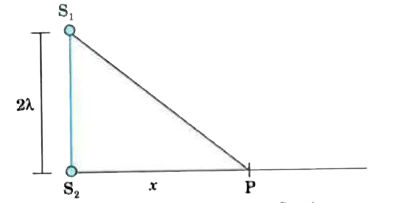
Two coherent point sources `S_(1)` and `S_(2)` vibrating in phase emit light of wavelength `lambda`. The separation between the sources is `2lambda`. Consider a line passing through `S_(2)` and perpendicular to line `S_(1) S_(2)`. Find the position of farthest and nearest minima.
.

Text Solution

Verified by Experts


Visualise a point just close to `S_2`. At this point, path difference between two waves would be `2 lambda` and hence there will be constructive interference at this point. When we move further on line, then path difference between waves decreases. At a point where path difference reduces to `3lambda//2`, destructive interference takes place and this is nearest minima. And if we go on moving on the same line, then at a point path difference will reduce to `lambda//2` and so destructive interference will take place at this point. This is farthest minima on this line.
Let there be a point P on the line at a distance x from `S_2` , then path diffrence at this point can be written as follows:
`Delta x = S_1P - S_2P`
`Dleta x = sqrt(x^2 + 4 lambda^2) - x`
1. Nearest minima
`Deltax = sqrt(x^2 + 4 lambda^2) - x = (3 lambda)/2`
`implies sqrt(x^2 + 4 lambda^2) = (3lambda)/(2) + x`
`implies x^2 + 4lambda^2 = (9 lambda^2)/(4) + x^2 + 3 lambda x`
`implies 3 lambdax = 4 lambda^2 - (9 lambda^2)/(4)`
`implies 3x = 4lambda - (9 lambda)/4`
`implies 3x = (7 lambda)/4`
`implies x = ( 7lambda)/12`
2. Farthest minima
`Dletax = sqrt(x^2 + 4 lambda^2) - x = lambda/2`
`implies sqrt(x^2 + 4lambda^2) = lambda/2 + x`
`implies x^2 + 4lambda^2 = (lambda^2)/4 + x^2 + lambdax`
`implies 4 lambda^2 = (lambda^2)/4 + lambda x`
`implies x = 4 lambda - lambda/4`
`implies x = (15 lambda)/4`.
Promotional Banner

Topper's Solved these Questions

  • WAVE OPTICAL

    MODERN PUBLICATION|Exercise Revision Exercises (Very Short Answer Questions)|51 Videos
  • WAVE OPTICAL

    MODERN PUBLICATION|Exercise Revision Exercises (Additional Questions)|12 Videos
  • WAVE OPTICAL

    MODERN PUBLICATION|Exercise NCERT (Exemplar Problems Subjective Questions) (Short Answer Type Questions)|3 Videos
  • SEMICONDUCTOR ELECTRONICS METERIALS DEVICES AND SIMPLE CIRCUITS

    MODERN PUBLICATION|Exercise CHAPTER PRACTICE TEST FOR BOARD EXAMINATION|12 Videos

Similar Questions

Explore conceptually related problems

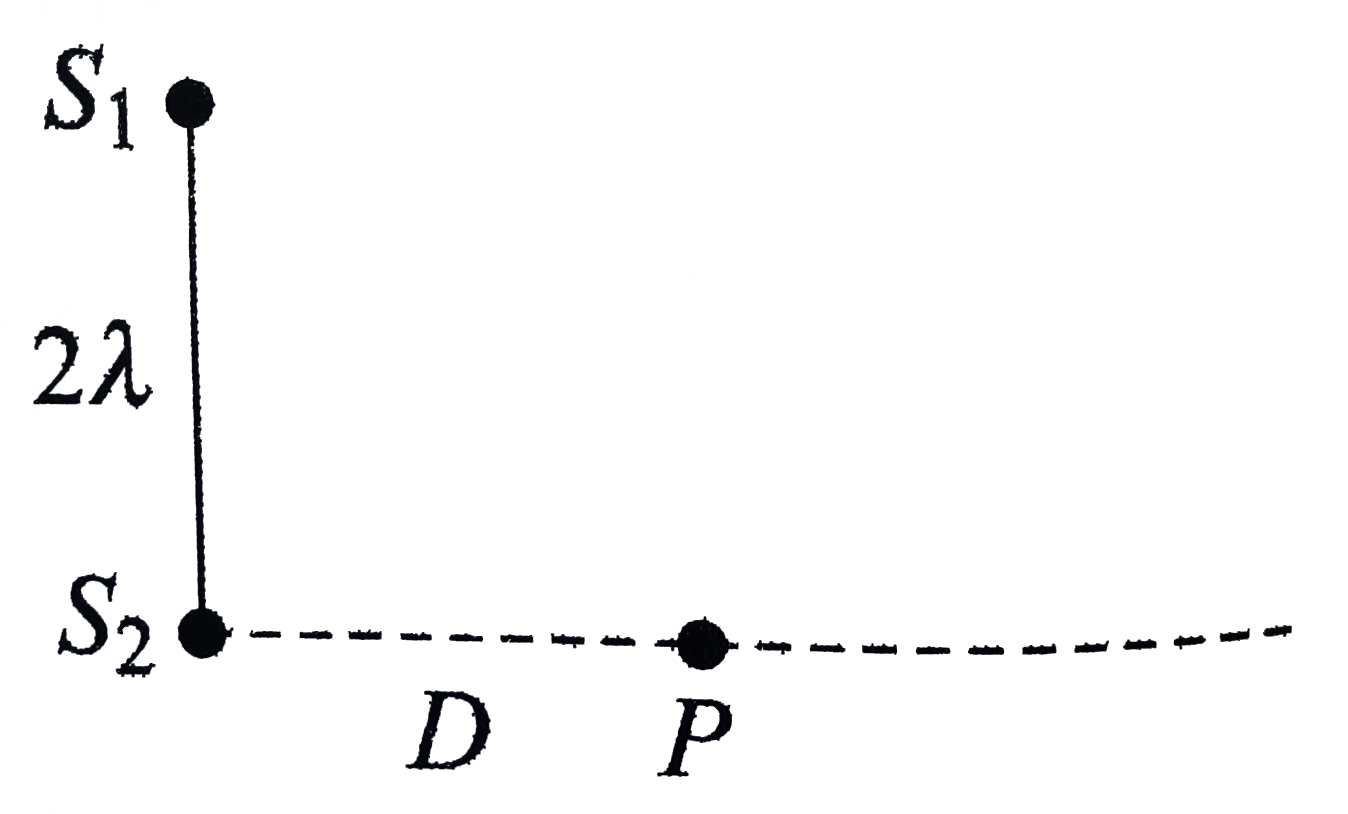
Two coherent point source S_(1) and S_(2) vibrating in phase emit light of wavelength lambda . The separation between them is 2 lambda as shown in figure. The first bright fringe is formed at 'P' due to interference on a screen placed at distance 'D' from S_(1)(Dgtgtlambda) , then OP is 1) sqrt(3)D , 2) 1.5D , 3) sqrt(2)D , 4) 2D

Two coherent point sources S_1 and S_2 vibrating in phase emit light of wavelength lamda . The separation between them is 2lamda . The light is collected on a screen placed at a distance Dgt gt lamda from the slit S_1 as shown. The minimum distance, so that intensity at P is equal to the intensity at O

Two identical light sources S_1 and S_2 emit light of same wavelength lambda . These light rays will exhibit interference if

Figure shows two coherent sources S_(1) and S_(2) which emit sound of wavelength lambda in phase. The separation between the sources is 3lambda. A circular wire of large radius is placed in such a way that S_(1)S_(2) lies in its plane and the middle point of S_(1)S_(2) is at the centre of the wire. Find the angular positions theta, on the wire for which constructive interference takes place.

Two monochromatic coherent point sources S_(1) and S_(2) are separated by a distance L. Each sources emits light of wavelength lambda , where L gt gt lambda . The line S_(1) S_(2) when extended meets a screen perpendicular to it at point A. Then

The two coherent sources of monochromatic light of wavelength lambda are located at a separation lambda . The two sources are placed on a horizontal line and screen is placed perpendicular to the line joining the sources. Find position of the farthest minima from the centre of the sources.

Two coherent sources emit light of wavelength lambda . Separation between them, d = 4 lambda . If a detector moves along the y-axis, what is the maximum number of minima observed?