Home
Class 12
PHYSICS
In a Young's double slit experiment, the...

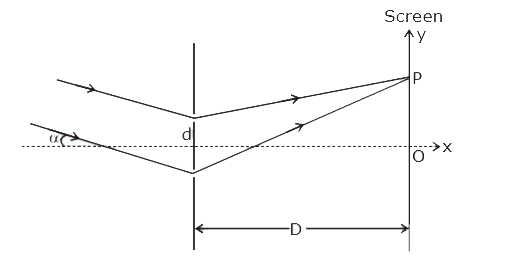
In a Young's double slit experiment, the slit separation d is 0.3 mm and the screen distance D is 1 m. A parallel beam of light of wavelength 600 nm is incident on the slits at angle  as shown in figure. On the screen, the point O is equidistant from the slits and distance PO is 11.0 mm. Which of the following statement(s) is/are correct ?

A

For `alpha = (0.36)/pi` degree, there will be destructive interference at point O.

B

Fringe spacing depends on `alpha`

C

For `alpha = (0.36)/pi` degree, there will be destructive interference at point P.

D

For `alpha = theta` there will be constructive interference at point P.

Text Solution

Verified by Experts

The correct Answer is:

C

Option (a)
Angle, `alpha = (0.36)/180 = 2 xx 10^(-3)` rad
For rays at an angle `alpha`, path difference can be written as follows:
`Delta H = d sin alpha`
Here angle `alpha` is very small hence,
`Delta x = d alpha = (3 xx 10^(-4)) (2 xx 10^(-3)) = 6 xx 10^(-7)m`
`Deltax = nlambda implies 6 xx 10^(-7) = n xx 6 xx 10^(-7) implies n = 1`
Hence constructive interfernece will take place at O. Hence option (a) is wrong.
Option (b)
Fringe width is given by `beta = (lambda D)/(d)` , hence it is independent of `alpha`. So option (b) is wrong.
Option (c )
Path difference at point P is given by :
`Delta x_P = d alpha + (y d)/D = d(alpha + y/D)`
`Delta x_P = (3 xx 10^(-4))(2 xx 10^(-3) + 11 xx 10^(-3)) = 39 xx 10^(-7)m`
`Delta x_P = n lambda implies 39 xx 10^(7) = n xx 6 xx 10^(-7) implies n = 6.5`
Hence destructive interference will take place at P hence option (c ) is correct.
Option (d)
When `alpha = 0` then path difference at P is given by
`Delta x_P = (dy)/D`
`Delta x_P = (3 xx 10^(-4)) (11 xx 10^(-3))//1 = 33 xx 10^(-7) m`
`Delta x_p = n lambda implies 33 xx 10^(-7) = n xx 6 xx 10^(-7) implies n = 5.5`
Hence destructive interference will take palce at P hence option (d) is wrong.
Promotional Banner

Topper's Solved these Questions

  • WAVE OPTICAL

    MODERN PUBLICATION|Exercise OBJECTIVE TYPE QUESTIONS (C. MULTIPLE CHOICE QUESTIONS)|14 Videos
  • WAVE OPTICAL

    MODERN PUBLICATION|Exercise OBJECTIVE TYPE QUESTIONS (D. MULTIPLE CHOICE QUESTIONS)|7 Videos
  • WAVE OPTICAL

    MODERN PUBLICATION|Exercise OBJECTIVE TYPE QUESTIONS (JEE (MAIN) & OTHER STATE BOARDS FOR ENGINEERING ENTRANCE)|22 Videos
  • SEMICONDUCTOR ELECTRONICS METERIALS DEVICES AND SIMPLE CIRCUITS

    MODERN PUBLICATION|Exercise CHAPTER PRACTICE TEST FOR BOARD EXAMINATION|12 Videos

Similar Questions

Explore conceptually related problems

In a Young's double slit experiment, the slit separation is 1mm and the screen is 1m from the slit. For a monochromatic light of wavelength 500nm , the distance of 3rd minima from the central maxima is

In Young's double slit experiment, slit separation is 0.6 mm and the separation between slit and screen is 1.2m . The angular width is (the wavelength of light used is 4800Å )

In Young's double-slit experiment, the slit separation is 0.5 mm and the screen is 0.5 m away from the slit. For a monochromatic light of wavelength 500 nm, the distance of 3rd maxima from the 2nd minima on the other side of central maxima is

In a Young’s double slit experiment, the slit separation is 0.2 cm , the distance between the screen and slit is 1 m . Wavelength of the light used is 5000 Å . The distance between two consecutive dark fringes (in mm ) is

A Young's double slit experiment is conducted with slit separation 10mm, where the screen is 2m away from the slits. If wavelength of light used is 6000 Å , answer the following Fringe width in mm is

In the Young's double slit experiment, the spacing between two slits is 0.1mm . If the screen is kept at a distance of 1.0m from the slits and the wavelength of ligth is 5000Å , then the fringe width is
