Home
Class 12
PHYSICS
There is a parallel beam of light of lar...

There is a parallel beam of light of larger aperture . Let I be the intensity of light . Perfectly reflecting sphere of radius r is kept in the path of this parallel beam . Find the force exerted by the light beam on sphere .

Text Solution

Verified by Experts
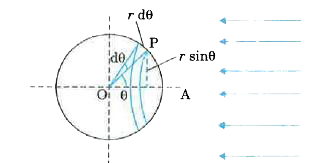
Let us select a reference line OA opposite to the direction of incident beam. Here O is centre of the sphere .

Let us select a radius OP of sphere at an angle `theta` with the reference line OA . Rotate this radius OP around OA to get a circle on sphere . Now increase this angle to `theta+dtetha` and again rotate OP about OA to get one more circle. Radius of this circular ring segment is `r sin tetha` .
Total are of this ring segment will be `2pi (r sin theta) ("rd"theta) = 2pir ^2 sin theta d theta.`
It we select some are `DeltaA` , then corresponding linear momentum falling on the same surface will be `DeltaU//c` . Light will be reflected at the smae angle with the normal and hence change in linear momentum can be written as follows :
`Deltap//Deltat=(2//c)I DeltaA cos^2theta`
The above expression is basically for the force acting on `DeltaA` portion of ring segment . This force acts perpendicular to the surface of the ring. And from symmetry , we can understand that components perpendicular to OA will be canalled and these along OA will be added, hence contribution of this force to the total force will be just component perpendicular to beam and can be written as follows :
`(Deltap//Deltat)costheta=(2//c)IDeltaA cos^3theta`
Now we can replace `DeltaA` with the total area of ring segment to get the force exerted on selected ring segment.
`dF=(2//c)I(2pir^2sintheta"d"theta)cos^3theta`
We can calculate total force on sphere by integrating the above relation for `theta = 0^@ " to" 90^@` because light is falling on the front portion of the sphere.
`F=(4pir^2I)/cint_0^(pi//2)cos^2theta(sintheta"d"theta)`
`F=(4pir^2I)/cint_0^(pi//2)cos^2theta(sintheta"d"theta)" "...(i)`
Let `t =costhetaimpliesdt=-sin theta"d"theta`
Substituting above values in equation (i) , we get the following :
`F=(4pir^2I)/c[(t^3)/4]_1^0`
`impliesF=(pir^2I)/c`
Promotional Banner

Topper's Solved these Questions

  • DUAL NATURE OF RADIATION AND MATTER

    MODERN PUBLICATION|Exercise Revision Exercises (Very Short Answer Questions)|45 Videos
  • DUAL NATURE OF RADIATION AND MATTER

    MODERN PUBLICATION|Exercise Revision Exercises (Additional Questions)|8 Videos
  • DUAL NATURE OF RADIATION AND MATTER

    MODERN PUBLICATION|Exercise NCERT FILE (NCERT - Exemplar Problems - Subjective Questions (Short Answer Type Questions))|6 Videos
  • CURRENT ELECTRICITY

    MODERN PUBLICATION|Exercise Chapter Practice Test|15 Videos
  • ELECTRIC CHARGES AND FIELDS

    MODERN PUBLICATION|Exercise Chapter Practice Test|15 Videos

Similar Questions

Explore conceptually related problems

A sphere of radius 1.00 cm is placed in the path of a parallel beam of light of large aperture. The intensity of the light is 0.50 W cm^-2 . If the sphere completely absorbs the radiation falling on it, find the force exerted by the light beam on the sphere.

Force Exerted By A Light Beam On A Surface

Figure2.25 shows a cone of radius R and height H with perfectly reflecting lateral surface, is placed in the path of a light beam of intensity I. Find the force exerted on this cone.

A perfectly reflecting solid hemisphere of radius R is placed in the path of a parallel beam of light of large aperture. If the beam carrries an intensity l, find the force exerted by the beam on the hemisphere.

In the path of a uniform light beam of large cross-sectional area and intensity I. a solid sphere of redius R which is perfectly reflecting is placed . Find the force exerted on this sphere due to the light beam.

A parallel beam of light falls on a solid tranparent sphere. Q. Which is corret?

If a parallel beam of light having intensity I is incident normally on a perfectly reflecting surface, the force exerted on the surface, equal F. When the surface is held at an angle theta , the force is

A planar source emits a parallel beam of light of power 20 W.Wavelength of light is 600 nm and is incident on a perfectly absorbing surface. Find the number of photons absorbed by the surface per second and the total force exerted on the surface .

