Home
Class 12
PHYSICS
Photoelectric effect experiments are per...

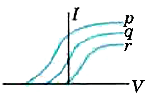
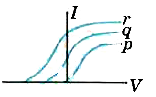
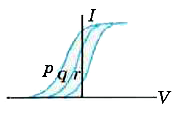
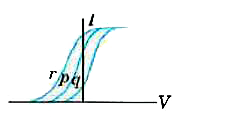
Photoelectric effect experiments are performed using three different metal plates p,q and r having work functions `phi_p=2.0eV,and `phi_q=2.5eV `and `phi_(tau) `= 3eV` and wavelengths of 550 nm,550nm, and 350 nm with equal intensities , illuminates each of the plates . The correct I - V graph for the experiment is (Take hc = 1240 eV nm)

A

B

C

D

Text Solution

AI Generated Solution

The correct Answer is:

To solve the problem regarding the photoelectric effect experiments with three different metal plates (P, Q, and R), we need to analyze the given data and apply the principles of the photoelectric effect. Here's a step-by-step solution: ### Step 1: Understand the Work Functions and Wavelengths We have three metal plates with the following work functions: - Plate P: \( \phi_p = 2.0 \, \text{eV} \) - Plate Q: \( \phi_q = 2.5 \, \text{eV} \) - Plate R: \( \phi_r = 3.0 \, \text{eV} \) The wavelengths of light illuminating these plates are: - Plate P: \( \lambda_p = 550 \, \text{nm} \) - Plate Q: \( \lambda_q = 550 \, \text{nm} \) - Plate R: \( \lambda_r = 350 \, \text{nm} \) ### Step 2: Calculate the Energy of the Incident Photons Using the formula for the energy of a photon: \[ E = \frac{hc}{\lambda} \] where \( hc = 1240 \, \text{eV} \cdot \text{nm} \). **For Plate P and Q (550 nm):** \[ E_p = E_q = \frac{1240}{550} \approx 2.25 \, \text{eV} \] **For Plate R (350 nm):** \[ E_r = \frac{1240}{350} \approx 3.54 \, \text{eV} \] ### Step 3: Calculate the Maximum Kinetic Energy The maximum kinetic energy of the emitted electrons can be calculated using: \[ KE_{max} = E - \phi \] **For Plate P:** \[ KE_{max, P} = E_p - \phi_p = 2.25 - 2.0 = 0.25 \, \text{eV} \] **For Plate Q:** \[ KE_{max, Q} = E_q - \phi_q = 2.25 - 2.5 = -0.25 \, \text{eV} \quad (\text{no photoelectrons emitted}) \] **For Plate R:** \[ KE_{max, R} = E_r - \phi_r = 3.54 - 3.0 = 0.54 \, \text{eV} \] ### Step 4: Calculate the Stopping Potential The stopping potential \( V_0 \) can be calculated using: \[ V_0 = \frac{KE_{max}}{e} \] **For Plate P:** \[ V_{0,P} = 0.25 \, \text{V} \] **For Plate Q:** \[ V_{0,Q} = \text{no emission} \quad (V_{0,Q} = 0 \, \text{V}) \] **For Plate R:** \[ V_{0,R} = 0.54 \, \text{V} \] ### Step 5: Analyze the I-V Characteristics - For Plate P, we will have a stopping potential of \( 0.25 \, \text{V} \) and a current that saturates after reaching this potential. - For Plate Q, there will be no current since the energy of the incident photons is less than the work function. - For Plate R, the stopping potential is \( 0.54 \, \text{V} \), and it will also saturate at this value. ### Conclusion The I-V graph will show: - A current for Plate P that saturates at \( 0.25 \, \text{V} \). - No current for Plate Q. - A current for Plate R that saturates at \( 0.54 \, \text{V} \). Thus, the correct I-V graph will show: - A line for Plate P saturating at \( 0.25 \, \text{V} \). - A flat line for Plate Q (no current). - A line for Plate R saturating at \( 0.54 \, \text{V} \).

To solve the problem regarding the photoelectric effect experiments with three different metal plates (P, Q, and R), we need to analyze the given data and apply the principles of the photoelectric effect. Here's a step-by-step solution: ### Step 1: Understand the Work Functions and Wavelengths We have three metal plates with the following work functions: - Plate P: \( \phi_p = 2.0 \, \text{eV} \) - Plate Q: \( \phi_q = 2.5 \, \text{eV} \) - Plate R: \( \phi_r = 3.0 \, \text{eV} \) ...
Promotional Banner

Topper's Solved these Questions

  • DUAL NATURE OF RADIATION AND MATTER

    MODERN PUBLICATION|Exercise COMPETITION FILE (OBJECTIVE TYPE QUESTIONS ( C - Multiple Choice Questions) )|8 Videos
  • DUAL NATURE OF RADIATION AND MATTER

    MODERN PUBLICATION|Exercise COMPETITION FILE (OBJECTIVE TYPE QUESTIONS ( D - Multiple Choice Questions) )|5 Videos
  • DUAL NATURE OF RADIATION AND MATTER

    MODERN PUBLICATION|Exercise COMPETITION FILE (OBJECTIVE TYPE QUESTIONS ( B - Multiple Choice Questions) (JEE (Main) & Other State Boards for Engineering entrance))|18 Videos
  • CURRENT ELECTRICITY

    MODERN PUBLICATION|Exercise Chapter Practice Test|15 Videos
  • ELECTRIC CHARGES AND FIELDS

    MODERN PUBLICATION|Exercise Chapter Practice Test|15 Videos

Similar Questions

Explore conceptually related problems

photoelectric affect experiments are performer using ther different medal plates p,q and r having work function phi_(p) = 2.0 eV, phi_(e) = 2.5 eV and phi_(r) = 3.0 eV respectively A light beam containing wavelength of 550nm , 450 nm and 350nm with equal intensities illuminates each of the plate . The correct 1 -V graph for the experiment is [Take hc = 1240 eV nm]

In a photoelectric effect experiment, the graph between the stopping potential (V) and frequency (v) of the incident radiations on two different metal plates P and Q are shown in plates, P and Q has greater value of work function ? (ii) What does the slope of the lines depict?

The graph between 1 //lambda and stopping potential ( V ) of three metals having work functions phi_(1) , phi_(2) and phi_(3) in an experiment of photoelectric effect is plotted as shwon in the figure. Which of the following statement (s) is // are correct ? [Here lambda is the wavelength of incident ray ].

If Photon having wavelength 6.2nm was allowed to strike a metal plate having work function 50eV then calculate wavelength associated with emitted electron :

Light of wavelength 350 nm falls on a metal having work function of 2eV. What is maximum possible magnitude of linear momentum of ejected electron ?

In a photo electric set up the radiation from Balmer series of hydrogen atoms are Incident on a metal of work function 2 eV. Find wavelength of incident radiations lying between 450 nm to 700 nm. Find the maximum kinetic energy of the photoelectron emitted (hc1242 eV nm).

A light beam of interest 3.01xx10^(-3) W m ^(-2) is incident normally on the square -sapped metal surface of side 1 cm and with work function 2 eV . The intensity of light is equal distributed among the three constituents' wavelength , 400 nm, 550 nm and 650 nm. Each photon emits one electron without any loss in the energy. Choose the correct option from the following regarding the photoelectric emission.

In a photoelectric effect experimetent, a metallic surface of work function 2.2 eV is illuminated with a light of wavelenght 400 nm. Assume that an electron makes two collisions before being emitted and in each collision 10% additional energy is lost. Q. Find the kinetic energy of this electron as it comes out of the metal.

MODERN PUBLICATION-DUAL NATURE OF RADIATION AND MATTER -COMPETITION FILE (OBJECTIVE TYPE QUESTIONS ( B - Multiple Choice Questions) (JEE (Advanced) for IIT Entrance))
  1. The fig. shows the variation of photon current with anode potential fo...

    Text Solution

    |

  2. The energy of a photon is equal to the kinetic energy of a proton. T...

    Text Solution

    |

  3. The potential difference applied to an X - ray tube is 5 kV and the cu...

    Text Solution

    |

  4. The wavelength associated with a golf ball weighing 200 g and moving a...

    Text Solution

    |

  5. Electrons with energy 80 keV are incident on the tungsten target of an...

    Text Solution

    |

  6. Which one of the following statement is WRONG in the context of X- ray...

    Text Solution

    |

  7. An alpha- particle and a proton are accelerated from rest by a potenti...

    Text Solution

    |

  8. Electrons with de-Broglie wavelength lambda fall on the target in an X...

    Text Solution

    |

  9. Photoelectric effect experiments are performed using three different m...

    Text Solution

    |

  10. Estimate the wavelength at which plasma reflection will occur for met...

    Text Solution

    |

  11. A silver of radius 1 cm and work function 4.7 eV is suspended from an ...

    Text Solution

    |

  12. In a historical experiment to determine Planck's constant, a metal sur...

    Text Solution

    |

  13. A metal surface is illuminated by light of two different wavelengths 2...

    Text Solution

    |

  14. A photelectric meterial having work-function phi(0) is illuminated wit...

    Text Solution

    |

  15. Light of wavelength lambda(ph)falls on a cathode plate inside a vacuum...

    Text Solution

    |
