Home
Class 12
PHYSICS
Light of wavelength lambda(ph)falls on a...

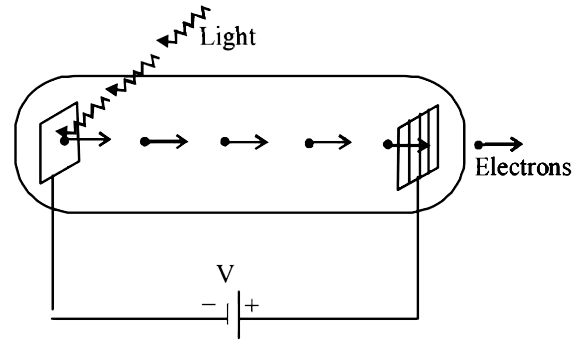
Light of wavelength `lambda_(ph)`falls on a cathode plate inside a vacuum tube as shown in the figure .The work function of the cathode surface is `phi` and the anode is a wire mesh of conducting material kept at distance d from the cathode. A potential different V is maintained between the electrodes. If the minimum de Broglie wavelength of the electrons passing through the anode is `lambda_(e) ` which of the following statement (s) is (are) true?

A

`lamda_e` decreases with increases in `phi and lamda_(ph)`

B

`lamda_e` is approximately halved if d is doubled

C

For large potential difference `(V gtgt phi//e),lamda_e` is approximately halved if V is made four times

D

`lamda_e` increases at the same rate as `lamda_(ph) ` for `lamda_(ph) lt hc //phi`

Text Solution

Verified by Experts

The correct Answer is:

C

Let m be the mass of electron and v be the speed of electron when it reaches anode. The de Broglie wavelength of electron can be written as follows :
`lamda_e=h/(mv)impliesm^2v^2=(h^2)/lamda_e^2implies1/2mv^2=h^2/(2mlamda_e^2)`
`implies` K.E. of electron on reaching anode `=h^2/(2mlamda_e^2)" "....(i)`
Kinetic energy of electron when emitted from cathode
`=(hc)/lamda_(ph)-phi`
K.E. is further increased due to work done by electric field.
`implies` K.E. of electron , on reaching anode
`=(hc)/lamda_(ph)-phi+eV" "...(ii)`
From (i) and (ii), we can write the following :
`h^2/(2mlamda_e^2)=(hc)/lamda_(ph) -phi+eV" "....(iii)`
From (iii) ,we can see that when `phi and lamda_(ph)` are increased then `lamda_e` also increases , hence option (a) wrong .
From (iii) we can see that `lamda_e` is independent of d, hence option (b) is wrong . When V is very large then `h^2/(2mlamda_e^2)~~eV` , hence when V is made 4 times, then `lamda_e` is approximately halved. So option (c) is correct.
From equation (iii) , we can understand that option (d) cannot be correct, hence only option (c) is correct in this equation.
Promotional Banner

Topper's Solved these Questions

  • DUAL NATURE OF RADIATION AND MATTER

    MODERN PUBLICATION|Exercise COMPETITION FILE (OBJECTIVE TYPE QUESTIONS ( C - Multiple Choice Questions) )|8 Videos
  • DUAL NATURE OF RADIATION AND MATTER

    MODERN PUBLICATION|Exercise COMPETITION FILE (OBJECTIVE TYPE QUESTIONS ( D - Multiple Choice Questions) )|5 Videos
  • DUAL NATURE OF RADIATION AND MATTER

    MODERN PUBLICATION|Exercise COMPETITION FILE (OBJECTIVE TYPE QUESTIONS ( B - Multiple Choice Questions) (JEE (Main) & Other State Boards for Engineering entrance))|18 Videos
  • CURRENT ELECTRICITY

    MODERN PUBLICATION|Exercise Chapter Practice Test|15 Videos
  • ELECTRIC CHARGES AND FIELDS

    MODERN PUBLICATION|Exercise Chapter Practice Test|15 Videos

Similar Questions

Explore conceptually related problems

Light of wavelength lambda_(ph) falls on a plate a vacum teke as shown in the figure .The work function of the conducting meterial kept at a distance d from the cathon A petential different V is maximum between the electrodes if the minimum de Brogle waveleeength of the electrons passing through the anode is lambda_(e) which of the following statement (s) is (are) true?

de-Broglie wavelength lambda is

If the potential difference between the anode and cathode of the X - ray tube is increases

An electron is accelerated through a potential difference of V volit .Find th e de Broglie wavelength associated with electron.

The potential difference between the cathode. And the target electrod in a coolidge tube is 24.75 kV. The minimum wavelength of the emitted X-rays is

The potential difference between the cathode and the target in a Collidge tube is 100 kV . The minimum wavelength of the X-rays emitted by the tube is

A proton and an electron are accelerated by the same potential difference, let lambda_(e) and lambda_(p) denote the de-Broglie wavelengths of the electron and the proton respectively

If the cathode-anode potential difference in an X-ray tube be 10 V then the maximum energy of X-ray photon can be

MODERN PUBLICATION-DUAL NATURE OF RADIATION AND MATTER -COMPETITION FILE (OBJECTIVE TYPE QUESTIONS ( B - Multiple Choice Questions) (JEE (Advanced) for IIT Entrance))
  1. The fig. shows the variation of photon current with anode potential fo...

    Text Solution

    |

  2. The energy of a photon is equal to the kinetic energy of a proton. T...

    Text Solution

    |

  3. The potential difference applied to an X - ray tube is 5 kV and the cu...

    Text Solution

    |

  4. The wavelength associated with a golf ball weighing 200 g and moving a...

    Text Solution

    |

  5. Electrons with energy 80 keV are incident on the tungsten target of an...

    Text Solution

    |

  6. Which one of the following statement is WRONG in the context of X- ray...

    Text Solution

    |

  7. An alpha- particle and a proton are accelerated from rest by a potenti...

    Text Solution

    |

  8. Electrons with de-Broglie wavelength lambda fall on the target in an X...

    Text Solution

    |

  9. Photoelectric effect experiments are performed using three different m...

    Text Solution

    |

  10. Estimate the wavelength at which plasma reflection will occur for met...

    Text Solution

    |

  11. A silver of radius 1 cm and work function 4.7 eV is suspended from an ...

    Text Solution

    |

  12. In a historical experiment to determine Planck's constant, a metal sur...

    Text Solution

    |

  13. A metal surface is illuminated by light of two different wavelengths 2...

    Text Solution

    |

  14. A photelectric meterial having work-function phi(0) is illuminated wit...

    Text Solution

    |

  15. Light of wavelength lambda(ph)falls on a cathode plate inside a vacuum...

    Text Solution

    |
