Home
Class 12
PHYSICS
Consider a radioactive nucleus A which d...

Consider a radioactive nucleus A which decays to a stable nucleus C through the following sequence
`A to B to C`
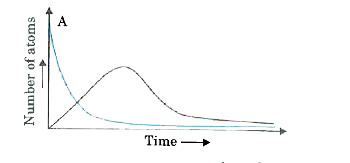
Here B is an intermediate nuclei which is also radioactive. Considering that there are `N_(0)` atoms of A initially , plot the praph showing the variation of number of atoms of A and B versus time.

Text Solution

Verified by Experts
Given that the radioactive decay of A to form the stable nucleus C is through the sequence
`A to B to C`
At t = 0,`N_(A)=N_(0)` and `N_(B)=0`. As time increases, `N_(A)` falls off exponentially, the number of atoms of B increases, becomes maximum and finally decay to zero at infinity as shown in the following figure:
Promotional Banner

Topper's Solved these Questions

  • NUCLEI

    MODERN PUBLICATION|Exercise HIGH ORDER THINKING SKILLS & ADVANCED LEVEL|9 Videos
  • NUCLEI

    MODERN PUBLICATION|Exercise REVISION EXERCISES (VERY SHORT ANSWER QUESTIONS)|47 Videos
  • NUCLEI

    MODERN PUBLICATION|Exercise NCERT FILE SOLVED (NCERT EXEMPLAR PROBLEMS SUBJECTIVE QUESTIONS) (VERY SHORT ANSWER TYPE QUESTIONS)|5 Videos
  • MOVING CHARGES AND MAGNETISM

    MODERN PUBLICATION|Exercise CHAPTER PRACTICE TEST|13 Videos
  • RAY OPTICS AND OPTICAL INSTRUMENTS

    MODERN PUBLICATION|Exercise CHAPTER PRACTICE TEST|14 Videos

Similar Questions

Explore conceptually related problems

A radioactive nucleus X undergoes spontaneous decay in the sequence z X to z-1 B to z-3 C to z-2 D, where Z is the atomic number of element Z. The possible decay particles in the sequence are:

Which type of radioactive decay produces a daughter nucleus with a higher atomic number?

A radioactive nucleus A with a half life T, decays into a nucleus B. At t = 0, there is no nucleus B. At sometime t, the ratio of the number of B to that of A is 0.3. Then, t is given by :

A sample of a radioactive nucleus A disintegrates to another radioactive nucleus B, which in turn disintegrates to some other stable nucleus C. Plot of a graph showing the variation of number of atoms of nucleus B vesus time is : (Assume that at t = 0, there are no B atoms in the sample)

A radioactive isotope X decays into a stable nucleus Y. Draw graphs showing the variation of rate of formation of Y versus time and the variation of population of Y versus time. Initial population of Y is zero.

A radioactive nucleus A with a half life T, decays into nucleus B. At t=0, there is no nucleus B. At somewhat t, the ratio of the number of B to that of A is 0.3 . Then, t is given by

