Home
Class 12
PHYSICS
Variation of radiant energy emitted by s...

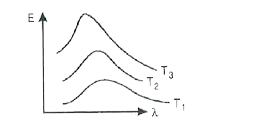
Variation of radiant energy emitted by sun, filament of tungsten lamp and welding arc as a function of its wavelength is shown in fig :

A

Sun- `T_(1)`, tungsten filament `T_(2)`, welding arc- `T_(3)`

B

Sun- `T_(2)`, tungsten filament - `T_(1)`, welding arc - `T_(3)`

C

Sun- `T_(3)`, tungsten filament- `T_(1)`, welding arc- `T_(2)`

D

Sun- `T_(1)`, tungsten filament - `T_(3)` welding arc- `T_(2)`.

Text Solution

Verified by Experts

The correct Answer is:

C

Here `lamda_(m_(3))ltlamda_(m_(2))ltlamda_(m_(1))`
`:.T_(m_(3))gtT_(2)gtT_(1)" As "lamda_(m).T=` constant.
Correct choice is (c ).
Promotional Banner

Topper's Solved these Questions

  • TRANSFERENCE OF HEAT

    MODERN PUBLICATION|Exercise Multiple Choice Questions (Level - II)|49 Videos
  • TRANSFERENCE OF HEAT

    MODERN PUBLICATION|Exercise Multiple Choice Questions (Level - III) Questions From AIEEE/JEE Examination)|5 Videos
  • SOLIDS & SEMICONDUCTOR DEVICES

    MODERN PUBLICATION|Exercise Revision Test|28 Videos
  • UNIFORM CIRCULAR MOTION

    MODERN PUBLICATION|Exercise Revision Test |57 Videos

Similar Questions

Explore conceptually related problems

Hydrogen atom in its ground state is excited by means of a monochromatic radiation of wavelength 970.6 Å. How many different transitions are possible in the resulting emission spectrum? Find the longest wavelength amongst these. (lonisation energy of hydrogen atom in its ground state is 13.6 eV and take h=6.6xx10^(-34)Js) Data : Wavelength of incident radiation = 970.6 Å = 970.6 X 10^(-10)m Ionisation energy of hydrogen atom in its ground state = 13.6 eV (i) Number of possible transitions = ? (ii) Longest wavelength emitted = ?

when a certain energy is applied to an hydrogen atom, an electron jumps from n =1 to n = 3 state. Find (i) the energy absorbed by the electron. (ii) wavelength of radiation emitted when the electron jump back to its initial state. ( Energy of electron in first orbit = - 13.6 eV , Planck's constant = 6.6225 xx10^(-34) Js, Charge on electron = 1.6 xx10^(-19) C, speed of light in vacuum = 3xx10^(8)ms^(-1)

For a metal the maximum wavelength required for photoelectron emission is 340 nm, find the work function. If the radiation of wavelength 250 nm falls on the surface of the given metal. Find the maximum kinetic energy of emitted photo electrons in eV. Given Planck's constant = 6.625 xx 10^(-34) Js , velocity of light in vacuum is 3 xx 10^(8)ms^(-1) .

5% of the energy supplied to a lamp is radiated as a visible light. How many quanta of light are emitted per second by 100 watt lamp ? Assume the average wavelength of visible light at 555 nm

X-rays fall on a photosensitive surface to cause photoelectric emission. Assuming that the work function of the surface can be neglected, find the relation between the de-Broglie wavelength ( lambda ) of the electrons emitted to the energy ( E_(v) ) of the incident photons. Draw the nature of the graph for lambda as a function of E_(v) .
