Home
Class 12
PHYSICS
A , B and C are the three identical cond...

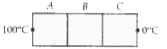
A , B and C are the three identical conductors but made from different materials . They are kept in contact as shown . Their thermal conductivities are K , 2K and `(K)/(2)` . The free end of A is at `100^(@) C` and the free end of C is at `0^(@)C` . During steady state , the temperature of the junction of A and B is nearly .... `""^(@) C` .

A

`37^(@)C`

B

`71^(@)C`

C

`29^(@)C`

D

`63^(@)C`.

Text Solution

Verified by Experts

The correct Answer is:

B

Let R be the thermal conductivity of conductor, then thermal conductivity of conductor `B=(R )/(2)` and thermal conductivity of conductor `C=2R`.

`:.` Heat current, `H=(100^(@)-0^(@))/(R+(R)/(2)+2R)=(200)/(7R)`
If T. be the temperature of the junction of A and B, then
`H=(100-T.)/(R)` or `(200)/(7R)=(100-T.)/(R)`
or `T.=(500)/(7)=71^(@)C`.
So, correct choice is (b).
Promotional Banner

Topper's Solved these Questions

  • TRANSFERENCE OF HEAT

    MODERN PUBLICATION|Exercise Multiple Choice Questions (Level - III) Questions From AIEEE/JEE Examination)|5 Videos
  • SOLIDS & SEMICONDUCTOR DEVICES

    MODERN PUBLICATION|Exercise Revision Test|28 Videos
  • UNIFORM CIRCULAR MOTION

    MODERN PUBLICATION|Exercise Revision Test |57 Videos

Similar Questions

Explore conceptually related problems

A slab consists of two parallel layers of copper and brass of same thickness and having thermal conductivies in the ratio 4:1 . If the free face of brass is at 100^(@)C and that of copper of 0^(@)C , the temperature of interface is

Two identical rods AC and CB made of two different metals having thermal conductivities in the ratio 2 : 3 are kept in contact with each other at the end C as shown in the figure.A is at 100^(@)C and B is at 25^(@) C.Then the junction C is at

The temperature of a steel rod is 330K. Its temperature in 0^@ C is

Three rods of same dimensions are arranged as shown in the figure. They have thermal conductivities K_(1) , K_(2) and K_(3) . The points A and B are maintained at different temperatures. For the heat to flow at the same rate along ACB and AB,

