

Home
Class 11
PHYSICS
Two point masses of 3.0kg and 1.0kg are ...

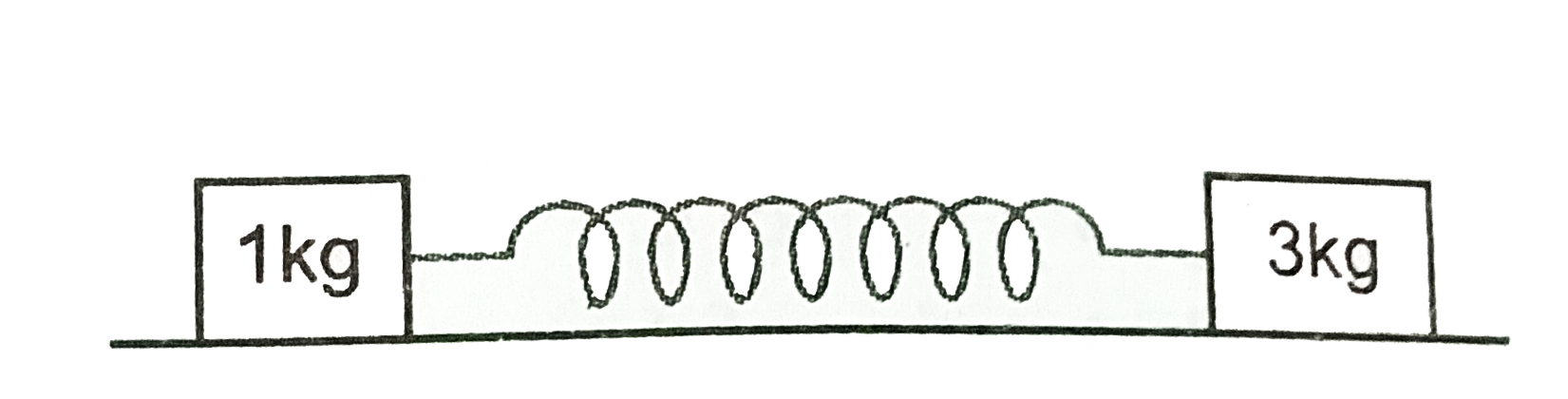
Two point masses of `3.0kg` and `1.0kg` are attached to opposite ends of a horizontal spring whose spring constant is `3Nm^(-1)` as shown in figure . The natural frequency of vibration so this system is `n//piHz`. Find the integral value of `n`.

Promotional Banner

Similar Questions

Explore conceptually related problems

Two point masses of 3.0 kg and 1.0 kg are attached to opposite ends of a horizontal spring whose spring constant is 300 N m^(-1) as shown in the figure. The natural vibration frequency of the system is of the order of :

Two point masses of 3.0 kg and 1.0 kg are attached to opposite ends of a horizontal spring whose spring constant is 300 N m^(-1) as shown in the figure. The natural vibration frequency of the system is of the order of :

Two point masses of 3.0 kg and 1.0 kg are attached to opposite ends of a horizontal spring whose spring constant is 300Nm^(-1) as shown in the figure. The natural vibration frequency of the system is of the order of :

Two point masses of 3 kg and 6 kg are attached to opposite ends of horizontal spring whose spring constant is 300 Nm^(-1) as shown in the figure. The natural vibration frequency of the system is approximately

Two point masses of 3 kg and 6 kg are attached to opposite ends of horizontal spring whose spring constant is 300 Nm^(-1) as shown in the figure. The natural vibration frequency of the system is approximately

If a mass of 2.0 kg is attached to one end of a spring and the spring has a spring constant 1500Nm^(-1) , then calculate the maximum velocity and acceleration of the mass body for an amplitude 0.05 m .

Two blocks of masses 6 kg and 3 kg are attached to the two ends of a massless spring of spring constant 2 pi^(2) N//m . If spring is compressed and released on a smooth horizontal surface then find the time period (in seconds) of each block.

Two blocks of masses 6 kg and 3 kg are attached to the two ends of a massless spring of spring constant 2 pi^(2) N//m . If spring is compressed and released on a smooth horizontal surface then find the time period (in seconds) of each block.

A body of mass 16 kg is made to oscillate on a spring of force constant 100 N kg^(-1) . Deduce the angular frequency.