

Home
Class 11
PHYSICS
A particle of mass m strikes elastically...

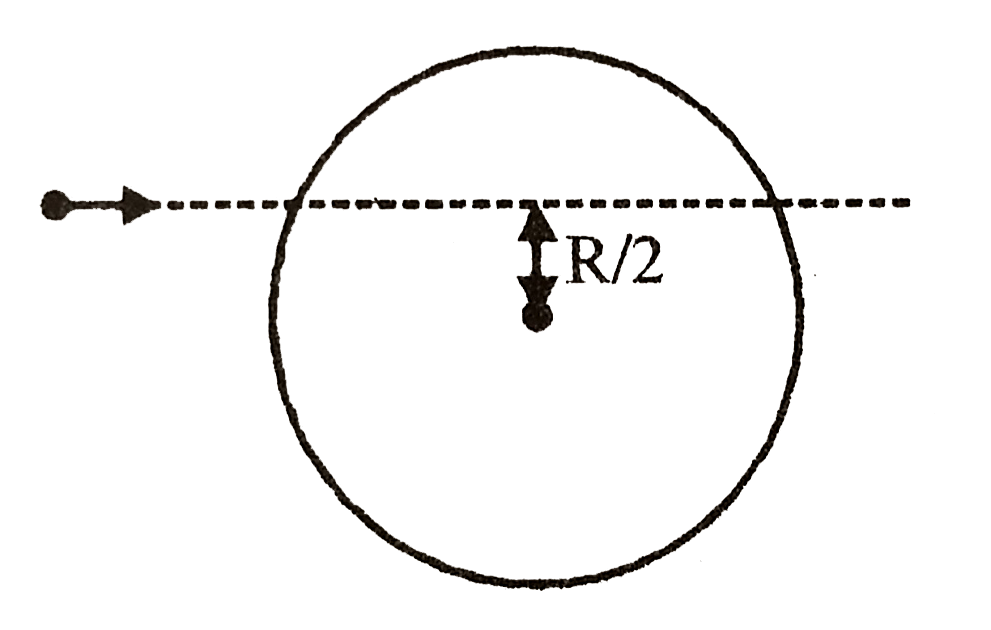
A particle of mass `m` strikes elastically with a disc of radius `R`, with a velocity `vec"v"` as shown in the figure. If the mass of the disc is equal to that of the particle and the surface of the contact is smooth, find the velocity of the disc just after the collision.

Promotional Banner

Similar Questions

Explore conceptually related problems

A particle of mass m strikes a disc of radius R and mass m with a speed u as shown in the figure. What is the speed of the particle just after the collision if the collision is perfectly inelastic ?

A particle of mass m strikes a disc of radius R and mass m with a speed u as shown in the figure. What is the speed of the particle just after the collision if the collision is perfectly inelastic ?

A particle of mass m_1 moves with velocity v_1 and collides with another particle at rest of equal mass. The velocity of the second particle after the elastic collision is

A disc of mass M and radius R moves in the x-y plane as shown in the figure. The angular momentum of the disc at the instant shown is –

A particle (a mud pallet, say) of mass m strikes a smooth stationary wedge of mass M with as velocity v_(0) at an angle theta with horizontal. If the collision is perfectly inelastic, find the a. velocity of the wedge just after the collision. b. Chane in KE of the system (M+m) in collision.

A particle (a mud pallet, say) of mass m strikes a smooth stationary wedge of mass M with as velocity v_(0) at an angle theta with horizontal. If the collision is perfectly inelastic, find the a. velocity of the wedge just after the collision. b. Change in KE of the system (M+m) in collision.

Three identical discs A, B, and C (figure) rest on a smooth horizontal plane. The disc A is set in motion with vector v after which it experiences an elastic collision simultaneously with the discs B and C. The distance between the centres of the latter discs prior of the collision is eta times greater than the diameter of each disc. Find the velocity of the disc A after the collision. At what value of eta will the disc A recoil after the collision, stop, move on?

A small disc and a thin uniform rod of length l, whose mass is eta times greater than the mass of the disc, lie on a smooth horizontal plane. The disc is set in motion, in horiozontal direction and perpendicular to the rod, with velocity v, after which it elastically collides with the end of the rod. Find the velocity of the disc and the angular velocity of the rod after the collision. At what value of eta will the velocity of the disc after the collision be equal to zero? reverse its direction?