

Home
Class 12
PHYSICS
Two block of A and B of mass 1kg and 2kg...

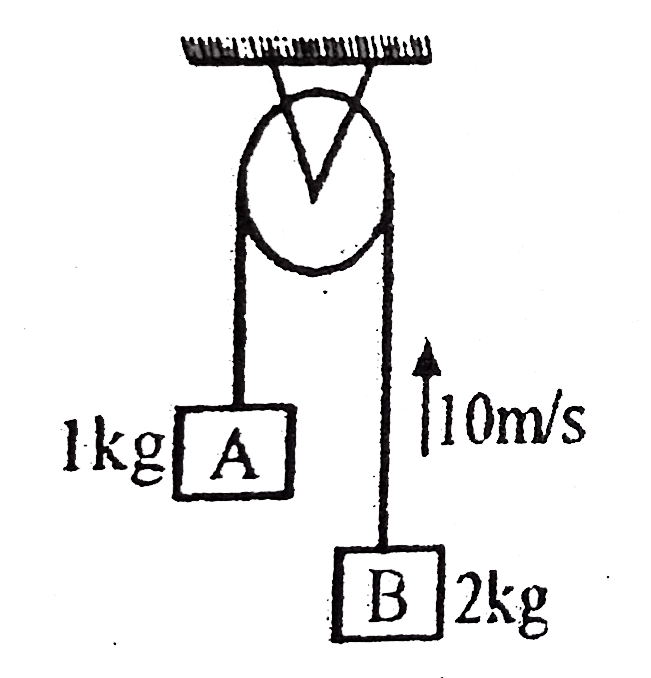
Two block of A and B of mass 1kg and 2kg are hung from light pulley. Initially the block B is held stationary. At `t=0` block B is given velocity 10m//s in upward direction. String and pulley are light and there is no friction anywhere.

Total mechanical energy lost when the string becomes taut is

Promotional Banner

Similar Questions

Explore conceptually related problems

Two block of A and B of mass 1kg and 2kg are hung from light pulley. Initially the block B is held stationary. At t=0 block B is given velocity 10m//s in upward direction. String and pulley are light and there is no friction anywhere. Time till which acceleration (magnitude and direction both) of the two block ramains same

Two block of A and B of mass 1kg and 2kg are hung from light pulley. Initially the block B is held stationary. At t=0 block B is given velocity 10m//s in upward direction. String and pulley are light and there is no friction anywhere. Velocity of block 'B' as block 'A' has acended by distance 5m from its original position

Two blocks A and B , each of mass 10 kg , are connected by a light string passing over a smooth pulley as shown in the figure. Block A will remain at rest if the friction on it is

Two block A and B of masses 1kg and 2kg respectively are connected by a string, passing over a light frictionless pulley B as shown. Another string connect the center of pulley. Both the blocks are resting on a horizontal floor and the pulley is help such that string remains just taut. At moment t = 0 , a force F = 20 t starts acting on the pully along vertically upwards direction as shown in figure.Calculate (a) velocity of A when B loses contact with the floor. (b) height raised by the pulley upto that instant. (Take = g =10 m//s^(2))

PQR is a wedge fixed to the floor. Two blocks A & B of equal mass m=1kg is placed on either side of wedge connected through a string passing over the pulley P . Initially PB=PA . Another block C of mass m=1kg moving with a velocity 10m//s collides inelasically with A . All the surfaces are smooth and pulley & string are massless. ( a ) What should be the minimum length of the string AB so that block A does not hit the pulley ? ( b ) What is the loss in meechanical energy from the instant C hits A to the instant when B starts moving upward ? ( g=10m//s^(2) )

Two block A and B of masses 1kg and 2kg respectively are connected by a string, passing over a light frictionless pulley B as shown. Another string connect the center of pulley. Both the blocks are resting on a horizontal floor and the pulley is help such that string remains just taut. At moment t = 0 , a force F = 20 t starts acting on the pully along vertically upwards direction as shown in figure.Calculate (a) velicity of A when B loses contact with the floor. (b) height raised by the pulley upto that instant. (Take = g =10 m//s^(2))

Two blocks A and B having masses m_(1)=1 kg m_(2)=4 kg are arranged as shown in the figure The pulleys P and Q are light and frictionless. All the blocks are resting on a horizontal floor and the pulleys are held such that strings remains just taut. At moment t=0 a force F=30 t (N) starts acting on the pulley P along vertically upward direction as shown in the figure The time when the blocks A and B loose contact with ground is 4//x sec then x is:

Find the mass (in kg) of the hanging block which will prevent the smaller block from slipping over the triangular block. All the surfaces are frictionless and the strings and the pulleys are light. Given m=M=1kg,cottheta=2 ,

Find the mass (in kg) of the hanging block which will prevent the smaller block from slipping over the triangular block. All the surfaces are frictionless and the strings and the pulleys are light. Given m=M=1kg,cottheta=2 ,