

Home
Class 12
PHYSICS
A loop (figure) is formed by two parall...

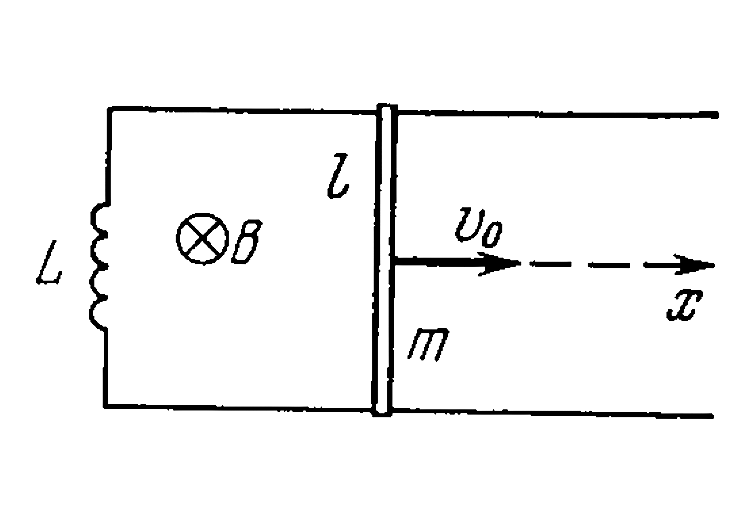
A loop (figure) is formed by two parallel conductores connected by a solenoid with inductance `L` and a conducting rod of mass `m` which can freely ( without friction) slide over the conductors. The conductors are located in a horizontal plane in a uniform vertical magnetic field with induction `B`. The distance between the conductors is equal to `l`. At the moment `t=0` the rod is imparted an initial velocity `upsilon_(0)` directed to the right. Find the law of its motion `x(t)` if the electric resistance of the loop is negligible.

Promotional Banner

Similar Questions

Explore conceptually related problems

A loop is formed by two parallel conductors connected by a solenoid with inductance L and a conducting rod of mass m which can freely (without friction) slide over the conductors. The conductors are located in a horizontal plane in a uniform vertical magnet field B . the distance between the conductors is l . At the moment t=0 , the rod is imparted an initial velocity v_(0) directed to the right. Find the law of its motion x(t) if the electric resistance of the loop is negligible.

A loop is formed by two parallel conductors connected by a selenoid with inductance L and a condutcing rod of mass which can freely (without friction) slide over the conductors. The conductors are located i a horizontal plane in as uniform vertical magnetic field B .The distance between the conductors is l . At the moment t=0 the rod is impaert dan initial velocity v_0 directed to the right. find the law of its motion d(t) if the electric resistance of the loop is negligible

A loop is formed by two parallel conductors connected by a selenoid with inductance L and a condutcing rod of mass which can freely (without friction) slide over the conductors. The conductors are located in a horizontal plane in as uniform vertical magnetic field B .The distance between the conductors is l . At the moment t=0 the rod is impart the initial velocity v_0 directed to the right. find the equation of its motion d(t) if the electric resistance of the loop is negligible

A loop is formed by two parallel conductors connected by a solenoid with inductance L=2H and a conducting rod of mass m=80g, which can freely (without fricition) slide over the conductors. The conductors are located in a horizontal plane in a uniform vertical magnetic field with induction B=4T. The distance between the conductors is equal to l=4cm. At the moment t=0 the rod is imparted an initial velocity v_(0)=2 cm//s directed to the right. Find the amplitude (in cm) for the oscillations of conducting rod, if the electric resistance of the loop is negligible.

A loop is formed by two parallel conductors connected by a solenoid with inductance L=2H and a conducting rod of mass m=80g, which can freely (without fricition) slide over the conductors. The conductors are located in a horizontal plane in a uniform vertical magnetic field with induction B=4T. The distance between the conductors is equal to l=4cm. At the moment t=0 the rod is imparted an initial velocity v_(0)=2 cm//s directed to the right. Find the amplitude (in cm) for the oscillations of conducting rod, if the electric resistance of the loop is negligible.

A loop is formed by two parallel conductors connected by a solenoid with inductance L=2H and a conducting rod of mass m=80g, which can freely (without fricition) slide over the conductors. The conductors are located in a horizontal plane in a uniform vertical magnetic field with induction B=4T. The distance between the conductors is equal to l=4cm. At the moment t=0 the rod is imparted an initial velocity v_(0)=2 cm//s directed to the right. Find the amplitude (in cm) for the oscillations of conducting rod, if the electric resistance of the loop is negligible.

A conductor of length l and mass m can slide without any friction along the two vertical conductors connected at the top through a capacitor. A uniform magnetic field B is set up _|_ to the plane of paper. The acceleration of the conductor

A conductor of length l and mass m can slide without any friction along the two vertical conductors connected at the top through a capacitor. A uniform magnetic field B is set up _|_ to the plane of paper. The acceleration of the conductor