

Home
Class 11
PHYSICS
In the masses of A and B are 10 kg and 5...

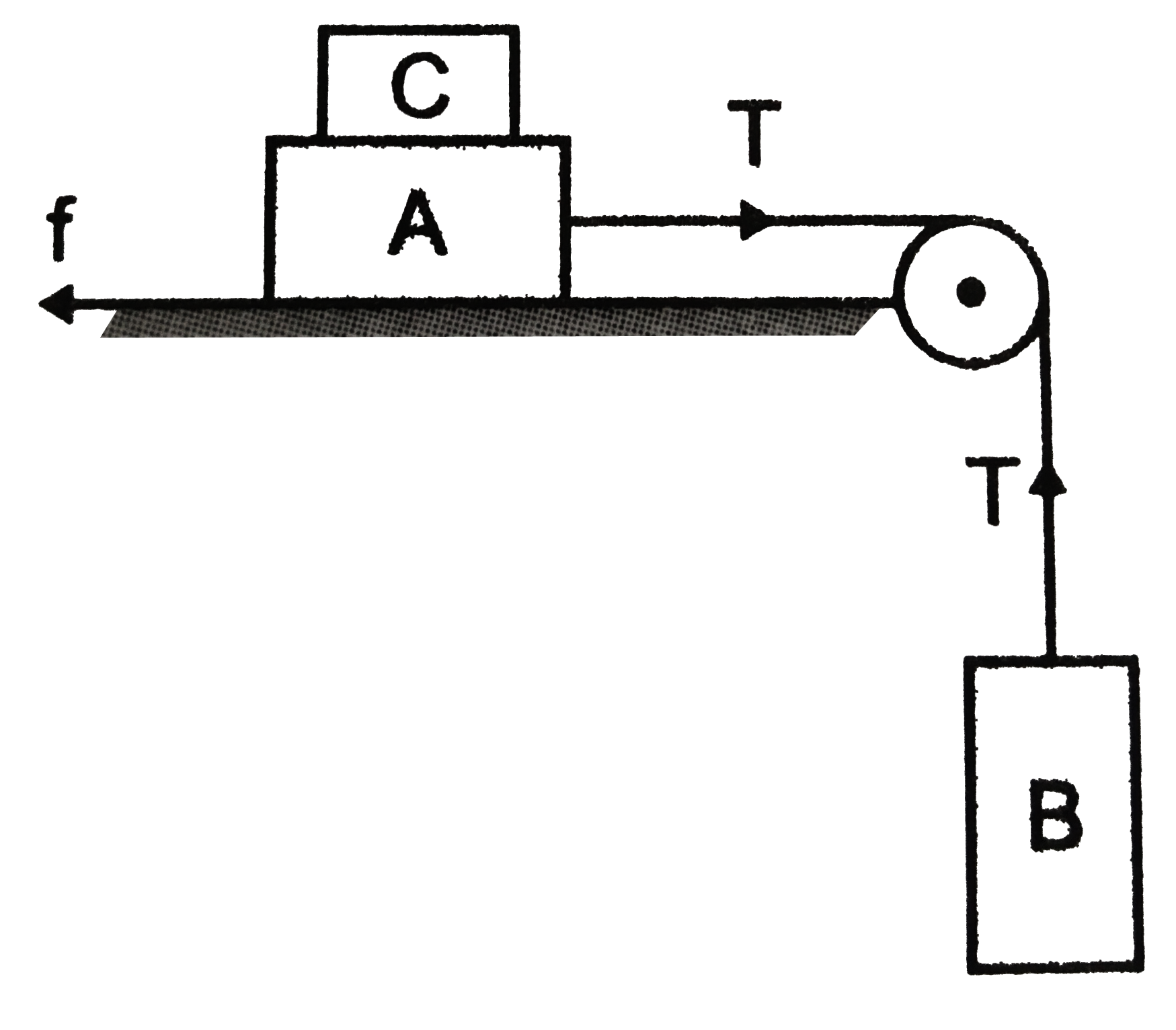
In the masses of A and B are 10 kg and 5 kg . Calculate the minimum mass of C which may stop A from slipping Coefficient of static friction between block A and table is 0.2
.

Promotional Banner

Similar Questions

Explore conceptually related problems

A block on table shown in is just on the edge of slipping Find the coefficient of static friction between the blocks and table .

A block on table shown in figure is just on the wedge of slipping. Find the coefficient of static friction between the block and table top.

Block B of mass m_(B) = 0.5 kg rests on block A, with mass m_(A) = 1.5kg which in turn is on a horizontal tabletop (as shown in figure) .The coefficient of kinetic friction between block A and the tabletop is mu_(k) = 0.4 and the coefficient of static friction between block A and blockB is mu_(s) = 0.6 A light string attached block A passes over a frictionless, massless pulley and block C is suspeneded from the other end of the string. What is the largest mass m_(c) (in kg) that block C can have so that block A and B still slide together when the system is relaced from rest?

Block B of mass m_(B) = 0.5 kg rests on block A, with mass m_(A) = 1.5kg which in turn is on a horizontal tabletop (as shown in figure) .The coefficient of kinetic friction between block A and the tabletop is mu_(k) = 0.4 and the coefficient of static friction between block A and blockB is mu_(s) = 0.6 A light string attached block A passes over a frictionless, massless pulley and block C is suspeneded from the other end of the string. What is the largest mass m_(c) (in kg) that block C can have so that block A and B still slide together when the system is relaced from rest?

Two masses A and B of 10 kg and 5 kg , respectively , are connected with a string passing over a frictionless pulley fixed at the corner of a table as shown. The coefficient of static friction between A and the table is 0.2 . The minimum mass C that should be placed on A to prevent it from moving is equal to

Two masses A and B of 10 kg and 5 kg , respectively , are connected with a string passing over a frictionless pulley fixed at the corner of a table as shown. The coefficient of static friction between A and the table is 0.2 . The minimum mass C that should be placed on A to prevent it from moving is equal to

Two masses A and B of 10 kg and 5 kg , respectively , are connected with a string passing over a frictionless pulley fixed at the corner of a table as shown. The coefficient of static friction between A and the table is 0.2 . The minimum mass C that should be placed on A to prevent it from moving is equal to