

Home
Class 12
PHYSICS
A conducting rod moves with constant vel...

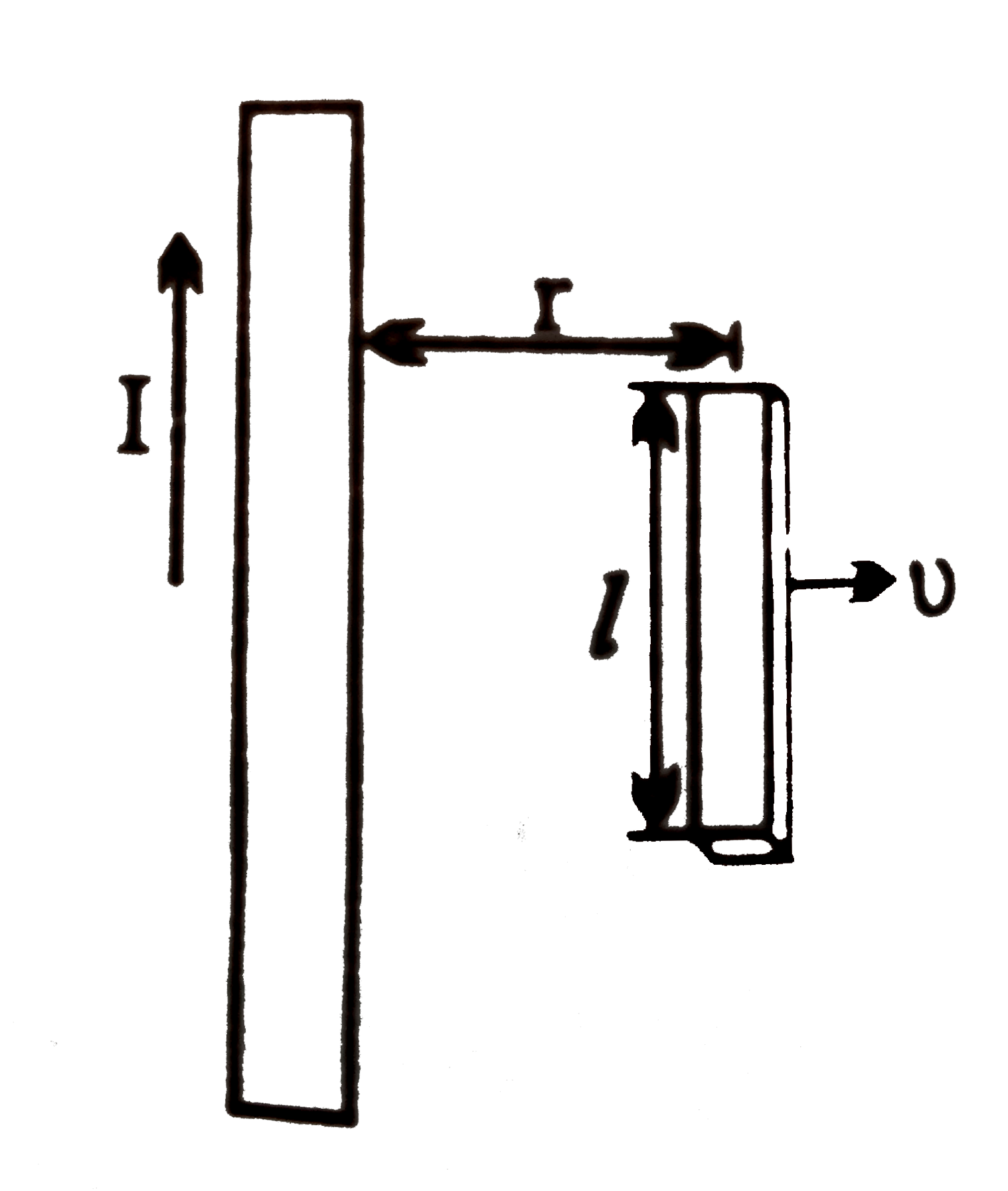
A conducting rod moves with constant velocity `v` perpendicular to the straight wire carrying a current I as shown compute that the emf generated between the ends of the rod

Promotional Banner

Similar Questions

Explore conceptually related problems

A cionducing rod moves with constant velocity v perpendicular to the straight wire carrying a current I as shown compute that the emf generated between the ends of the rod

A copper rod moves with a constant angular velocity omega about a long straight wire carrying a current I. If the ends of the rod from the wire are at distances a and b, then the e.m.f induced in the rod is

A conducting rod MN moves with a speed v parallel to a long straight wire which carries a constant current i , as shown in fig. The length of the rod is normal to the wire. Find the emf induced in the total length of the rod. State which end will be at a lower potential.

A rod of length b moves with a constant velocity v in the magnetic field of a straight long conductor that carries a current I as shown in the below figure. The emf induced in the rod is

A uniform metal rod is moving with a uniform velocity v parallel to a long straight wire carrying a current I. The rod is perpendicular to the wire with its ends at distance r_(1) and r_(2) (with r_(2) gt r_(1) ) form it. The E.M.F. induced in the rod at that instant is

A conducting rod is moved with a constant velocity v n a magnetic field. A potential difference appears across the two ends

A conducting rod length 1m moves with a speed of 2m//s parallel to a straight long wire carrying 4 A current. Axis of rod is kept perpendicular to the wire with its near end at a distance of 1m from the wire. Magnitude of induced emf in rod is N xx 10^(-7) log 16 "volt" . Find the value of N .

A segment AB of wire carrying current I_1 is placed perpendicular to a long straight wire carrying current I_2 as shown in figure. The magnitude of force experieced by the straight wire AB is

A conducting circular loop of radius a and resistance per unit length R is moving with a constant velocity v_0 , parallel to an infinite conducting wire carrying current i_0 . A conducting rod of length 2a is approaching the centre of the loop with a constant velocity v_0/2 along the direction 2 of the current. At the instant t = 0 , the rod comes in contact with the loop at A and starts sliding on the loop with the constant velocity. Neglecting the resistance of the rod and the self-inductance of the circuit, find the following when the rod slides on the loop. (a) The current through the rod when it is at a distance of (a/2) from the point A of the loop. (b) Force required to maintain the velocity of the rod at that instant.