

Home
Class 11
PHYSICS
A uniform cylinder is lying on a rough s...

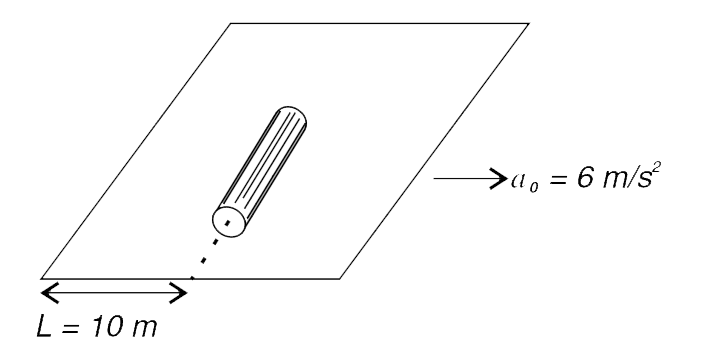
A uniform cylinder is lying on a rough sheet of paper as shown in fig. The strip is pulled horizontally to the right with a constant acceleration of `a_(0) = 6 m//s^(2)`. Initially the cylinder is located at a distance of `L = 10 m` from the left end of the strip. Find the velocity of the centre of the cylinder at the instant it moves off the edge of the strip. Assume that the cylinder does not slip.

Promotional Banner

Similar Questions

Explore conceptually related problems

A cylinder of mass m and radius R is kept on a rough surface after giving its centre a horizontal speed v_(0) . Find the speed of the centre of the cylinder when it stops slipping.

A cylinder of mass m and radius R is kept on a rough surface after giving its centre a horizontal speed v_(0) . Find the speed of the centre of the cylinder when it stops slipping.

In the figure the plank resting on two cylinders is horizontal. The plank is pulled to the right such that the centre of smaller cylinder moves with a constant velocity v . Friction is large enough to prevent slipping at all surfaces. Find- (a) The velocity of the centre of larger cylinder. (b) The ratio of accelerations of the points of contact of the two cylinders with the plank.

A trolley intially at rest with a solid cylinder placed on its bed such that cylinder axis makes angle theta with direction of motion of trolley as shown in the figure starts to move forward with constant acceleration a. If initial distance of midpoint of cylinder axis from rear edge of trolley bed is d , calculate the distance s which the trolley goes before the cylinder rolls off the edge of its horizontal bed. Assume dimensions of cylinder to be very small in comparision to other dimensions. Neglect slipping. Calculate als, frictional force acting on the cylinder.

Consider a cylinder of mass M resting on a rough horizontal rug that is pulled out from under it with acceleration 'a' perpendicular to the axis of the cylinder. What is F_("friction") at point P ? It is assumed that the cylinder does not slip.

Consider a cylinder of mass M resting on a rough horizontal rug that is pulled out from under it with acceleration 'a' perpendicular to the axis of the cylinder. What is F_("friction") at point P? It is assumed that the cylinder does not slip.

Consider a cylinder of mass M resting on a rough horizontal rug that is pulled out from under it with acceleration 'a' perpendicular to the axis of the cylinder. What is F_("friction") at point P ? It is assumed that the cylinder does not slip.

A uniform cylinder of mass m rests on two rough horizontal planks. A thread is wound on the cylinder. The hanging end of the thread is pulled vertically down with a constant force F

A force F is applied horizontally on a cylinder in the line of centre as shown in the figure. The cylinder is on a rough surface of coefficient of fricition mu . The direction of the friction force acting on the cylinder will be