Home
Class 12
MATHS
If A(n) is the area bounded by y=x and y...

If `A_(n)` is the area bounded by y=x and `y=x^(n), n in N,` then `A_(2).A_(3)…A_(n)=`

A

`(1)/(n(n+1))`

B

`(1)/(2^(n)n(n+1))`

C

`(1)/(2^(n-1)n(n+1))`

D

`(1)/(2^(n-2)n(n+1))`

Text Solution

Verified by Experts

The correct Answer is:
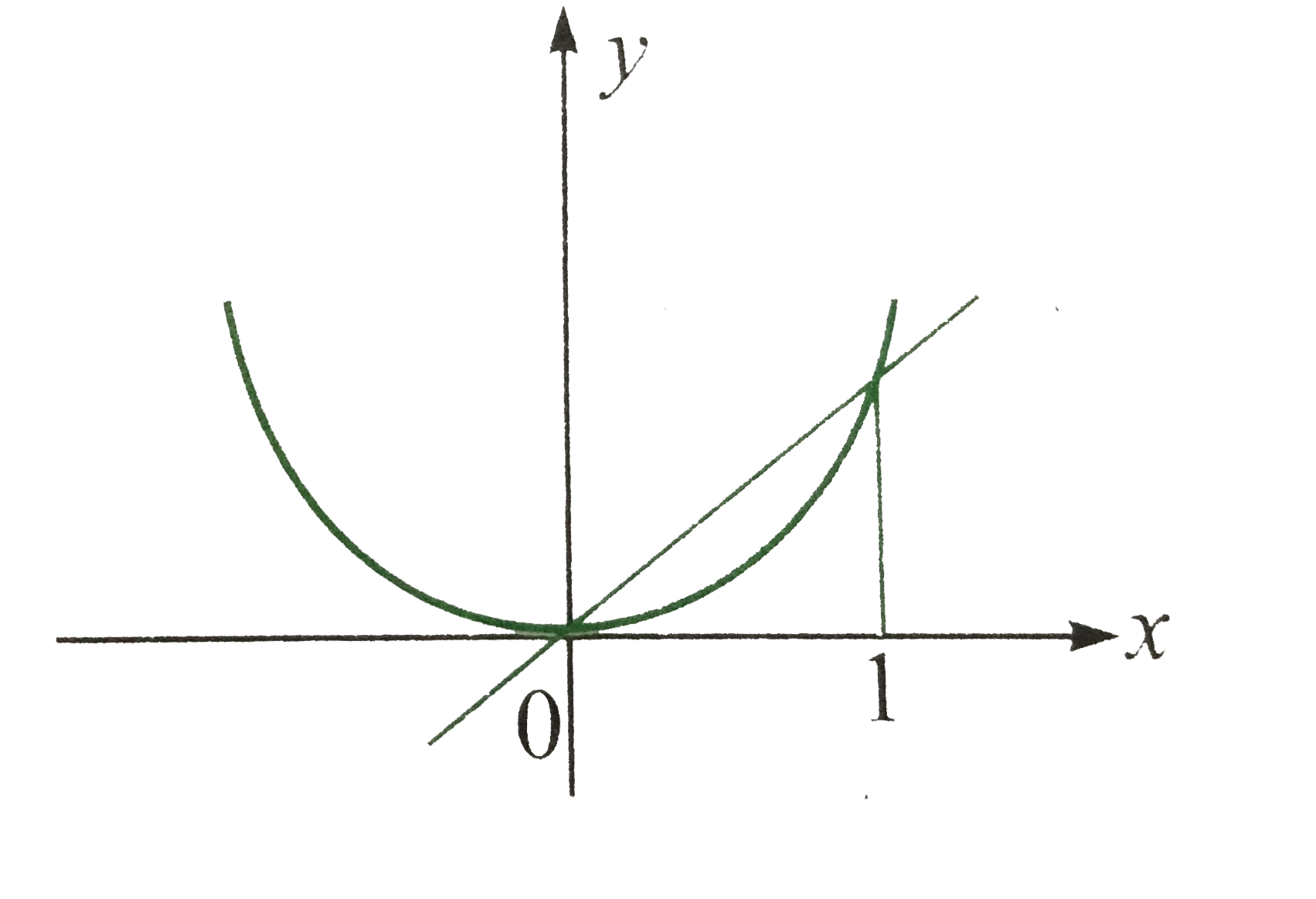
D

`y=x" intersect "y=x^(n)" at "(0,0) and (1,0)" for all " n in N`

`"Area "A_(n)=overset(1)underset(0)int(x-x^(n))dx`
`=[(x^(2))/(2)-(x^(n+1))/(n+1)]_(0)^(1)`
`=(1)/(2)-(1)/(n+1)`
`=(n-1)/(2(n+1))`
`"Thus, "A_(2)cdotA_(3)cdotA_(4)....A_(n)=(1)/(2^(n-1))((1)/(3)cdot(2)/(4)cdot(3)/(5)...(n-1)/(n+1))`
`=(1)/(2^(n-2).n(n+1))`
Promotional Banner

Topper's Solved these Questions

  • AREA

    CENGAGE|Exercise Exercise (Multiple)|10 Videos
  • AREA

    CENGAGE|Exercise Exercise (Comprehension)|21 Videos
  • AREA

    CENGAGE|Exercise Exercise 9.3|7 Videos
  • APPLICATIONS OF DERIVATIVES

    CENGAGE|Exercise Question Bank|29 Videos
  • AREA UNDER CURVES

    CENGAGE|Exercise Question Bank|20 Videos

Similar Questions

Explore conceptually related problems

If A_(n) is the area bounded by y=(1-x^(2))^(n) and coordinate axes,n in N, then

Let A_(n) be the area bounded by the curve y=x^(n)(n>=1) and the line x=0,y=0 and x=(1)/(2). If sum_(n=1)^(n)(2^(n)A_(n))/(n)=(1)/(3) then find the value of n .

If A_n be the area bounded by the curve y=(tanx^n) ands the lines x=0,\ y=0,\ x=pi//4 Prove that for n > 2. , A_n+A_(n+2)=1/(n+1) and deduce 1/(2n+2)< A_(n) <1/(2n-2)

B={a_(n):n in N,a_(n)+1=2a_(n) and a_(1)=3}

A_(1), A_(2), A_(3), ……, A_(n) " and " B_(1), B_(2), B_(3), …., B_(n) are non-singular square matrices of order n such that A_(1)B_(1) = I_(n), A_(2)B_(2) = I_(n), A_(3)B_(3) = I_(n),……A_(n)B_(n) = I_(n) " then"(A_(1) A_(2)A_(3)….. A_(n))^(-1) = ______.

If A_(1),A_(2),A_(3) denote respectively the areas of an inscribed polygon of 2n sides , inscribed polygon of n sides and circumscribed poylgon of n sides ,then A_(1),A_(2),A_(3) are in

If A_(1);A_(2);....A_(n) are independent events associated with a random experiment; then P(A_(1)nA_(2)n......n_(n))=P(A_(1))P(A_(2))......P(A_(n))

If f(x+y)=f(x)f(y) for all x and y,f(1)=2 and a_(n)=f(n),n in N, then the equation of the circle having (a_(1),a_(2)) and (a_(3),a_(4)) as the ends of its one diameter

CENGAGE-AREA-Exercise (Single)
  1. The area inside the parabola 5x^(2)-y=0 but outside the parabola 2x^(2...

    Text Solution

    |

  2. Area enclosed between the curves |y|=1-x^2a n dx^2+y^2=1 is (3pi-8)/3 ...

    Text Solution

    |

  3. If A(n) is the area bounded by y=x and y=x^(n), n in N, then A(2).A(3)...

    Text Solution

    |

  4. The area of the region is 1st quadrant bounded by the y-axis, y=(x)/(4...

    Text Solution

    |

  5. The area of the closed figure bounded by y=(x^2)/2-2x+2 and the tangen...

    Text Solution

    |

  6. The area of the region bounded by x^(2)+y^(2)-2x-3=0 and y=|x|+1 is

    Text Solution

    |

  7. The area enclosed by the curve y=sqrt(4-x^2),ygeqsqrt(2)sin((xpi)/(2sq...

    Text Solution

    |

  8. The area bounded by the curve y^(2)=1-x and the lines y=([x])/(x),x=-...

    Text Solution

    |

  9. The area bounded by the curves y=(log)e xa n dy=((log)e x)^2 is e-2s q...

    Text Solution

    |

  10. The area bounded by y = 3-|3-x| and y=6/(|x+1|) is

    Text Solution

    |

  11. Find the area enclosed between the curves: y = loge (x + e) , x = loge...

    Text Solution

    |

  12. Find the area enclosed the curve y=sin x and the X-axis between x=0 an...

    Text Solution

    |

  13. The area bounded by y=x^(2),y=[x+1], 0 le x le 2 and the y-axis is whe...

    Text Solution

    |

  14. The area of the region bounded by the parabola (y-2)^(2) = x- 1, the t...

    Text Solution

    |

  15. The area bounded by the curves y=x e^x ,y=x e^(-x) and the line x=1 is...

    Text Solution

    |

  16. The area of the region whose boundaries are defined by the curves y=2 ...

    Text Solution

    |

  17. Area bounded by y=sec^-1x,y=cot^-1x and line x=1 is given by

    Text Solution

    |

  18. The area bounded by the curve y=3/|x| and y+|2-x|=2 is

    Text Solution

    |

  19. The area enclosed by y=x^(2)+ cos x" and its normal at "x=(pi)/(2) in ...

    Text Solution

    |

  20. "Given "f(x)=int(0)^(x)e^(t)(log(e)sec t- sec^(2)t)dt, g(x)=-2e^(x) ta...

    Text Solution

    |

