Home
Class 12
MATHS
If A1 is the area area bounded by |x-ai...

If `A_1` is the area area bounded by `|x-a_i| + |y|=b_i, i in N` ,where `a_(i+1) =a_i+3/2 b_i and b_(i+1)=b_i/2,a_i=0 and b_i=32`, then

A

`A_(3)=128`

B

`A_(3)=256`

C

`underset(nrarroo)limoverset(n)underset(i=1)SigmaA_(i)=(8)/(3)(32)^(2)`

D

`underset(nrarroo)limoverset(n)underset(i=1)SigmaA_(i)=(4)/(3)(16)^(2)`

Text Solution

Verified by Experts

The correct Answer is:
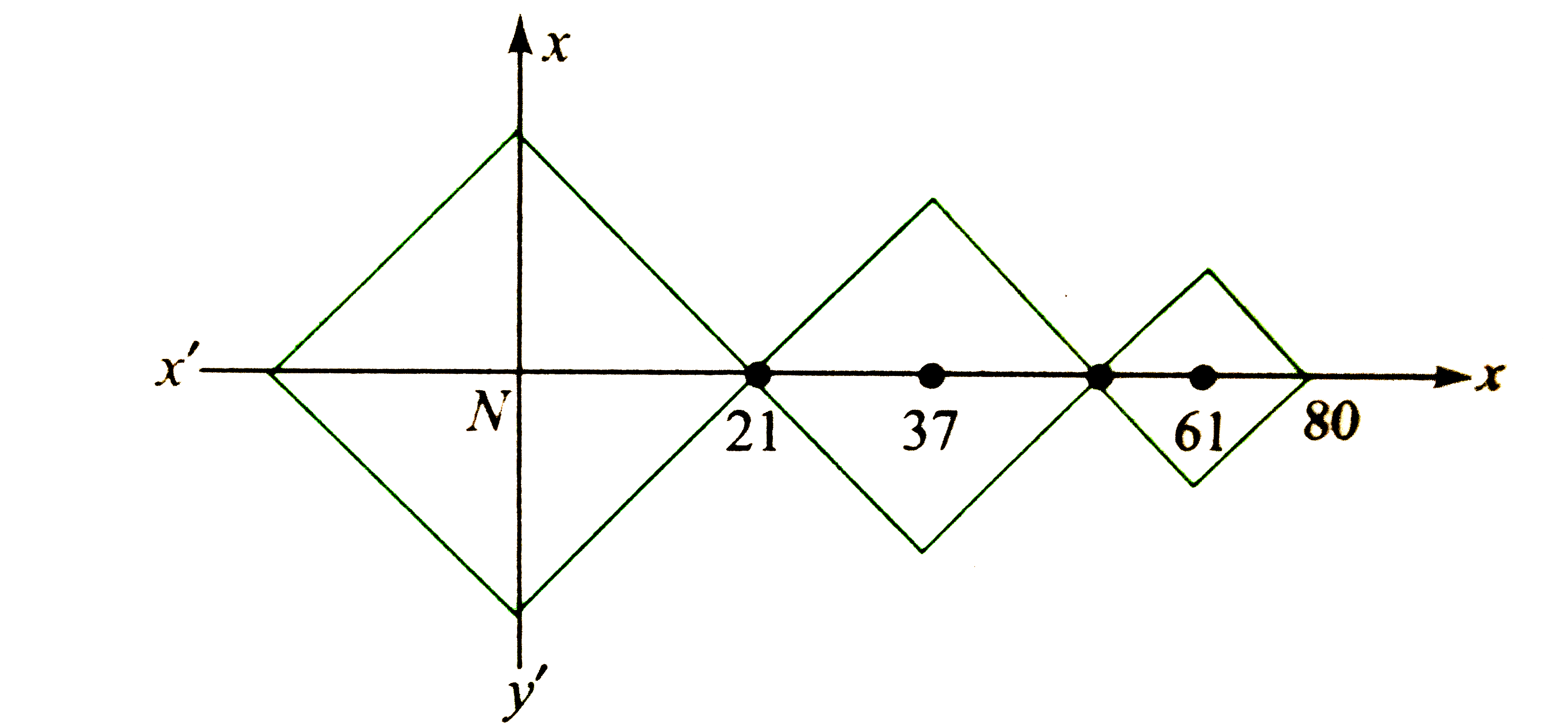
A, C

`a_(1)=0,b_(1)=32,a_(2)=a_(1)+(3)/(2)b_(1)=48,b_(2)=(b_(1))/(2)=16`
`a_(3)=48+(3)/(2)xx16=72,b_(3)=(16)/(2)=8`

So the three loops from i=1 to i=3 are alike.
Now area of ith loop (square) `=(1)/(2) ("diagonal")^(2)`
`A_(i)=(1)/(2)(2b_(i))^(2)=2(b_(i))^(2)`
`So, (A_(i)+1)/(A_(i))=(2(b_(i+1))^(2))/(2(b_(i))^(2))=(1)/(4).`
So the areas from a G.P. series.
So, the sum of the G.P. up to infinite terms is
`A_(1)(1)/(1-r)=2(32)^(2)xx(1)/(1-(1)/(4))`
`=2xx(32)^(2)xx(4)/(3)=(78)/(3)(32)^(2)` sq. units.
Promotional Banner

Topper's Solved these Questions

  • AREA

    CENGAGE|Exercise Exercise (Comprehension)|21 Videos
  • AREA

    CENGAGE|Exercise Exercise (Matrix)|4 Videos
  • AREA

    CENGAGE|Exercise Exercise (Single)|40 Videos
  • APPLICATIONS OF DERIVATIVES

    CENGAGE|Exercise Question Bank|29 Videos
  • AREA UNDER CURVES

    CENGAGE|Exercise Question Bank|20 Videos

Similar Questions

Explore conceptually related problems

If A_(1) is the area area bounded by |x-a_(i)|+|y|=b_(i),i in N, where a_(i+1)=a_(i)+(3)/(2)b_(i) and b_(i+1)=(b_(i))/(2),a_(i)=0 and b_(i)=32 ,then

Find a and b if a+2b+2ai= 4+6i

A_1 A_2 A_3............A_n is a polygon whose all sides are not equal, and angles too are not all equal. theta_1 is theangle between bar(A_i A_j +1) and bar(A_(i+1) A_(i +2)),1 leq i leq n-2.theta_(n-1) is the angle between bar(A_(n-1) A_n) and bar(A_n A_1), while theta_n, is the angle between bar(A_n A_1) and bar(A_1 A_2) then cos(sum_(i=1)^n theta_i) is equal to-

If a_i > 0 for i=1,2,…., n and a_1 a_2 … a_(n=1) , then minimum value of (1+a_1) (1+a_2) ….. (1+a_n) is :

If the arithmetic mean of a_(1),a_(2),a_(3),"........"a_(n) is a and b_(1),b_(2),b_(3),"........"b_(n) have the arithmetic mean b and a_(i)+b_(i)=1 for i=1,2,3,"……."n, prove that sum_(i=1)^(n)(a_(i)-a)^(2)+sum_(i=1)^(n)a_(i)b_(i)=nab .

If a=1+i, then a^(2) equals 1-i b.2i .(1+i)(1-i) d.(i-1)

Find the real value of a for which 3i^(3)-2ai^(2)+(1-a)i+5 is real

