Home
Class 12
MATHS
If y=f(x) is a monotonic function in (a,...

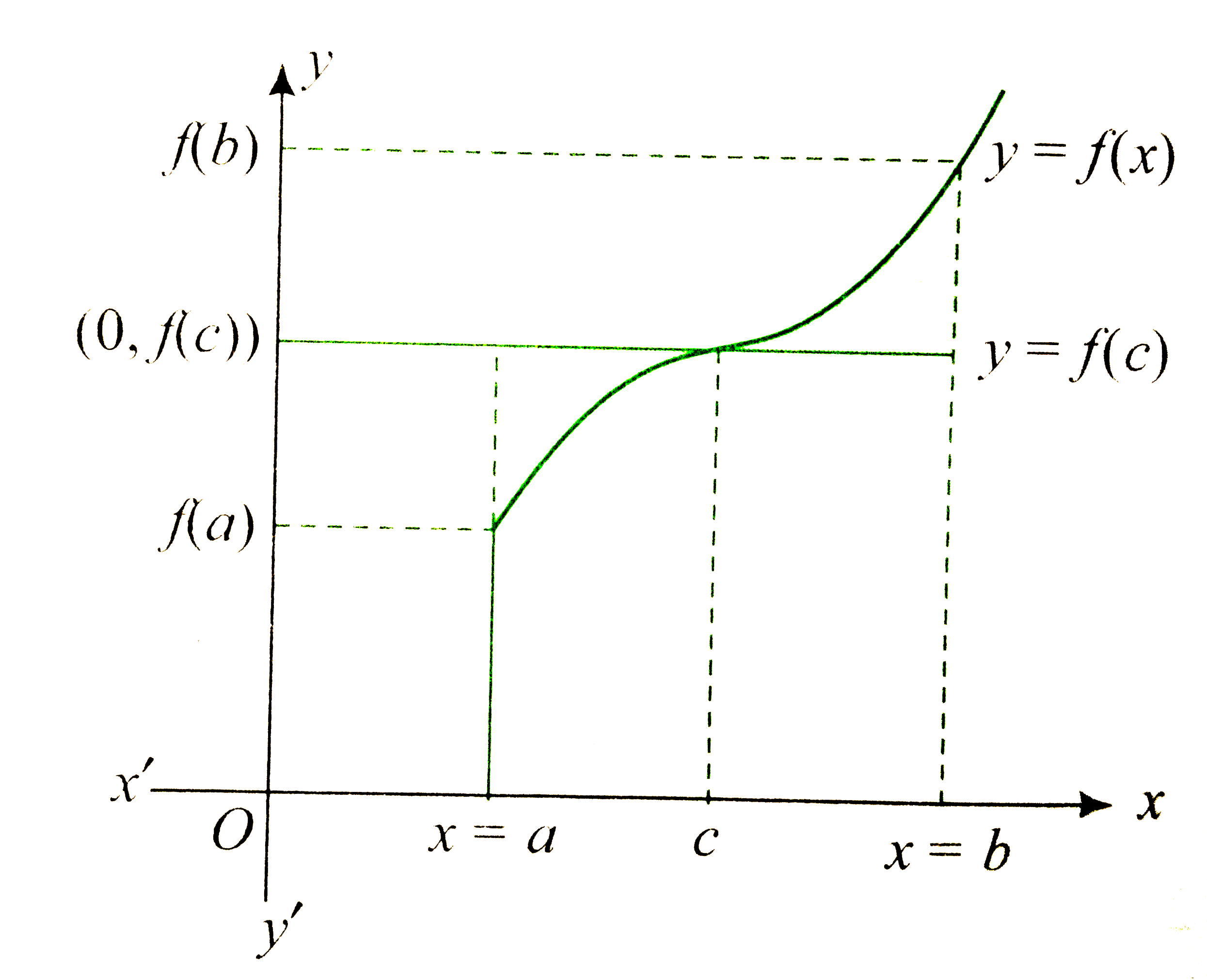
If y=f(x) is a monotonic function in (a,b), then the area bounded by the ordinates at `x=a, x=b, y=f(x) and y=f(c)("where "c in (a,b))" is minimum when "c=(a+b)/(2)`.
`"Proof : " A=int_(a)^(c) (f(c)-f(x))dx+int_(c)^(b) (f(c))dx`
`=f(c)(c-a)-int_(a)^(c) (f(x))dx+int_(a)^(b) (f(x))dx-f(c)(b-c)`
`rArr" "A=[2c-(a+b)]f(c)+int_(c)^(b) (f(x))dx-int_(a)^(c) (f(x))dx`

Differentiating w.r.t. c, we get
`(dA)/(dc)=[2c-(a+b)]f'(c)+2f(c)+0-f(c)-(f(c)-0)`
For maxima and minima , `(dA)/(dc)=0`
`rArr" "f'(c)[2c-(a+b)]=0(as f'(c)ne 0)`
Hence, `c=(a+b)/(2)`
`"Also for "clt(a+b)/(2),(dA)/(dc)lt0" and for "cgt(a+b)/(2),(dA)/(dc)gt0`
Hence, A is minimum when `c=(a+b)/(2)`.
The value of the parameter a for which the area of the figure bounded by the abscissa axis, the graph of the function `y=x^(3)+3x^(2)+x+a`, and the straight lines, which are parallel to the axis of ordinates and cut the abscissa axis at the point of extremum of the function, which is the least, is

A

2

B

0

C

-1

D

1

Text Solution

Verified by Experts

The correct Answer is:

C

`f(x)=x^(3)+3x^(2)+x+a`
`f'(x)=3x^(2)+6x+1=0`
`rArr" "x=-1pm (sqrt(6))/(3).`
Hence, f(x) cuts the x-axis at
`(1)/(2)[(-1+(sqrt(6))/(3))+(-1-(sqrt(6))/(3))]=-1.`
`f(-1)=-1+3-1+a=0`
`a=-1.`
Promotional Banner

Topper's Solved these Questions

  • AREA

    CENGAGE|Exercise Exercise (Matrix)|4 Videos
  • AREA

    CENGAGE|Exercise Exercise (Numerical)|16 Videos
  • AREA

    CENGAGE|Exercise Exercise (Multiple)|10 Videos
  • APPLICATIONS OF DERIVATIVES

    CENGAGE|Exercise Question Bank|29 Videos
  • AREA UNDER CURVES

    CENGAGE|Exercise Question Bank|20 Videos

Similar Questions

Explore conceptually related problems

If y=f(x) is a monotonic function in (a,b), then the area bounded by the ordinates at x=a, x=b, y=f(x) and y=f(c)("where "c in (a,b))" is minimum when "c=(a+b)/(2) . "Proof : " A=int_(a)^(c)(f(c)-f(x))dx+int_(c)^(b)(f(c))dx =f(c)(c-a)-int_(a)^(c) (f(x))dx+int_(a)^(b)(f(x))dx-f(c)(b-c) rArr" "A=[2c-(a+b)]f(c)+int_(c)^(b)(f(x))dx-int_(a)^(c)(f(x))dx Differentiating w.r.t. c, we get (dA)/(dc)=[2c-(a+b)]f'(c)+2f(c)+0-f(c)-(f(c)-0) For maxima and minima , (dA)/(dc)=0 rArr" "f'(c)[2c-(a+b)]=0(as f'(c)ne 0) Hence, c=(a+b)/(2) "Also for "clt(a+b)/(2),(dA)/(dc)lt0" and for "cgt(a+b)/(2),(dA)/(dc)gt0 Hence, A is minimum when c=(a+b)/(2) . If the area enclosed by f(x)= sin x + cos x, y=a between two consecutive points of extremum is minimum, then the value of a is

If y=f(x) is a monotonic function in (a,b), then the area bounded by the ordinates at x=a, x=b, y=f(x) and y=f(c)("where "c in (a,b))" is minimum when "c=(a+b)/(2) . "Proof : " A=int_(a)^(c)(f(c)-f(x))dx+int_(c)^(b)(f(c))dx =f(c)(c-a)-int_(a)^(c)(f(x))dx+int_(a)^(b)(f(x))dx-f(c)(b-c) rArr" "A=[2c-(a+b)]f(c)+int_(c)^(b)(f(x))dx-int_(a)^(c)(f(x))dx Differentiating w.r.t. c, we get (dA)/(dc)=[2c-(a+b)]f'(c)+2f(c)+0-f(c)-(f(c)-0) For maxima and minima , (dA)/(dc)=0 rArr" "f'(c)[2c-(a+b)]=0(as f'(c)ne 0) Hence, c=(a+b)/(2) "Also for "clt(a+b)/(2),(dA)/(dc)lt0" and for "cgt(a+b)/(2),(dA)/(dc)gt0 Hence, A is minimum when c=(a+b)/(2) . If the area bounded by f(x)=(x^(3))/(3)-x^(2)+a and the straight lines x=0, x=2, and the x-axis is minimum, then the value of a is

int_(a + c)^(b+c) f(x)dx=

Property 3:int_(a)^(b)f(x)dx=int_(a)^(c)f(x)dx+int_(c)^(b)f(x)dx

(1)/(c )int_(ac)^(bc)f((x)/(c ))dx=

If |int_(a)^(b)f(x)dx|=int_(a)^(b)|f(x)|dx,a

1/c int _(a) ^(b) f ((x)/(c )) dx =

CENGAGE-AREA-Exercise (Comprehension)
  1. Let A(r) be the area of the region bounded between the curves y^(2)=(e...

    Text Solution

    |

  2. If y=f(x) is a monotonic function in (a,b), then the area bounded by t...

    Text Solution

    |

  3. If y=f(x) is a monotonic function in (a,b), then the area bounded by t...

    Text Solution

    |

  4. If y=f(x) is a monotonic function in (a,b), then the area bounded by t...

    Text Solution

    |

  5. Consider the area S(0),S(1),S(2)…. bounded by the x-axis and half-wave...

    Text Solution

    |

  6. Consider the sequence of natural numbers s0,s1,s2,... such that s0 =3,...

    Text Solution

    |

  7. Consider the area S(0),S(1),S(2)…. bounded by the x-axis and half-wave...

    Text Solution

    |

  8. "Two curves "C(1)equiv[f(y)]^(2//3)+[f(x)]^(1//3)=0 and C(2)equiv[f(y)...

    Text Solution

    |

  9. "Two curves "C(1)equiv[f(y)]^(2//3)+[f(x)]^(1//3)=0 and C(2)equiv[f(y)...

    Text Solution

    |

  10. "Two curves "C(1)equiv[f(y)]^(2//3)+[f(x)]^(1//3)=0 and C(2)equiv[f(y)...

    Text Solution

    |

  11. Consider the two curves C(1):y=1+cos x and C(2): y=1 + cos (x-alpha)" ...

    Text Solution

    |

  12. Consider two curves C1:y =1/x and C2.y=lnx on the xy plane. Let D1, de...

    Text Solution

    |

  13. Consider the function defined implicity by the equation y^(2)-2ye^(sin...

    Text Solution

    |

  14. Consider the function defined implicity by the equation y^(2)-2ye^(sin...

    Text Solution

    |

  15. Consider two functions f (x) ={[x] , -2 leq x leq -1 and |x|+1 , -1 ...

    Text Solution

    |

  16. Computing area with parametrically represented boundaries : If the bou...

    Text Solution

    |

  17. Computing area with parametrically represented boundaries : If the bou...

    Text Solution

    |

  18. Computing area with parametrically represented boundaries : If the bou...

    Text Solution

    |

  19. Let f(x) be a continuous function fiven by f(x)={(2x",", |x|le1),(x^(2...

    Text Solution

    |

  20. Let f(x) be continuous function given by f(x)={2x ,|x|lt=1x^2+a x+b ,|...

    Text Solution

    |
