Home
Class 12
MATHS
If y=f(x) is a monotonic function in (a,...

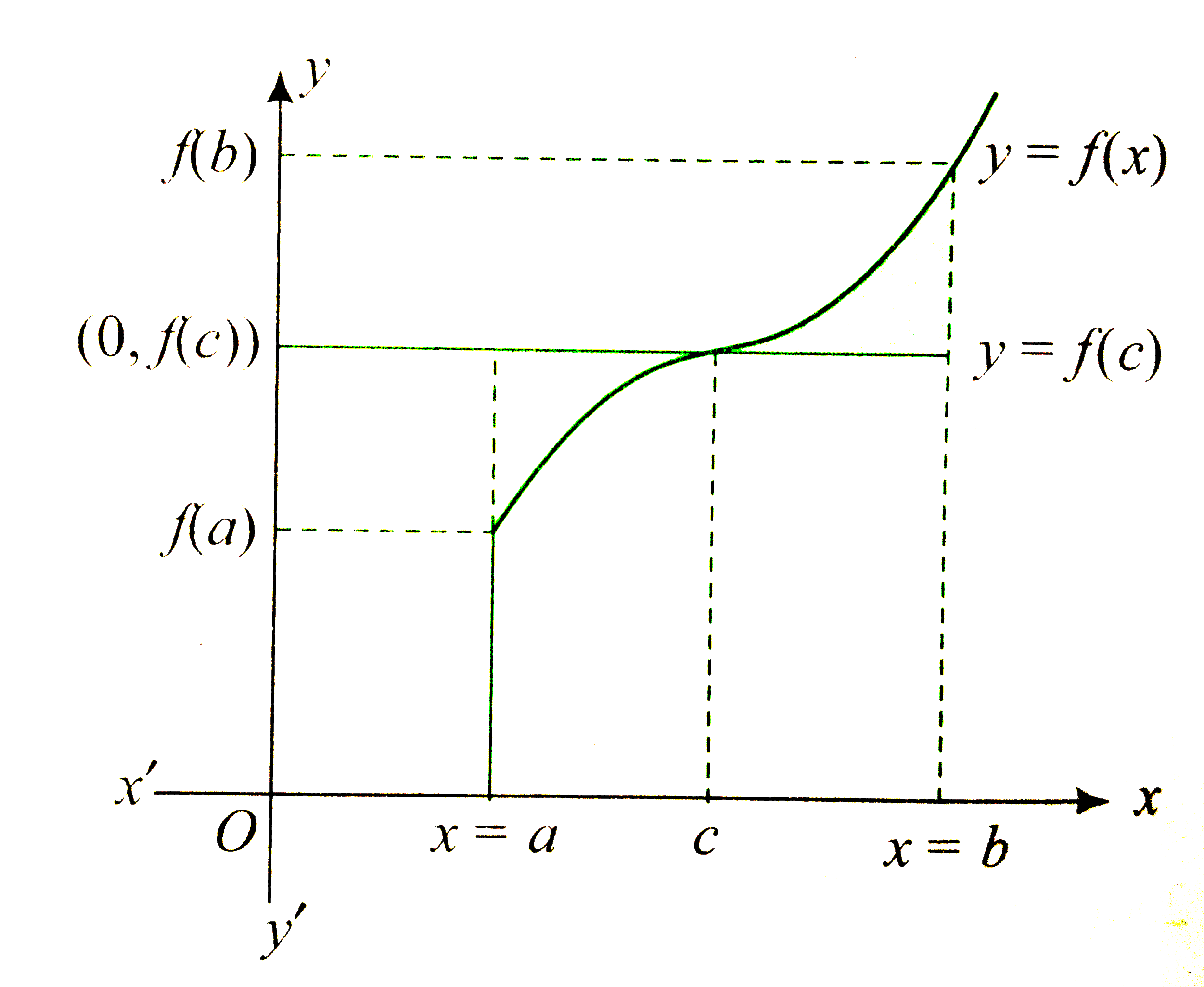
If y=f(x) is a monotonic function in (a,b), then the area bounded by the ordinates at `x=a, x=b, y=f(x) and y=f(c)("where "c in (a,b))" is minimum when "c=(a+b)/(2)`.
`"Proof : " A=int_(a)^(c)(f(c)-f(x))dx+int_(c)^(b)(f(c))dx`
`=f(c)(c-a)-int_(a)^(c) (f(x))dx+int_(a)^(b)(f(x))dx-f(c)(b-c)`
`rArr" "A=[2c-(a+b)]f(c)+int_(c)^(b)(f(x))dx-int_(a)^(c)(f(x))dx`

Differentiating w.r.t. c, we get
`(dA)/(dc)=[2c-(a+b)]f'(c)+2f(c)+0-f(c)-(f(c)-0)`
For maxima and minima , `(dA)/(dc)=0`
`rArr" "f'(c)[2c-(a+b)]=0(as f'(c)ne 0)`
Hence, `c=(a+b)/(2)`
`"Also for "clt(a+b)/(2),(dA)/(dc)lt0" and for "cgt(a+b)/(2),(dA)/(dc)gt0`
Hence, A is minimum when `c=(a+b)/(2)`.
If the area enclosed by `f(x)= sin x + cos x, y=a` between two consecutive points of extremum is minimum, then the value of a is

A

0

B

-1

C

1

D

2

Text Solution

Verified by Experts

The correct Answer is:

A

`f(x)= sin x + cos x`
`"or "(df(x))/(dx)=cos x- sin x`
`"If "(df(x))/(dx)=0," then " cos x= sin x rArr x=(pi)/(4) and x=(5pi)/(4)`
(considering any two of consecutive points of extremum).
For minimum area bounded by `y=f(x) and y=a,` between
`x=(pi)/(4) and x=(5pi)/(4),` graphs of g(x) must cut y =a at
`c=((pi)/(4)+(5pi)/(4))/(2)=(3pi)/(4).`
`a=f((3pi)/(4))`
`rArr" "a=sin ((3pi)/(4))+cos ((3pi)/(4))=0.`
Promotional Banner

Topper's Solved these Questions

  • AREA

    CENGAGE|Exercise Exercise (Matrix)|4 Videos
  • AREA

    CENGAGE|Exercise Exercise (Numerical)|16 Videos
  • AREA

    CENGAGE|Exercise Exercise (Multiple)|10 Videos
  • APPLICATIONS OF DERIVATIVES

    CENGAGE|Exercise Question Bank|29 Videos
  • AREA UNDER CURVES

    CENGAGE|Exercise Question Bank|20 Videos

Similar Questions

Explore conceptually related problems

If y=f(x) is a monotonic function in (a,b), then the area bounded by the ordinates at x=a, x=b, y=f(x) and y=f(c)("where "c in (a,b))" is minimum when "c=(a+b)/(2) . "Proof : " A=int_(a)^(c)(f(c)-f(x))dx+int_(c)^(b)(f(c))dx =f(c)(c-a)-int_(a)^(c)(f(x))dx+int_(a)^(b)(f(x))dx-f(c)(b-c) rArr" "A=[2c-(a+b)]f(c)+int_(c)^(b)(f(x))dx-int_(a)^(c)(f(x))dx Differentiating w.r.t. c, we get (dA)/(dc)=[2c-(a+b)]f'(c)+2f(c)+0-f(c)-(f(c)-0) For maxima and minima , (dA)/(dc)=0 rArr" "f'(c)[2c-(a+b)]=0(as f'(c)ne 0) Hence, c=(a+b)/(2) "Also for "clt(a+b)/(2),(dA)/(dc)lt0" and for "cgt(a+b)/(2),(dA)/(dc)gt0 Hence, A is minimum when c=(a+b)/(2) . If the area bounded by f(x)=(x^(3))/(3)-x^(2)+a and the straight lines x=0, x=2, and the x-axis is minimum, then the value of a is

If y=f(x) is a monotonic function in (a,b), then the area bounded by the ordinates at x=a, x=b, y=f(x) and y=f(c)("where "c in (a,b))" is minimum when "c=(a+b)/(2) . "Proof : " A=int_(a)^(c) (f(c)-f(x))dx+int_(c)^(b) (f(c))dx =f(c)(c-a)-int_(a)^(c) (f(x))dx+int_(a)^(b) (f(x))dx-f(c)(b-c) rArr" "A=[2c-(a+b)]f(c)+int_(c)^(b) (f(x))dx-int_(a)^(c) (f(x))dx Differentiating w.r.t. c, we get (dA)/(dc)=[2c-(a+b)]f'(c)+2f(c)+0-f(c)-(f(c)-0) For maxima and minima , (dA)/(dc)=0 rArr" "f'(c)[2c-(a+b)]=0(as f'(c)ne 0) Hence, c=(a+b)/(2) "Also for "clt(a+b)/(2),(dA)/(dc)lt0" and for "cgt(a+b)/(2),(dA)/(dc)gt0 Hence, A is minimum when c=(a+b)/(2) . The value of the parameter a for which the area of the figure bounded by the abscissa axis, the graph of the function y=x^(3)+3x^(2)+x+a , and the straight lines, which are parallel to the axis of ordinates and cut the abscissa axis at the point of extremum of the function, which is the least, is

int_(a + c)^(b+c) f(x)dx=

Property 3:int_(a)^(b)f(x)dx=int_(a)^(c)f(x)dx+int_(c)^(b)f(x)dx

If |int_(a)^(b)f(x)dx|=int_(a)^(b)|f(x)|dx,a

Which of the following is incorrect? int_(a+c)^(b+c)f(x)dx=int_(a)^(b)f(x+c)dxint_(a+c)^(bc)f(x)dx=c int_(a)^(b)f(cx)dxint_(-ac)^(a)f(x)dx=(1)/(2)int_(-a)^(a)(f(x)+f(-x)dx None of these

1/c int _(a) ^(b) f ((x)/(c )) dx =

CENGAGE-AREA-Exercise (Comprehension)
  1. Let A(r) be the area of the region bounded between the curves y^(2)=(e...

    Text Solution

    |

  2. If y=f(x) is a monotonic function in (a,b), then the area bounded by t...

    Text Solution

    |

  3. If y=f(x) is a monotonic function in (a,b), then the area bounded by t...

    Text Solution

    |

  4. If y=f(x) is a monotonic function in (a,b), then the area bounded by t...

    Text Solution

    |

  5. Consider the area S(0),S(1),S(2)…. bounded by the x-axis and half-wave...

    Text Solution

    |

  6. Consider the sequence of natural numbers s0,s1,s2,... such that s0 =3,...

    Text Solution

    |

  7. Consider the area S(0),S(1),S(2)…. bounded by the x-axis and half-wave...

    Text Solution

    |

  8. "Two curves "C(1)equiv[f(y)]^(2//3)+[f(x)]^(1//3)=0 and C(2)equiv[f(y)...

    Text Solution

    |

  9. "Two curves "C(1)equiv[f(y)]^(2//3)+[f(x)]^(1//3)=0 and C(2)equiv[f(y)...

    Text Solution

    |

  10. "Two curves "C(1)equiv[f(y)]^(2//3)+[f(x)]^(1//3)=0 and C(2)equiv[f(y)...

    Text Solution

    |

  11. Consider the two curves C(1):y=1+cos x and C(2): y=1 + cos (x-alpha)" ...

    Text Solution

    |

  12. Consider two curves C1:y =1/x and C2.y=lnx on the xy plane. Let D1, de...

    Text Solution

    |

  13. Consider the function defined implicity by the equation y^(2)-2ye^(sin...

    Text Solution

    |

  14. Consider the function defined implicity by the equation y^(2)-2ye^(sin...

    Text Solution

    |

  15. Consider two functions f (x) ={[x] , -2 leq x leq -1 and |x|+1 , -1 ...

    Text Solution

    |

  16. Computing area with parametrically represented boundaries : If the bou...

    Text Solution

    |

  17. Computing area with parametrically represented boundaries : If the bou...

    Text Solution

    |

  18. Computing area with parametrically represented boundaries : If the bou...

    Text Solution

    |

  19. Let f(x) be a continuous function fiven by f(x)={(2x",", |x|le1),(x^(2...

    Text Solution

    |

  20. Let f(x) be continuous function given by f(x)={2x ,|x|lt=1x^2+a x+b ,|...

    Text Solution

    |
