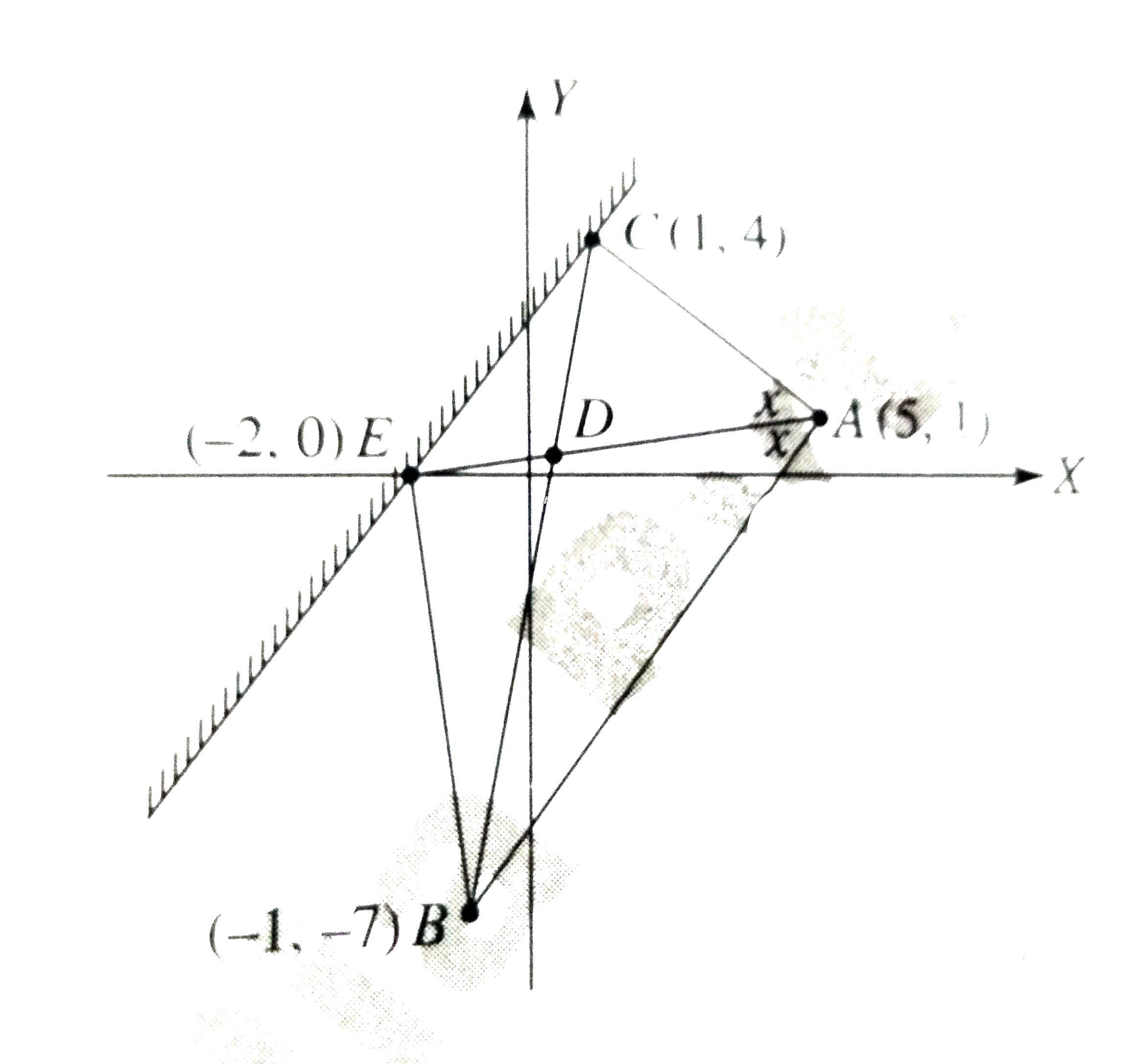
A triangle ABC has vertices `A(5, 1), B (-1, -7) and C(1, 4)` respectively. L be the line mirror passing through C and parallel to AB and a light ray eliminating from point A goes along the direction of internal bisector of the angle A, which meets the mirror and BC at E, D respectively. If sum of the areas of `triangle ACE` and `triangle ABE` is `K` sq units then`(2K)/5-6` is
A
17 sq. units
B
18 sq. units
C
`(50)/(3)` sq. units
D
20 sq. units
Text Solution
Verified by Experts
The correct Answer is:
C
`(AD)/(DE) =(BD)/(DC) =(AB)/(AC)` `:.` Point `D ((1)/(3),(1)/(3))` and `E(-2,0)`. Area of `DeltaADC +` Area of `DeltaBDE` `=(25)/(3) +(25)/(3)` `=(50)/(3)` sq. units
In Delta ABC, D and E are the midpoint of AB and AC respectively. Find the ratio of the areas of Delta ADE and Delta ABC .
The bisectors of the angles B and C of a triangle ABC, meet the opposite sides in D and E respectively.If DE|BC, prove that the triangle is isosceles.
A triangle ABC right angled at A has points A and B as (2, 3) and (0, -1) respectively. If BC = 5 units, then the point C is
AD is a median of Delta ABC. The bisector of /_ADB and /_ADC meet AB and AC in E and F respectively.Prove that EF |BC
A straight line parallel to the base BC of the triangle ABC intersects AB and AC at the points D and E respectively. If the area of the Delta ABE be 36 sq. cm, then the area of the Delta ACD is
CENGAGE-COORDINATE SYSTEM-Multiple Correct Answers Type