Home
Class 12
MATHS
A point moves such that the sum of the s...

A point moves such that the sum of the squares of its distances from the two sides of length ‘a’ of a rectangle is twice the sum of the squares of its distances from the other two sides of length b. The locus of the point can be:

A

a circle

B

an ellipse

C

a hyperbola

D

a pair of lines

Text Solution

Verified by Experts

The correct Answer is:
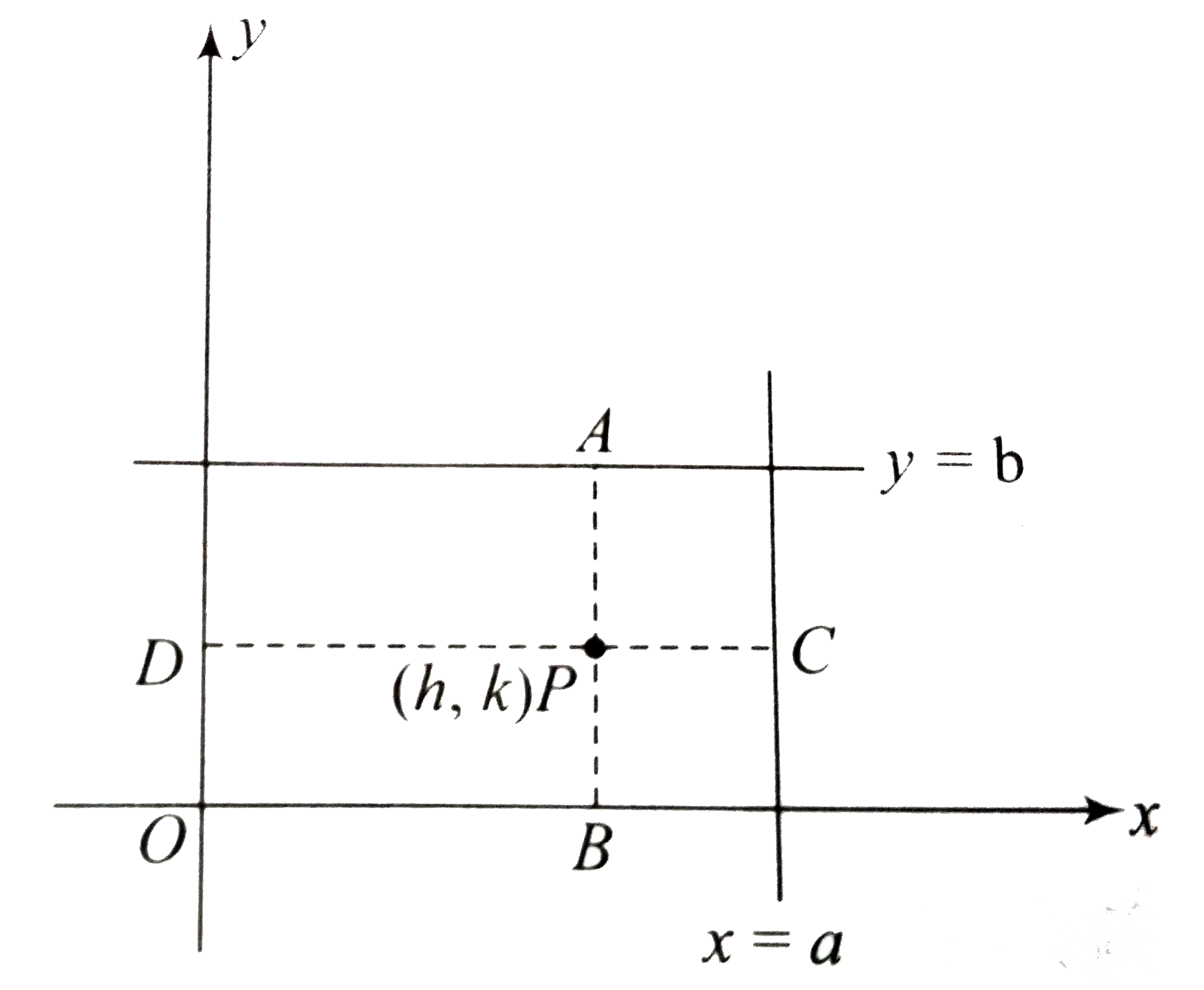
C, D

Let the two sides of the rectangle lie along x-axis and y-axis.

Let point P be (h,k)
Given that
`(PA)^(2) + (PB)^(2) = 2 (PC^(2)+PD^(2))`
`rArrk^(2) - (k-b)6(2) = 2(h^(2) + (a-h)^(2))`
`rArr 2k^(2) - 2kb + b^(2) = 4h^(2) - 4ah + 2a^(2)`
Replacing h by x and k by y
`rArr 2y^(2) - 2by + b^(2) = 4x^(2) - 4ax + 2a^(2)`
or `2(y^(2)-by) + b^(2) = 4(x^(2)-ax) + 2a^(2)`
or `4(x-(a)/(2))^(2) - 2(y-(b)/(2))^(2) = (b^(2))/(2) -a^(2)`
Hence it is a hyperbola if `(b^(2))/(2) -a^(2) ne 0`
or pair of lines if `(b^(2))/(2) -a^(@) =0`
Promotional Banner

Similar Questions

Explore conceptually related problems

A point moves such that the sum of the squares of its distances from the sides of a square of side unity is equal to 9, the locus of such point is

A point moves such that the sum of the squares of its distances from the sides of a square of side unity is equal to 9, the locus of such point

A point moves so that the sum of squares of its distances from the points (1,2) and (-2,1) is always 6. then its locus is

A point p is such that the sum of squares of its distance from the axes of coordinates is equal to the square of its distance from the line x-y=1. Find the locus of P

A point moves so that the sum of the squares of its distances from two intersecting straight lines is constant.Prove that its locus is an ellipse.

The locus of the point,for which the sum of the squares of distances from the coordinate axes is 25 is

Find the locus of a point which moves so that sum of the squares of its distance from the axes is equal to 3.

In triangle ABC, a = 4 and b = c = 2 sqrt(2) . A point P moves within the triangle such that the square of its distance from BC is half the area of rectangle contained by its distance from the other two sides. If D be the centre of locus of P, then

