Home
Class 12
MATHS
A ladder 13 m long is leaning against a ...

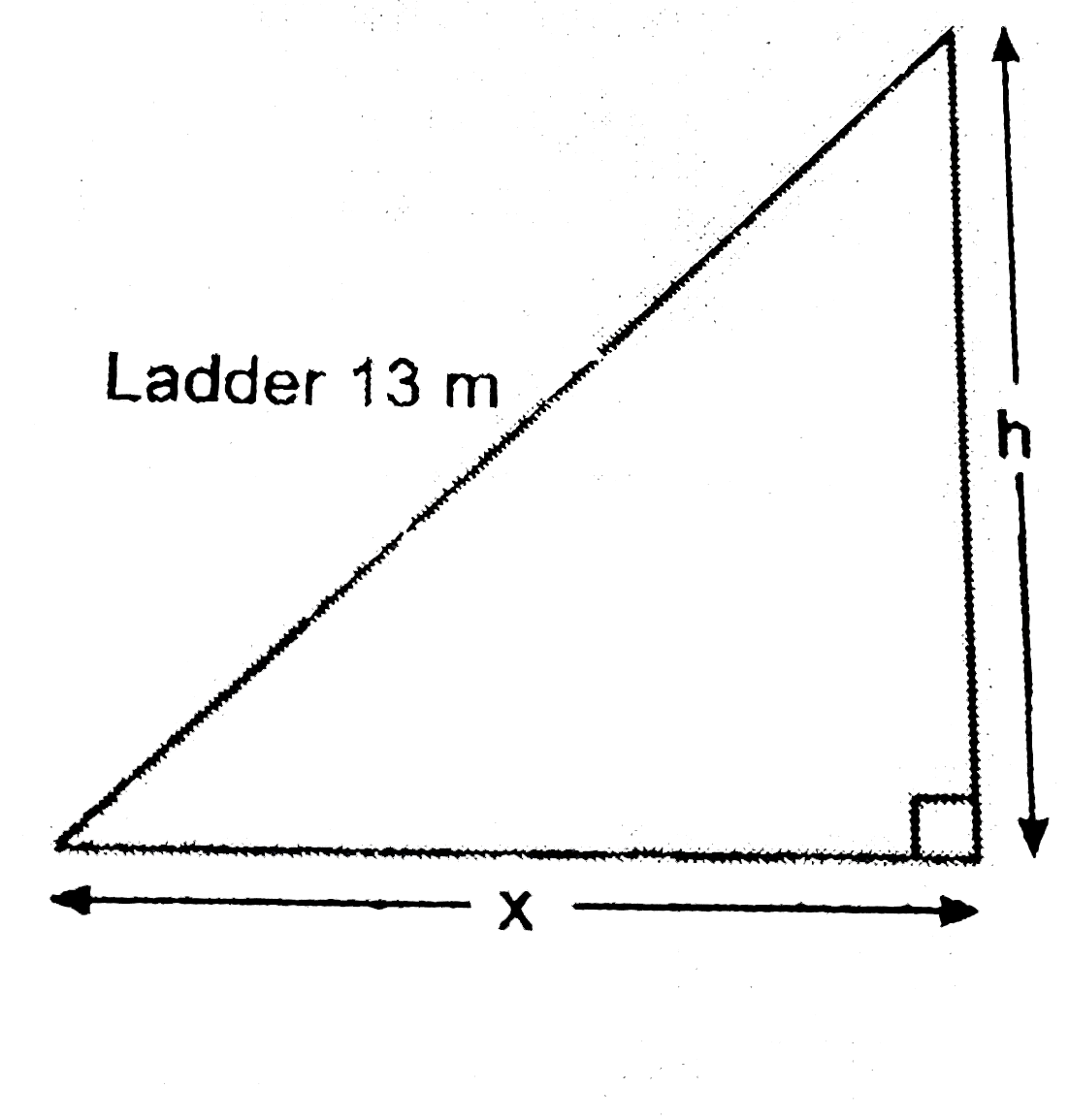
A ladder 13 m long is leaning against a wall. The bottom of the ladder is pulled along the ground away from the wall at the rate of 4 m/sec. Find the rate of decreasing at which the top of the ladder moving downwards on wall when the foot of the ladder is 5 m away from the wall.

A

`(-5)/3 m//sec.`

B

`(5)/3 m//sec.`

C

`(-10)/3 m//sec.`

D

`(10)/3 m//sec.`

Text Solution

Verified by Experts

The correct Answer is:
A

Let at any time 't' , the foot of the ladder be 'x' m away from the wall and the top of the ladder is at 'h' m height from the ground.
`:. h^(2)+x^(2)=13^(2)`
`rArr h = sqrt(169-x^(2))`
`rArr (dh)/(dt)=(-2x)/(2sqrt(169-x^(2))).(dx)/(dt)`
` At x = 5 m, (dx)/(dt)=4 m//sec`
` :. " "(dh)/(dt)= (-5)/(sqrt(169-5^(2)))xx4`
`=(-5 xx 4 )/(12) = (-5)/3 m//sec.`
Therefore the top of the ladder is moving downwards at a rate of `5/3 m//sec.`
Promotional Banner

Topper's Solved these Questions

  • APPLICATIONS OF DERIVATIVES

    NAGEEN PRAKASHAN|Exercise Exercise 6a|20 Videos
  • APPLICATIONS OF DERIVATIVES

    NAGEEN PRAKASHAN|Exercise Exercise 6b|11 Videos
  • APPLICATIONS OF INTEGRALS

    NAGEEN PRAKASHAN|Exercise Miscellaneous Exercise|19 Videos

Similar Questions

Explore conceptually related problems

A ladder 5m long is leaning against a wall. The bottom of the ladder is pulled along the ground,away from the wall,at the rate of 2cm/s. How fast is its height on the wall decreasing when the foot of the ladder is 4m away from the wall?

A ladder 5m long is leaning against a wall. The bottom of the ladder is pulled along the ground,away from the wall,at the rate of 2cm/s. How fast is its height on the wall decreasing when the foot of the ladder is 4m away from the wall?

A ladder 5m long is leaning against a wall. The bottom of the ladder is pulled along the ground,away from the wall at the rate of 10cm/s. How fast is the angle between the ladder and the ground decreasing when the foot of the ladder is 2m away from the wall?

A 13-m long ladder is leaning against a wall. The bottom of the ladder is pulled along the ground, away from the wall, at the rate of 2 m/s. How fast is its height on the wall decreasing when the foot of the ladder is 5m aways from the wall ?

A ladder 5m long is leaning against a wall. The foot of the ladder is pulled out along the ground away from from the wall at a rate of 2 m//s . How fast is the height of ladder on the decreasing at the instant when the foot of the ladder is 4 m away from the wall?

A ladder 13m long leans against a wall. The foot of the ladder is pulled along the ground away from the wall, at the rate of 1.5m/sec. How fast is the angle theta between the ladder and the ground is changing when the foot of the ladder is 12m away from the wall.

A ladder 5 m in length is resting against vertical wall. The bottom of the ladder is pulled along the ground away from the wall at the rate of 1.5m/sec. The length of the highest point of the ladder when the foot of the ladder 4.0 m away from the wall decreases at the rate of

A ladder 10 meter long is leaning against a vertical wall. If the bottom of the ladder is pulled horizontally away from the wall at the rate of 1.2 meters per seconds, find how fast the top of the ladder is sliding down the wall when the bottom is 6 meters away from the wall

A ladder 5 m long leans against a vertical wall. The bottom of the ladder is 3m from the wall. If the bottom of the ladder is pulled 1 m farther from the wall, how much does the top of the ladder slide down the wall

A 2 m ladder leans against a vertical wall. If the top of the ladder begins to slide down the wall at the rate 25 cm/s, then the rate (in cm/s) at which the bottom of the ladder slides away from the wall on the horizontal ground when the top of the ladder is 1 m above the ground is

NAGEEN PRAKASHAN-APPLICATIONS OF DERIVATIVES-Miscellaneous Exercise
  1. A ladder 13 m long is leaning against a wall. The bottom of the ladder...

    Text Solution

    |

  2. Using differentials, find the approximate value of each of the follow...

    Text Solution

    |

  3. Show that the function given by f(x)=(logx)/xhas maximum at x = e.

    Text Solution

    |

  4. The two equal sides of an isosceles triangle with fixed base b are ...

    Text Solution

    |

  5. Find the equation of the normal to the curve x^2=4ywhich passes throu...

    Text Solution

    |

  6. Show that the normal at any point theta to the curve x=acostheta+at...

    Text Solution

    |

  7. Find the intervals in which the function f given by f(x)=(4sinx-2x-x c...

    Text Solution

    |

  8. Find the intervals in which the function f given by f(x)=\ x^3+1/(...

    Text Solution

    |

  9. Find the maximum area of an isosceles triangle inscribed in the ellip...

    Text Solution

    |

  10. A tank with rectangular base and rectangular sides, open at the top is...

    Text Solution

    |

  11. The sum of the perimeter of a circle and square is k, where k is so...

    Text Solution

    |

  12. A window is in the form of a rectangle surmounted by a semicircular...

    Text Solution

    |

  13. A point on the hypotenuse of a triangle is at distance a and b from t...

    Text Solution

    |

  14. Find the points at which the function f given by f(x)=(x-2)^4(x+1)^3 h...

    Text Solution

    |

  15. Find the absolute maximum and minimum values of the function f give...

    Text Solution

    |

  16. Show that the altitude of the right circular cone of maximum volume...

    Text Solution

    |

  17. Let f be a function defined on [a, b] such that f^(prime)(x)>0, for al...

    Text Solution

    |

  18. Show that the height of the cylinder of maximum volume that can be in...

    Text Solution

    |

  19. Show that height of the cylinder of greatest volume which can be insc...

    Text Solution

    |

  20. A cylindrical tank of radius 10 m is being filled with wheat at the r...

    Text Solution

    |

  21. The slope of the tangent to the curve x=t^2+3t-8,y=2t^2-2t-5at the po...

    Text Solution

    |

