Home
Class 12
MATHS
Find the points at which the function f ...

Find the points at which the function `f` given by `f(x)=(x-2)^4(x+1)^3` has local maxima local minima point of inflexion

Text Solution

Verified by Experts
Given equation is ,
`f(x)=(x-2)^(4)(x+1)^(3)`
`f'(x) = (x-2)^(4)3(x+1)^(2)+(x+1)^(3)4(x-2)^(3)`
` = (x-2)^(3)(x+1)^(2){3(x-2)+4(x+1)}`
` = (x-2)^(3)(x+1)^(2)(7x-2)`
For maxima/minima, `f'(x)=0`
` rArr (x-2)^(3)(x+1)^(2)(7x-2)=0`
`rArr x= 2, -1, 2/7`
(i) At ` x = 2/7`,

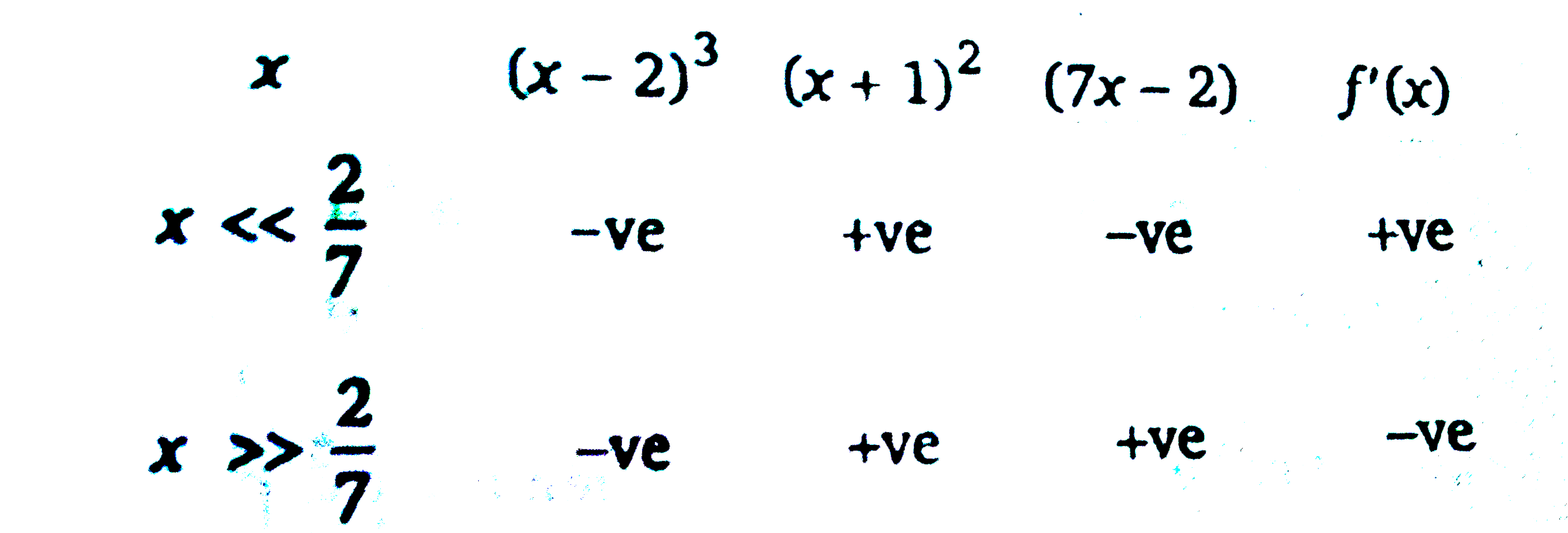
`:. f'(x)` changes its sign from positive to negative, so ` x = 2/7` is a point of local maxima.
(ii) At x = 2,

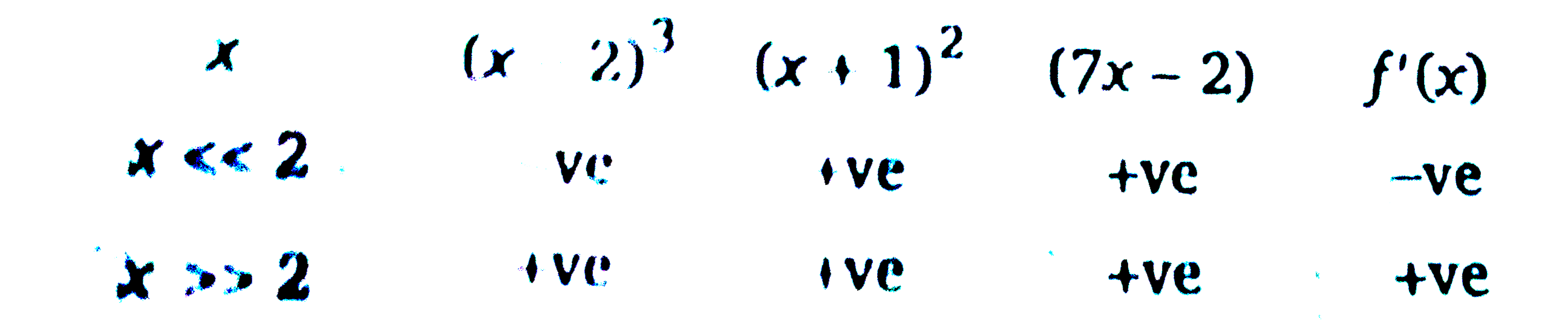
`:. f'(x)` changes its sign from negative to positive, so x = 2 is a point of local minima.
(iii) At x =- 1,

`:. f'(x)` does not change its sign , so = - 1 is a point of inflexion.
Promotional Banner

Topper's Solved these Questions

  • APPLICATIONS OF DERIVATIVES

    NAGEEN PRAKASHAN|Exercise Exercise 6.5|29 Videos
  • APPLICATIONS OF INTEGRALS

    NAGEEN PRAKASHAN|Exercise Miscellaneous Exercise|19 Videos

Similar Questions

Explore conceptually related problems

Find the points at which the function f given by f(x)=(x-2)^(4)(x+1)^(3) has local maxima and local minima and points of inflexion.

Find the points of local maxima and minima of the function f(x)=x^(2)-4x .

Find the points of local maxima and minima of the function f given by f(x)= x^(3)-12x^(2)+36x+5 .

For the function f(x)=4/3x^3-8x^2+16 x+5,x=2 is a point of local maxima (2) local minima point of inflexion (4) decreasing increasing

Find all points of local maxima and local minima of the function f given by f(x)=x^(3)-3x+3

Find the local maxima and minima of the function f(x)=x^(3)-2x^(2)+x+6 .

Find the points of local maxima/minima of function f(x) = x ln x

Find the points of local maxima/minima of function f(x) = - (x - 1)^(3) (x + 1)^(2)

Find all the points of local maxima and minima of the function f given by f(x)= sinx- cosx , x in [0,2pi]

Find all the points of local maxima and minima of the function f given by f(x)= 4x^(3)-12x^(2)+12x+10

NAGEEN PRAKASHAN-APPLICATIONS OF DERIVATIVES-Miscellaneous Exercise
  1. Show that the normal at any point theta to the curve x=acostheta+at...

    Text Solution

    |

  2. Find the intervals in which the function f given by f(x)=(4sinx-2x-x c...

    Text Solution

    |

  3. Find the intervals in which the function f given by f(x)=\ x^3+1/(...

    Text Solution

    |

  4. Find the maximum area of an isosceles triangle inscribed in the ellip...

    Text Solution

    |

  5. A tank with rectangular base and rectangular sides, open at the top is...

    Text Solution

    |

  6. The sum of the perimeter of a circle and square is k, where k is so...

    Text Solution

    |

  7. A window is in the form of a rectangle surmounted by a semicircular...

    Text Solution

    |

  8. A point on the hypotenuse of a triangle is at distance a and b from t...

    Text Solution

    |

  9. Find the points at which the function f given by f(x)=(x-2)^4(x+1)^3 h...

    Text Solution

    |

  10. Find the absolute maximum and minimum values of the function f give...

    Text Solution

    |

  11. Show that the altitude of the right circular cone of maximum volume...

    Text Solution

    |

  12. Let f be a function defined on [a, b] such that f^(prime)(x)>0, for al...

    Text Solution

    |

  13. Show that the height of the cylinder of maximum volume that can be in...

    Text Solution

    |

  14. Show that height of the cylinder of greatest volume which can be insc...

    Text Solution

    |

  15. A cylindrical tank of radius 10 m is being filled with wheat at the r...

    Text Solution

    |

  16. The slope of the tangent to the curve x=t^2+3t-8,y=2t^2-2t-5at the po...

    Text Solution

    |

  17. The line y = m x + 1is a tangent to the curve y^2=4xif the value of m...

    Text Solution

    |

  18. The normal at the point (1,1) on the curve 2y+x^2=3 is

    Text Solution

    |

  19. The normal to the curve x^2=4y passing (1,2) is

    Text Solution

    |

  20. Find the point on the curve 9y^2=x^3, where the normal to the curve ma...

    Text Solution

    |