

Home
Class 11
PHYSICS
A balloon starts rising upwards with con...

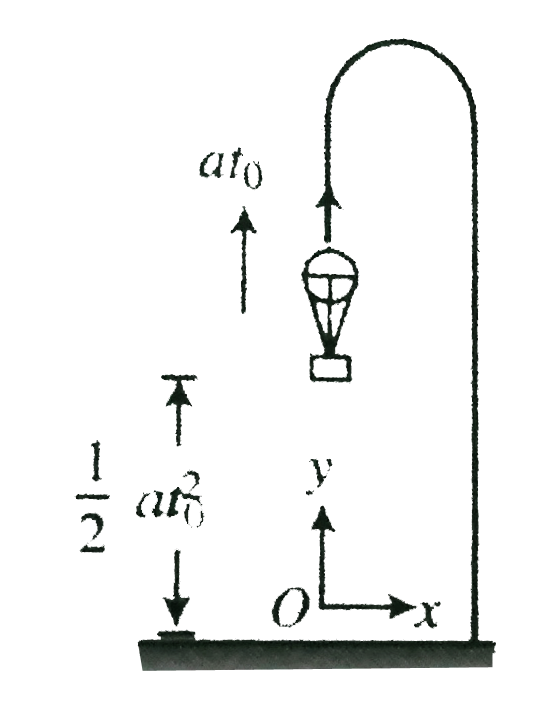
A balloon starts rising upwards with constant acceleration a and afrer time `t_(0)`, second, a packet is dropped from it which reaches the ground aftre t seconds of dropping . Derermine the value of `t`
.

Promotional Banner

Similar Questions

Explore conceptually related problems

A ballon starts rising from ground from rest at some constant acceleration. After some time, a storne is dropped from it. If the stone reaches the ground in the same time in which balloon reached the dropping poing from ground, find the acceleration of the balloon.

A ballon starts risintg from ground from rest at some constant acceleration. After some time, a storne is dropped from it. If the stone reaches the ground in the same time in which balloon reached the dropping poing from ground, find the acceleration of the balloon.

A balloon starts from the state of rest from the ground with constant acceleration g/n. after time T, a stone is dropped from the balloon. If stone takes time T to reach the ground then calculate value of n.

A balloon is rising upwards with an acceleration. A stone is dropped frome the balloon, is at a height of 50.4 m. The stone reaches the ground after 6s. What was the velocity of the balloon when the stone was dropped?

A balloon starts rising from ground from rest with an upward acceleration 2m//s^(2) . Just after 1 s, a stone is dropped from it. The time taken by stone to strike the ground is nearly

A balloon starts rising from ground from rest with an upward acceleration 2m//s^(2) . Just after 1 s, a stone is dropped from it. The time taken by stone to strike the ground is nearly

A stone is let to fall from a balloon ascending with an acceleration f . Aftre time t . A second stonr is dropped. Prove that the distance between the stones after time t' since the second stone is dropped, is (1)/(2) (f+g)t(t+2t') .

A stone is let to fall from a balloon ascending with an acceleration f . After time t , a second stone is dropped. Prove that the distance between the stones after time t' since the second stone is dropped, is (1)/(2) (f+g)t(t+2t') .

A balloon starts rising with constant acceleration 2 m//s^(2) from ground at t=0s . A stone is dropped at t=5s . S-t graph for the given situation is shown in figure answer the following Q. The maximum hight reached by the stone is