

Home
Class 11
PHYSICS
Block B has mass m and is released from ...

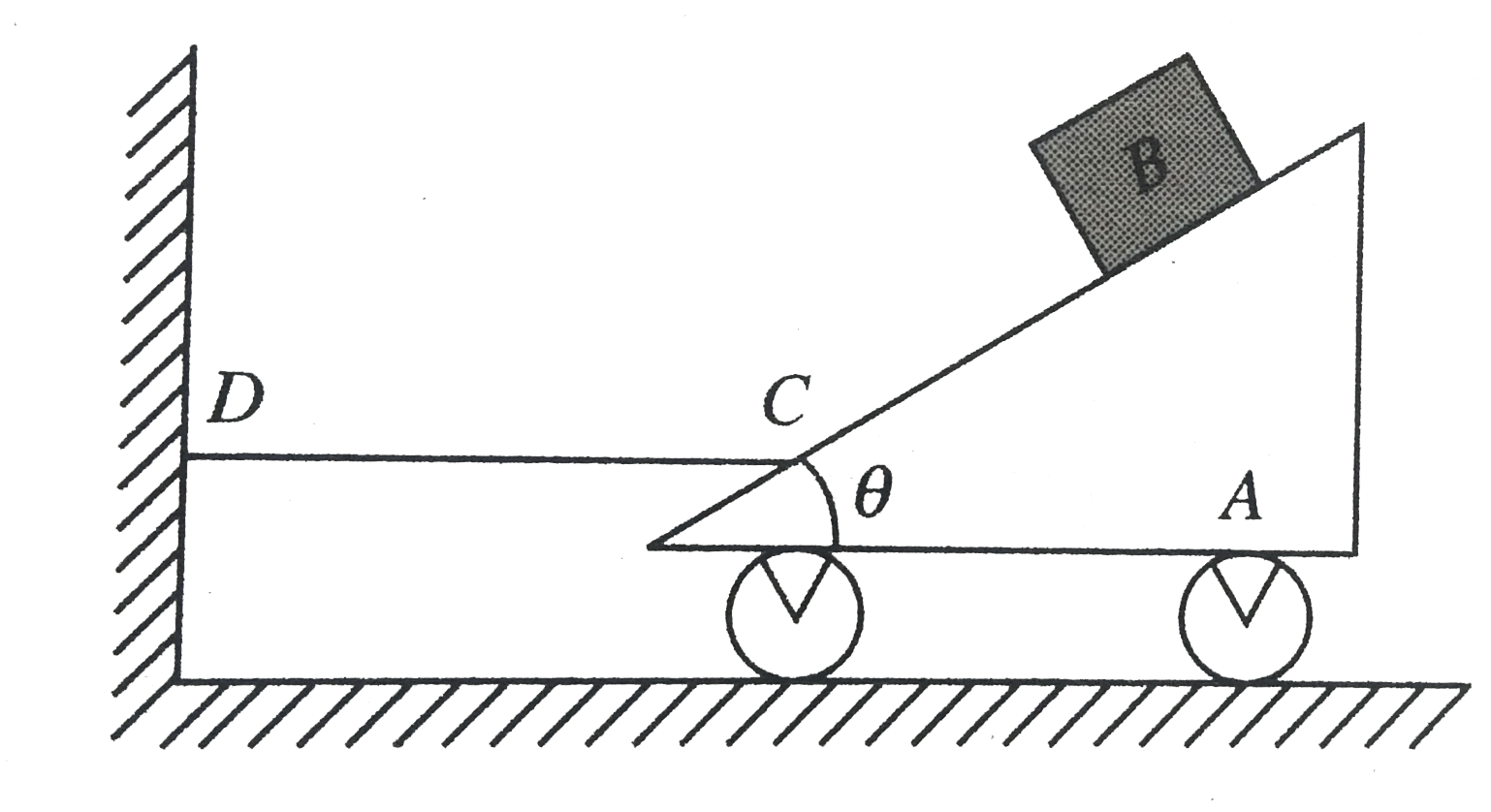
Block B has mass m and is released from rest when it is on top of wedge A, which has a mass 3m. Determine the tension in cord CD needed to hold the wedge from moving while B is sliding down A. Neglect friction.

Promotional Banner

Similar Questions

Explore conceptually related problems

A block of mass m is released from the top of a wedge of mass M as shown in figure. Find the displacement of wedges on the horizontal ground when the block reaches the bottom of the wedges. Neglect friction everywhere.

A block of mass m is released from the top of a wedge of mass M as shown in figure. Find the displacement of wedges on the horizontal ground when the block reaches the bottom of the wedges. Neglect friction everywhere.

A block of mass m is released from a wedge of mass m as shown in figure . Find the time taken by the block to reach the end of the wedge.

A block of mass m is released from a wedge of mass m as shown in figure . Find the time taken by the block to reach the end of the wedge.

A small ball ( uniform solid sphere ) of mass m is released from the top of a wedge of the same mass m . The wedge is free to move on a smooth horizontal surface. The ball rolld without sliding on the wedge. The required height of the wedge are mentioned in the figure. The total kinetic energy of the ball just before it falls on the ground

A small ball ( uniform solid sphere ) of mass m is released from the top of a wedge of the same mass m . The wedge is free to move on a smooth horizontal surface. The ball rolld without sliding on the wedge. The required height of the wedge are mentioned in the figure. The total kinetic energy of the ball just before it falls on the ground

In the figure, the block B of mass m starts from rest at the top of a wedge W of mass M . All surfaces are without friction. W can slide on the ground. B slides down onto the ground, moves along it with a speed v, has an elastic collision with the wall, and climbs back on to W .

In the figure, the block B of mass m starts from rest at the top of a wedge W of mass M . All surfaces are without friction. W can slide on the ground. B slides down onto the ground, moves along it with a speed v, has an elastic collision with the wall, and climbs back on to W .

In the figure, the block B of mass m starts from rest at the top of a wedge W of mass M. All surfaces are without friction. W can slide on the ground. B slides down onto the ground, moves along it with a speed v, has an elastic collision with the wall, and climbs back two W.

A ball of mass m is released from A inside a smooth wedge of mass m as shown in figure. What is the speed of the wedge when the ball reaches point B?