

Home
Class 11
PHYSICS
A spherical container made of non conduc...

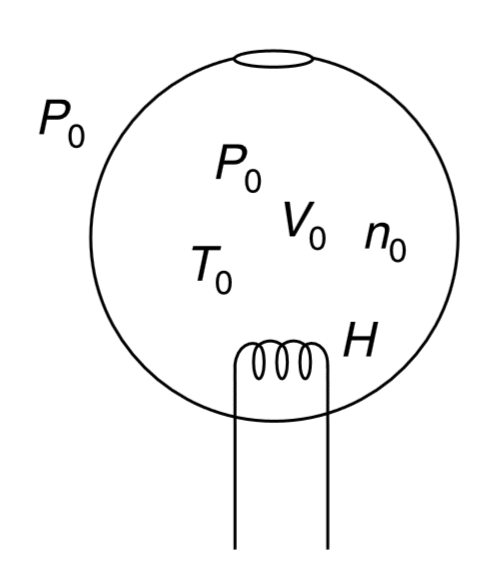
A spherical container made of non conducting wall has a small orifice in it. Initially air is filled in it at atmospheric pressure `(P_(0))` and atmospheric temperature `(T_(0))`. Using a small heater, heat is slowly supplied to the air inside the container at a constant rate of H J/s. Assuming air to be an ideal diatomic gas find its temperature as a function of time inside the container.

Promotional Banner

Similar Questions

Explore conceptually related problems

An exhausted chamber with nonconducting walls is connected through a valve to the atmosphere where the pressure is p_0 and the temperature is T_0 .The valve is openeds lightly and air flows into the chamber until the pressure with in the chamber is p_0 .Assuming the air to be have like an ideal gas with constant heat capacities, the final temperature of the air in the chamber is

Two idential container joined by a small pipe initially contain the same gas at pressure p_(0) and absolute temperature T_(0) . One container is now maintained at the same temperature while the other is heated to 2T_(0) . The common pressure of the gas

Two idential container joined by a small pipe initially contain the same gas at pressure p_(0) and absolute temperature T_(0) . One container is now maintained at the same temperature while the other is heated to 2T_(0) . The common pressure of the gas

Two containers A and B of equal volume V_(0)//2 each are connected by a narrow tube which can be closed by a value. The containers are fitted with pistons which can be moved to change the volumes. Initially the value is open and the containers contain an ideal gas (C_(p)//C_(v)=gamma) at atmospheric pressure P_(0) and atmospheric temperature 2T_(0) . The walls of the containers A are highly conducting and of B are non-conducting. The value is now closed and the pistons are slowly pulled out to increase the volumes of the containers to double the original value. (a) Calculate the temperature and pressure in the two containers. (b) The value is now opened for sufficient time so that the gases acquire a common temperature and pressure. Find the new values of the temperature and the pressure.

Two containers A and B of equal volume V_(0)//2 each are connected by a narrow tube which can be closed by a value. The containers are fitted with pistons which can be moved to change the volumes. Initially the value is open and the containers contain an ideal gas (C_(p)//C_(v)=gamma) at atmospheric pressure P_(0) and atmospheric temperature 2T_(0) . The walls of the containers A are highly conducting and of B are non-conducting. The value is now closed and the pistons are slowly pulled out to increase the volumes of the containers to double the original value. (a) Calculate the temperature and pressure in the two containers. (b) The value is now opened for sufficient time so that the gases acquire a common temperature and pressure. Find the new values of the temperature and the pressure.

Conside a cubical vessel of edge a having a small hole in one of its walls is r. At time t=0 , it contains air at atmospheric pressure p_(a) and temperature T_(0) . The temperature of the surrouding air is T_(a)(gtT_(0) . Find the amount of the gas (in moles) in the vessel at time t. Take C_(v) of air to be 5 R//2 .

An adiabatic cylinder of cross section A is fitted with a mass less conducting piston of thickness d and thermal conductivity K. Initially, a monatomic gas at temperature T_(0) and pressure P_(0) occupies a volume V_(0) in the cylinder. The atmospheric pressure is P_(0) and the atmospheric temperature is T_(1) (gt T_(0)) . Find (a) the temperature of the gas as a function of time (b) the height raised by the piston as a function of time. Neglect friction and heat capacities of the container and the piston.

Two containers, each of volume V_(0) , joined by a small pipe initially contain the same gas at pressure P_(0) and at absolute temperature T_(0) . One container is now maintained at the same temperature while the other is heated to 2T_(0) . Find(1) commom pressure of the gas, and(2) the number of moles of gas in the container at temperature 2T_(0)