Home
Class 10
CHEMISTRY
J-shped tube closed at one end was used ...

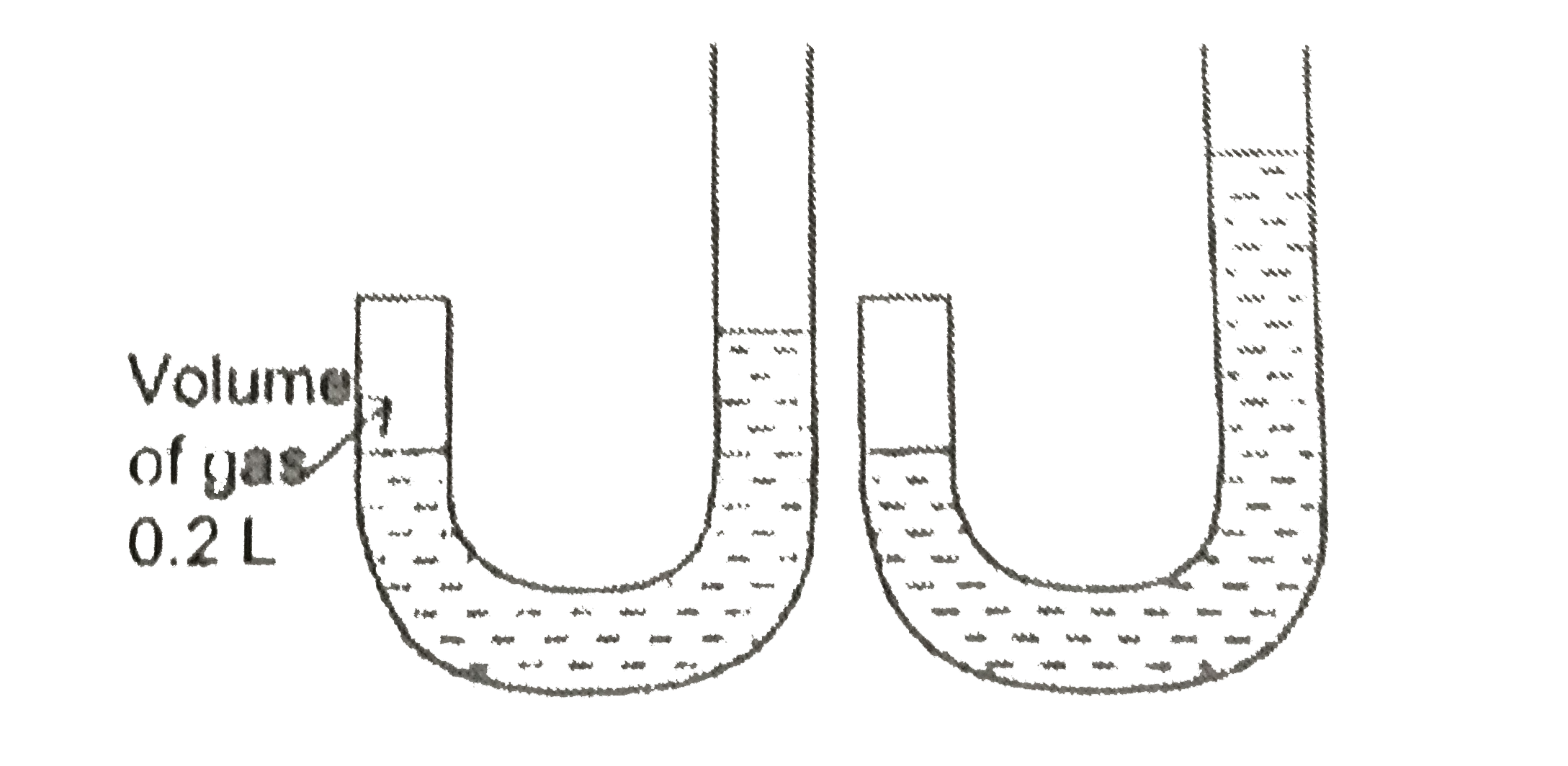
J-shped tube closed at one end was used by Boyle to study the relationship between the pressure of the trapped gas and its volume. Such a set up is given here. Initially some amount of gas is taken in the tube and mercury is poured in it. The volume of the gas is 0.2 L and the difference in the height of the mercury column is 760 mm of Hg. Now, some more amount of mercury is poured and the difference in the height of the mercury column is found to be 1140 mm of Hg. Calculate the new volume of the gas considering the temperature constant.

Text Solution

Verified by Experts

`V_(1) = 0.2 L V_(2)` =?
`P_(1) = 760 "mm "P_(2) = 1140" mm "+ 760` mm
According to Boyle's law ` P_(1) V_(1) = P_(2) V_(2)`
` 1520 xx 0.2 = 1900 xx V_(2) rArr V_(2) = (1520 xx 0.2)/(1900) = 0.16 `L
Promotional Banner

Similar Questions

Explore conceptually related problems

Establish the relationship between temperature pressure and volume of a given mass of a gas.

Calculate the atmospheric pressure , if the height of mercury column in a barometer is 760 mm

A quantity of gas is collected in a gradutated tube over the mercury. The volume of the gas at 20^(@)C is 50.0 mL and the level of the mercury in the tube is 100 mm above the outside mercury level. The barometer reads 750 mm . Volume at STP is

Derive the relation between specific heats of a gas at constant pressure and at constant volume, when the amount of gas is one gram molecule.

Given J-tube has 2.4 mL of air at a pressure of 1 atm. On adding mercury, volume of air is reduced to 1.9 mL as shown. Difference in the level of mercury in two columns is:

An open U-tube contains mercury. When 11.2 cm of water is poured into one of the arms of the tube, how high does the mercury rise in the other arm from its initial level ?

A gas heated from 273 k to 373k at 1atm pressure if the initial volume of the gas is 10L its final volume would be

The pressure of an ideal gas varies with volume as P= aV, where a is a constant. One mole of the gas is allowed to undergo expansion such that its volume becomes ‘m’ times its initial volume. The work done by the gas in the process is
