Home
Class 10
CHEMISTRY
In the fraph given below, identify the ...

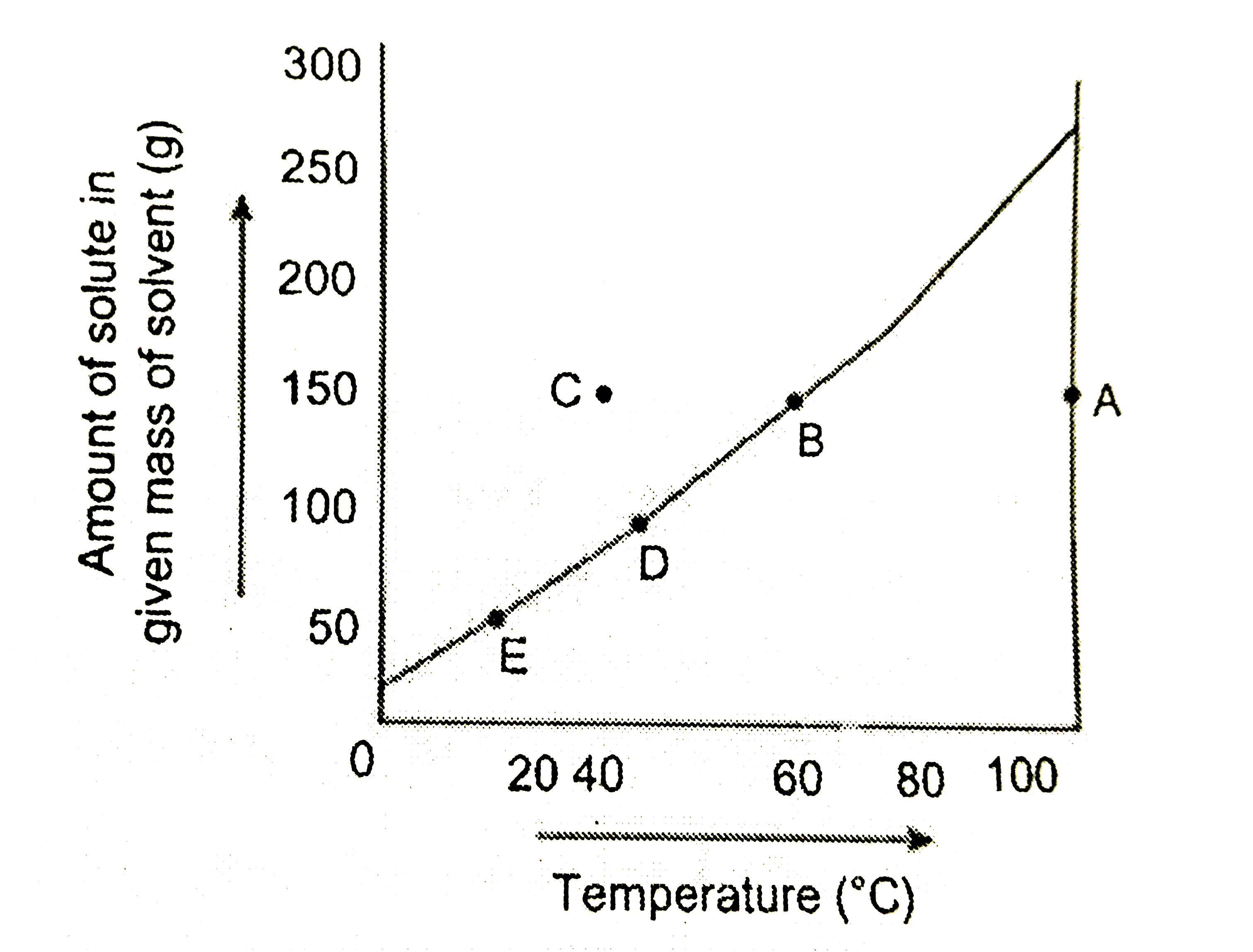
In the fraph given below, identify the states of solution at the various points A, B, C and E.If the solution is cooled from point 'A' at which temperature, precipitation normally starts ? Also, find out the amount of solute precipitated at `40^(@)C` at A and the amount of solute in the solution at point 'E'. What would be the maximum amount of solute that can be precipitated in the process?

Text Solution

Verified by Experts

The curve indicates that the solubility of the solute at `100^(@)C` is 250 g. However, the given solution contains only 150 g of solute. The solution at point 'A' is an unsaturated solution. Therefore, no precipitation takes place up to point 'B' at `60^(@) C`, where the solution becomes saturated, with just 150 gas solubility. Point 'B' indicates saturated solution and hence, precipitations normally starts at `60^(@)C`. With the fall in temperature, solubility decreases and the extra amount should get precipitated: Point 'C' at `40^(@)C` indicates that the solution still contained 150 g of solute, which is a supersaturated solution. That means, it is possible to cool a solution from `60^(@)C" to" 40^(@)C` without any crystallisation by creating conditions such as absence of dust particles. At `40^(@)C`, when crystallisation starts, the solution ultimately becomes saturated , and this is represented by point D.At point D (`40^(@)C`), the solubility is 100 g . That means, 50 g of solute would have been precipitated. At 'E' also the solution remains saturated by precipitating 25 g more of solute leaving behing 75 g of solute in the solution. At `0^(@)C`, when water starts to solidify, the solution still contains 5 g of solute without precipitation. That means, 125 g of solute can be precipitated.
Promotional Banner

Topper's Solved these Questions

  • MOLE CONCEPT, STOICHIOMETRY AND BEHAVIOUR OF GASES

    PEARSON IIT JEE FOUNDATION|Exercise Level 2|23 Videos
  • METALLURGY

    PEARSON IIT JEE FOUNDATION|Exercise LEVEL 3|10 Videos
  • PERIODIC TABLE

    PEARSON IIT JEE FOUNDATION|Exercise LEVEL 3 APPLICATION-BASED QUESTIONS|5 Videos

Similar Questions

Explore conceptually related problems

Colligative properties depend upon the amount fraction of solute in solution.

What happens when a freshly precipitated Fe(OH)_(3) is shaken with little amount of dilute solution of FeCl_(3) ?

When 400 g of a 20% solution by weight was cooled, 50 g of solute precipitated. What is the percentage by mass of solute in the remaining solution ?

A solution which cannot dissolve any more amount of solute in it is called "_____"
