

Home
Class 11
PHYSICS
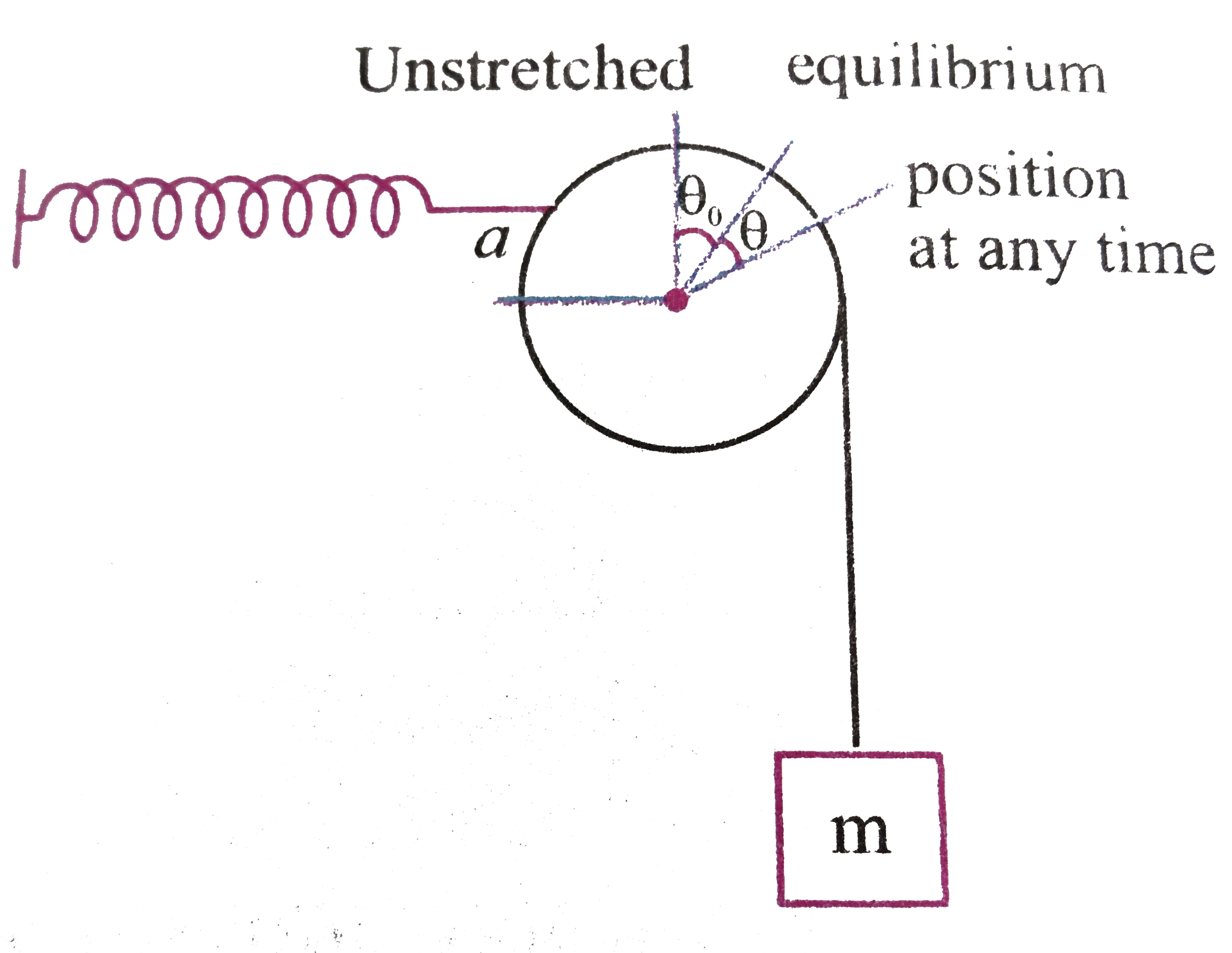
In the system shown in Fig, a disc pivot...

In the system shown in Fig, a disc pivoted at its centre has a spring attached at a distance 'a' form centre and `a` mass 'm' that cen rotate the disc. For small angular displacement calculate the frequency of oscillation

Promotional Banner

Similar Questions

Explore conceptually related problems

A uniform disc of mass m and radius R is pivoted smoothly at its centre of mass. A light spring of stiffness k is attached with the dics tangentially as shown in the Fig. Find the angular frequency in (rad)/(s) of torsional oscillation of the disc. (Take m=5kg and K=10(N)/(m) .)

A uniform disc of mass m and radius R is pivoted smoothly at its centre of mass. A light spring of stiffness k is attached with the dics tangentially as shown in the Fig. Find the angular frequency in (rad)/(s) of torsional oscillation of the disc. (Take m=5kg and K=10(N)/(m) .)

A uniform disc of mass m and radius R is pivoted smoothly at its centre of mass. A light spring of stiffness k is attached with the dics tangentially as shown in the Fig. Find the angular frequency in (rad)/(s) of torsional oscillation of the disc. (Take m=5kg and K=10(N)/(m) .)

What will be distance of centre of mass of the disc (See fig.) from its geometrical centre ?

A disc of mass M = 2m and radius R is pivoted at its centre. The disc is free to rotate in the vertical plane about its horizontal axis through its centre O. A particle of mass m is stuck on the periphery of the disc. Find the frequency of small oscillations of the system about its equilibrium position.

One end of spring of spring constant k is attached to the centre of a disc of mass m and radius R and the other end of the spring connected to a rigid wall. A string is wrapped on the disc and the end A of the string (as shown in the figure) is pulled through a distance a and then released. The disc is placed on a horizontal rough surface and there is no slipping at any contact point. What is the amplitude of the oscillation of the centre of the disc?

One end of a metal rod of length L and mass M is pivoted to a fixed support and to its free end, a thin disc of mass m and radius r (L) is attached at its centre. In one case, the disc is attached to the rod in such a way that it is not free to rotate about its centre and in another case, teh disc is free to rotate about its centre. When the rod-disc system is displaced slightly from its equilibrium position and released. it peforms S.H.M. in vertical plane. Compare the restoring torque acting on the system and angular frequency in both the cases.