
Home
Class 12
CHEMISTRY
Which of the following will not undergo ...

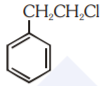
Which of the following will not undergo `S_N^1` reaction with `OH^-`

A

B

C

D

Text Solution

AI Generated Solution

The correct Answer is:

To determine which of the given compounds will not undergo an \( S_N^1 \) reaction with \( OH^- \), we need to analyze the stability of the carbocations that would form during the reaction. The \( S_N^1 \) mechanism involves two main steps: the formation of a carbocation intermediate and the attack of the nucleophile (in this case, \( OH^- \)) on the carbocation. ### Step-by-Step Solution: 1. **Identify the Compounds**: List the compounds provided in the question. For this example, let's assume we have the following compounds: - Compound A: \( CH_3CH_2Cl \) (ethyl chloride) - Compound B: \( (CH_3)_3CCl \) (tert-butyl chloride) - Compound C: \( C_6H_5CH_2Cl \) (benzyl chloride) - Compound D: \( CH_3CHClCH_3 \) (isopropyl chloride) 2. **Determine Carbocation Formation**: For each compound, determine the type of carbocation that would form after the leaving group (Cl) departs: - **Compound A**: Forms a primary carbocation (\( CH_3CH_2^+ \)), which is unstable. - **Compound B**: Forms a tertiary carbocation (\( (CH_3)_3C^+ \)), which is very stable. - **Compound C**: Forms a benzyl carbocation (\( C_6H_5CH_2^+ \)), which is stabilized by resonance. - **Compound D**: Forms a secondary carbocation (\( CH_3C^+HCH_3 \)), which is relatively stable. 3. **Evaluate Stability of Carbocations**: The stability of carbocations increases with the degree of substitution: - Tertiary > Secondary > Primary > Methyl - Benzyl carbocations are also stable due to resonance. 4. **Identify the Compound that Will Not Undergo \( S_N^1 \)**: - **Compound A** (ethyl chloride) forms a primary carbocation, which is too unstable to undergo an \( S_N^1 \) reaction. Therefore, it will not react with \( OH^- \) via this mechanism. - The other compounds (B, C, and D) form stable carbocations and can undergo \( S_N^1 \) reactions. ### Conclusion: The compound that will not undergo an \( S_N^1 \) reaction with \( OH^- \) is **Compound A: \( CH_3CH_2Cl \)**.
Promotional Banner

Topper's Solved these Questions

  • POLYMERS

    NEET PREVIOUS YEAR (YEARWISE + CHAPTERWISE)|Exercise Exercise|29 Videos
  • RE-NEET 2024

    NEET PREVIOUS YEAR (YEARWISE + CHAPTERWISE)|Exercise Question|50 Videos

Similar Questions

Explore conceptually related problems

Which of the following will not undergo HVZ reaction?

Which of the following is not true for S_(N^(1)) reaction ?

Which of the following alkyl halides will undergo S_N1 reaction most readily ?

Which of the following haloalkanes would undergo S_(N^(2)) reaction faster

NEET PREVIOUS YEAR (YEARWISE + CHAPTERWISE)-RE-NEET 2020-All Questions
  1. Among the compounds shown below which one revealed a linear structure ...

    Text Solution

    |

  2. Which of the following compounds is most reactive in electrophilic aro...

    Text Solution

    |

  3. Which of the following will not undergo SN^1 reaction with OH^-

    Text Solution

    |

  4. Which of the following will not true abount chloramphenicol ?

    Text Solution

    |

  5. Which of the following statement is correct about Bakellite?

    Text Solution

    |

  6. If for a certain reaction trianglerH is 30KJ mol^(-1) at 450K, the val...

    Text Solution

    |

  7. Match the element in column I with that in columb II. Identify the...

    Text Solution

    |

  8. Which of the following is a free radical substitution reaction?

    Text Solution

    |

  9. The reaction of concentrated sulphuric acid with carbohydrates (C(12)H...

    Text Solution

    |

  10. Which of the following substituted phenols is the strongest acid?

    Text Solution

    |

  11. Match the compounds of Xe in column I with the molecular structure in ...

    Text Solution

    |

  12. The half life for a zero order reaction having 0.02M initial concentra...

    Text Solution

    |

  13. Identify the incorrect statement from the following:

    Text Solution

    |

  14. Match the following aspects with the respective metal.

    Text Solution

    |

  15. If 8g of a non-electrolyte solute is dissolved in 114g of n-octane to ...

    Text Solution

    |

  16. Match the coordination number and type of hybridisation with distribut...

    Text Solution

    |

  17. The number of angular nodes and radical nodes in 3s orbital are

    Text Solution

    |

  18. Identify the correct statement from the following

    Text Solution

    |

  19. Deficiency of which vitamin causes osteomalacia?

    Text Solution

    |

  20. Identify the wrongly matched pair.

    Text Solution

    |
