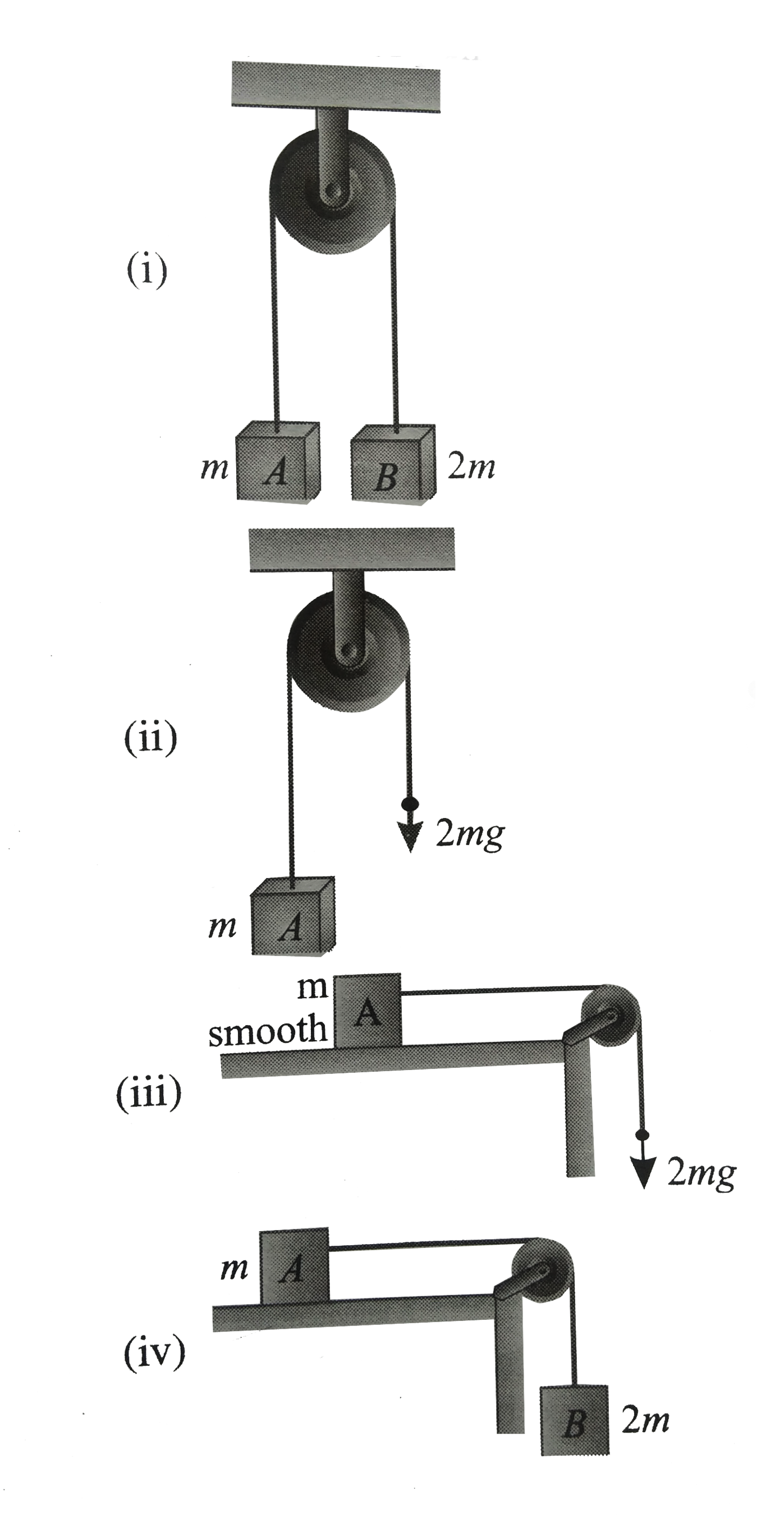
 In which of the following cases the magnitude of acceleration of the block A will be maximum (neglecting friction, mass of pulley and string)


Similar Questions
Explore conceptually related problems
Recommended Questions
- In which of the following cases the magnitude of acceleration of the b...
Text Solution
|
- Consider the situation shown in figure. All the surfaces are frictions...
Text Solution
|
- Two blocks A and B of equal masses are attached to a string passing ov...
Text Solution
|
- Study in fig. and answer the following questions accordingly. Neglect ...
Text Solution
|
- Study in fig. and answer the following questions accordingly. Neglect ...
Text Solution
|
- In which of the following cases the magnitude of acceleration of the b...
Text Solution
|
- In the figure shown neglecting friction and mass of pulley, what is th...
Text Solution
|
- In the arrangement shown in fig neglect the masses of pulleys and stri...
Text Solution
|
- Two blocks of equal mass are tied with a light string, which passes ov...
Text Solution
|