

Home
Class 12
PHYSICS
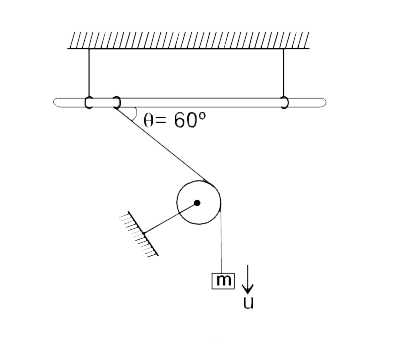
The figure shows mass m moves with velo...

The figure shows mass m moves with velocity u. Find the velocity of ring at that moment. Ring is restricted to move on smooth rod.

Promotional Banner

Similar Questions

Explore conceptually related problems

A charge +Q is uniformly distributed over a thin ring with radius R . A negative point charge -Q and mass m starts from rest at a point far away from the centre of the ring and moves towards the centre. Find the velocity of this particle at the moment it passes through the centre of the ring .

A charge +Q is uniformly distributed over a thin ring with radius R . A negative point charge -Q and mass m starts from rest at a point far away from the centre of the ring and moves towards the centre. Find the velocity of this particle at the moment it passes through the centre of the ring .

A charge +Q is uniformluy distributed over a thin ring with radus R. a negative point charge -Q and mass m starts from rest at a pont far away from the centre of the ring and moves towardsn then centre. Find the velocity of this particle at the moment it passes through the centre of the ring .

ltbgt Find the velocity of block B when ring A is moving downward with velocity v.

A bullet of mass 'm' is fired from a gum of mass M with a (muzzle) velocity u . If the cart on which gun is fixed can move on the smooth horizontal floor as shown Find recoil velocity of the cart

A rocket moves in the absence of external forces by ejecting a steady jet with velocity u constant relative to the rocket. Find the velocity v of the rocket at the moment when its mass is equal to m, if at the initial moment it possessed the mass m_0 and its velocity was equal to zero. Make use of the formula given in the foregoing problem.

A bullet of mass 'm' is fired from a gum of mass M with a (muzzle) velocity u . If the cart on which gun is fixed can move on the smooth horizontal floor as shown Find maximum compression of spring of spring constant (K) is

A ball of mass '2m' moving with velocity u hat(i) collides with another ball of mass 'm' moving with velocity - 2 u hat(i) . After the collision, mass 2m moves with velocity (u)/(2) ( hat(i) - hat(j)) . Then the change in kinetic energy of the system ( both balls ) is

A ball of mass '2m' moving with velocity u hat(i) collides with another ball of mass 'm' moving with velocity - 2 u hat(i) . After the collision, mass 2m moves with velocity (u)/(2) ( hat(i) - hat(j)) . Then the change in kinetic energy of the system ( both balls ) is