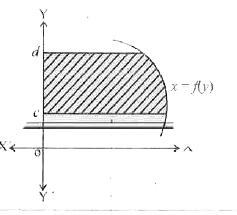
(i) Area of the shaded portion in the figure is equal to (a) `int_(d)^(c)f(x)dx` (b) `int_(c)^(d) f(x) dx` (c)`int_(d)^(c)f(y)dy` (d) `int_(c)^(d)f(y)dy` (ii) Consider the curve `y = x^(2), x = 0, y = 1, y = 4`.Draw a rough sketch and shade the region bounded by the these curves. Find the area of the shaded region.
Text Solution
Verified by Experts
The correct Answer is:
(i)d. `int_(c)^(d)f(y)dy` ii.`(28)/(3) sq.units`
Topper's Solved these Questions
APPLICATION OF INTEGRALS
NEW JOYTHI PUBLICATION|Exercise NCERT TEXT BOOK EXERCISE 8.1|13 Videos
APPLICATION OF INTEGRALS
NEW JOYTHI PUBLICATION|Exercise NCERT TEXT BOOK EXERCISE 8.2|7 Videos
BINOMIAL THEOREM
NEW JOYTHI PUBLICATION|Exercise QUESTIONS FROM COMPETITIVE EXAMS|51 Videos
Similar Questions
Explore conceptually related problems
Sketch the region bounded by the curves y=x^2a n dy=2/(1+x^2) . Find the area.
(i) Draw a rough sketch of the curve y^(2) = x and shade the region bounded by the line x = 1 and the curve. (ii) Using integration find the area of the shaded region.
Prove that int_(a)^(b)f(x)dx=(b-a)int_(0)^(1)f((b-a)x+a)dx
Consider the functions, f(x) = |x| - 1 and g(x) = 1 - |x| (a) Sketch their graphs and shade the closed region between them. (b) Find the area of their shaded region.
Sketch the region bounded by the curves y=sqrt(5-x^2) and y=|x-1| and find its area.
Figure shows the curve y=x^2 . Find the area of the shaded part between x=0 and x=6 .
Find the area of the region bounded by the curves y = x^(2) + 2, y = x, x = 0 and x = 3.
If f(x) is continuous for all real values of x , then sum_(r=1)^nint_0^1f(r-1+x)dx is equal to (a) int_0^nf(x)dx (b) int_0^1f(x)dx (c) int_0^1f(x)dx (d) (n-1)int_0^1f(x)dx
NEW JOYTHI PUBLICATION-APPLICATION OF INTEGRALS-CONTINUOUS EVALUATION (LAB Work )